Showing posts with label Seasons. Show all posts

Sunday, 18 December 2022

Pilgrims Way damson gin

Thursday 15 September. The Queen is Dead and it’s day ten of national mourning. The weather is changing from summer into autumn and it feels like the mood – in fact the world – is changing, too, from an era of relative stability into an uncertain and unsettled future. There’s a chill to the wind and the sun is struggling to break through, only occasionally piercing the low, grey, moody Kentish skies to diffuse weakly outwards. I decide to set out from Hythe by bicycle to Wye crown, carved into the North Kent Downs high above Wye in 1902 to celebrate the coronation of King Edward VII, by students from the town’s agricultural college. I first spotted the giant crown from the train earlier in the year, en route from London to Margate, and was intrigued, wondering what on earth had made them to go all that effort. 
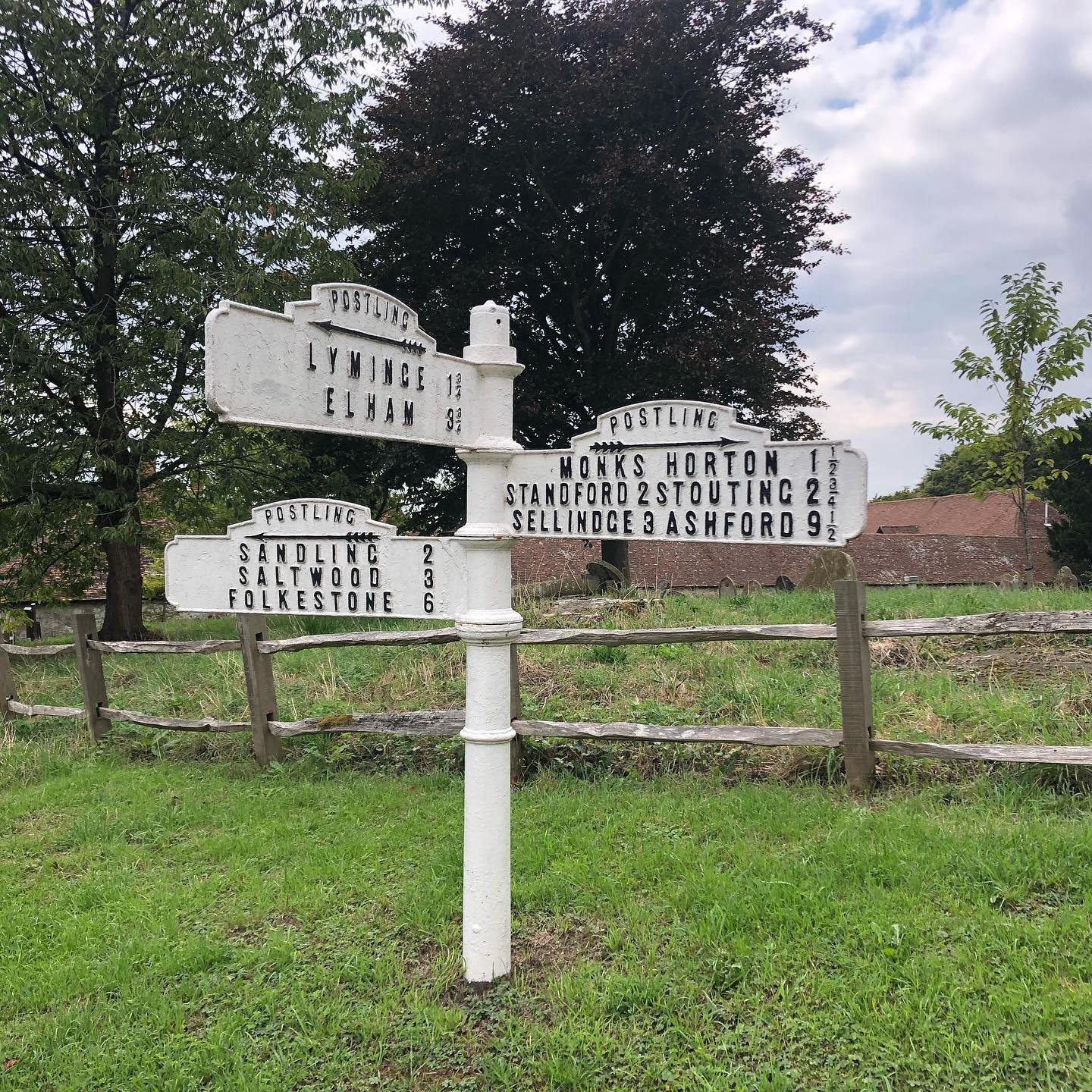
My route takes me uphill to Saltwood, where I get up close to a group of curious peacocks from the writer and broadcaster Kenneth Clark (and later, his right-wing politician son, Alan)’s castle, past the nursery where we used to go to pick out a Christmas tree every year from austere rows of pines, and over the M20 to Postling, a village that, while quite pretty, has no amenities except for a museum in a phone box. Joseph Conrad’s former home on the outskirts now has an airstrip outside, the fins of vintage planes peeking out of an old barn building. 
Soon afterwards, I pick up the Pilgrims Way, the route once taken to Thomas Becket’s shrine in Canterbury cathedral, which crosses Stone Street, the former Roman Road. The narrow road looks over the flat landscape below; marsh sheep and oast houses are now joined by vineyards and wind turbines. I pass homemade produce signs and honesty boxes closely monitored by CCTV and The Tiger Inn, advertising Mackeson’s Hythe Ales in large letters on its frontage. Damsons line the side of the road and apples rot in large back gardens; no-one’s picking them. As I struggle uphill, a couple overtake me on electric bikes. They have the right idea, I think to myself. 
As I reach Wye, I leave the road for an exposed, elevated footpath and the ground turns sandy and orange. The crown comes gradually into view, but the picture is partial and fragmented; close up it’s just a collection of white-painted rocks, enmeshed in wire. I follow a curve and try to picture the sections forming a crown in my head, then walk down the slope to see if I can get a better view. It’s impossible to see the whole from here – it’s best seen from the train line below, passing at speed, on the way to somewhere else.

Saturday, 15 December 2018

Folkestone Warren sloe gin

Fight your way through tangles of brambles, nettles and blackthorn bushes, and keep your footing on the narrow, uneven paths that lead down to Folkestone’s Warren, and you’re rewarded with access to the town’s most attractive beach.

The Warren is a bay at the foot of the white cliffs, looking across to the low-lying coast of France on a clear day. Despite being geographically close, it feels a world away from the Folkestone’s most popular beach, Sunny Sands, where the raw bodied and raw faced holiday people observed in Ted Hughes’ poem Work and Play

Are laid out like wounded
Flat as in ovens
Roasting and basting
With faces of torment as space burns them blue.

Although out of town, the Warren is well worth the trip. As part of an exposed coastal landscape that has been remade by landslips over the years, the cliffs are shored up by a wide concrete apron constructed after the Second World War. When the tide is right, regular rows of concrete groynes create the impression of a series of private beaches, both separated from the promenade above and cut off by gently lapping waves to the side. At low tide, the concrete is coated in a springy carpet of vivid green moss that’s treacherous under foot. At high tide, fishermen cast their rods out to sea and concrete steps provide the perfect entry point for swimming in the English Channel, which turns a Mediterranean turquoise under the summer sun. In winter, when stormy grey waves slap unpredictably against the edge, it’s wise to keep your distance.
Although the Warren is home to a small campsite – and the occasional illicit camper and hermit residing in shacks built into the cliffs – it’s mercifully free of crowds. It’s overlooked only by a couple of Martello Towers, a lone clifftop café at Capel-le-Ferne and a clifftop artwork, Siren, by Marc Schmitz and Dolgor Ser-Od, inspired by the improbable early twentieth-century wartime technology of concrete listening ears, and installed as part of the 2017 Folkestone Triennial.

It wasn’t always this way. The Warren, which had a reputation as Folkestone’s ‘Little Switzerland’, was once a destination for daytrippers and pleasure seekers, served by its own train station.

The Warren is separated from touristy Sunny Sands by an expanse of rocks, popular with fossil hunters. Sifting idly through the beach’s mixture of sand and pebbles reveals its own treasures, though: pebbles made from brick in various shades of red and yellow, worn smooth over the years, and translucent, gem-like ‘sea glass’, delicately frosted ovals of white, green, brown and blue glass created from decades of discarded bottles being thrown around and ground down by the tide.

Follow the cliffs in the other direction, past Abbot’s Cliff nudist beach, and eventually you’ll reach the port of Dover. The Folkestone to Dover trainline, too, takes this route, through the cliffs and past the Warren. Though short, it’s a dramatic ride, as the train emerges suddenly alongside the sea. Although spectacular, the route has its perils. In December 2015, storm damage closed the trainline for a full nine months, a reminder that the conceit of man’s control over our island coastline is illusory at best, and that its shape, form and the nature of our relationship with it is something we should never take for granted.

Saturday, 17 December 2011

Three litres of sloe gin, or a tale of two blackthorn bushes

This sloe gin started life in late-summer 2011 as ripe sloes gathered from two blackthorn bushes: one on the banks of the Ashton Canal, Ancoats and one by the River Sett between New Mills and Hayfield in the Peak District.

The Ashton Canal winds its way from central Manchester to the market town of Ashton-under-Lyne, six miles to the east. It's a remarkable journey that takes walkers, cyclists, boats and geese past the boom and bust regeneration of inner-city Manchester (half rebuilt and reinvented as New Islington, half still rubble and spaces left by ruined mills and factories); alongside Manchester City Football Club's glittering stadium and the slightly less glamorous Eastlands retail park (highlight – ASDA); near the shabby Victorian elegance of Philips Park, Manchester's first public park, leading to reclaimed nature reserve Clayton Vale and the Medlock Valley; and next to Fairfield Moravian Settlement, an island of tranquil cobblestones and Georgian cottages surrounded by suburban Tameside with its canal-side sports pitches and pensioners playing waterside pétanque.

We are lucky to have this urban oasis running through the city: the canal would have been closed in the 1960s if the local council had its way. When road transport became widespread, canals went out of fashion. They grew obsolete and expensive to maintain – and it took volunteers across the country long and laborious hours to restore Britain's canal network. These campaigners reimagined a new use for the inland waterways as sites of leisure and tourism – for boating holidays and afternoon walks – rather than toil – horses and boats still hauled coal and other goods along canals, including the Ashton, well into the twentieth century, the purpose for which they had been built centuries before. At Ashton-under-Lyne, the Ashton Canal hits the Portland Basin (home to the Wooden Canal Boat Society and Portland Basin Museum), where canal adventurers head south east onto the Peak Forest Canal to continue their journey through the Cheshire towns of Hyde and Marple and then on to New Mills (a place defined by its spectacular geography; the town rises up into the hills as the rivers Sett and Goyt descend into sunken Torrs below) and Whaley Bridge in Derbyshire, where the canal comes to an end.

The second blackthorn bush was encountered along the Sett Valley Trail between New Mills and Hayfield on a rainy yet peaceful bank holiday weekend walk. Hayfield is a picturesque rural village overlooked by the Peak District National Park's highest point, Kinder Scout – a landmark visible back in the city, from Ancoats, where this story starts. In April 1932, Kinder was the scene of one of Britain's most famous protests. Several hundred ramblers from Manchester and the surrounding region, including folk singer Ewan MacColl, led a mass trespass up Kinder Scout to protest that what had previously been common land had been taken over by private interests. It's them we must thank for our rights to roam over Britain's countryside today, something we can take for granted: the ability to explore and reach out from the crowded cities around us, to wander at our leisure.

2012 will be the 80th anniversary of the Kinder Trespass. Find out more at http://kindertrespass.com or visit Salford's Working Class Movement Library, which holds material related to the protest.

The Golden Age of Canals, an excellent BBC4 programme about the formation of the Inland Waterways, mass activism to save canals and their changing uses, will be repeated on Monday at 7pm.

Friday, 3 December 2010

The Shrieking Violet and Manchester Modernist Society joint event — Newspapers on Film, Saturday December 11


Newspapers on film

Saturday 11th December, 3.30pm-6.30pm

Manchester Modernist Society HQ, 142 Chapel Street, Salford M3 6AF

Free

The Shrieking Violet fanzine and Manchester Modernist Society invite you to a seasonal gathering celebrating Manchester's media heritage through documentaries from the North West Film Archive.

There will also be some baked goods from recipes which have appeared in past issues of the Shrieking Violet fanzine expect shortbread, sloe gin, grape vodka, tea and an edible, highly glittered Daily Express building.

Showing

People and Places Around Ordsall

Salford newsagent, amateur filmmaker and onetime newspaper delivery boy Ralph Brookes documented the changing face of the inner city area Ordsall in the 1960s and ‘70s, making over ninety home movies about the community around him, documenting everything from his home, family, birthdays and Christmas to mingling with the stars for an episode of Coronation Street which was filmed in the local park.

Here is the News

Colourful, jaunty, jazz-soundtracked film about how the Evening News is produced. Made in 1968 to celebrate the newspaper's centenary, the film shows the 'daily miracle' that is producing a newspaper, from visiting the various departments in the newspaper offices to distributing copies around the city to be read in suburban family homes.

News Story

A day in the life of the famous Guardian newspaper in 1960 (four years before it moved to London), from meeting the journalists in the various departments which put it together to printing with linotype and hot lead and its distribution around the country.

The event accompanies a media themed special of Manchester-based fanzine The Shrieking Violet which looks at various aspects of Manchester and the media including Jack Hale of Manchester Modernist Society writing in praise of the innovative Daily Express building on Great Ancoats Street. The films in the North West film archive help give a sense not just of the labour and space intensive process that traditionally went into making newspapers, pre-digitisation, and the buildings in which they were made, but also illustrate the importance of newspapers in the city. The films, which each last around twenty minutes, provide fascinating insights into the time in which they were made: Here is the News is an optimistic look at the modernist city in the swinging sixties, whereas People and Places in Ordsall depicts the other side of life in the region, and the great changes Salford was undergoing at the time as part of slum clearance programmes.

Poster by Lauren Velvick.

www.manchestermodernistsociety.org/

Here's the edible Express Building — shortbread topped with readymade black icing from the Arndale Market, into which was embedded many silver balls. Sprinkled with black edible glitter.

Thursday, 25 November 2010

Sloe Gin

This week, coinciding with the start of the freezing weather, I had the first taste of my sloe gin, which has been steeping for ten and a half weeks. Although it's a bit early, I wanted to bottle a small quantity to give to a friend for her birthday this week. It's a deep red colour, almost opaque, that glows warmly when you hold it up to the light. The consistency is smooth and glossy, thicker than gin, and there are two distinct tastes intensely bitter (perhaps because of the gin, or maybe because I picked the sloes early in autumn before they'd had chance to sweeten) and very sweet but with an overall fruitiness. It's so rich it invites being savoured in tiny quantities. I looked all over for the perfect bottles, considering some ornamental Vom Fass bottles from the Selfridges food hall, but it wasn't possible to buy bottles without the oil and I didn't want the problem of what to do with the oil. In the end, I bought a 250ml bottle of Devon apple juice from the chiller cabinet as it had a screw top, drank the juice, sterilised the bottle and came up with a colour co-ordinated, vaguely icicle themed label. The rest of my sloe gin has gone back in the cupboard to steep some more before I get it out again properly in December.

Friday, 29 October 2010

Pumpkin vs. squash

Although technically a type of squash, I find the light, subtle, juicy orange flesh of the round, orange skinned pumpkin infinitely nicer, both in texture and in taste, than the bland, soapy, sweet, almost perfumey stodginess of something like a butternut squash. Unfortunately, pumpkins only tend to appear in this country in October and then disappear again after Halloween once their novelty factor has worn off, which is a shame for such a versatile vegetable which yields so much delicious food, both from its flesh and seeds. Luckily, pumpkin flesh is ideal for freezing, so it’s easy to eat fresh pumpkin around Halloween then freeze the rest (either in thick slabs or bite size chunks) to be used throughout the winter, in meals as diverse as soup, curries, risotto and lasagna — or simply just enjoyed roasted.

To prepare a pumpkin, I slice the top off with a long, serrated knife and remove the seeds with my hands, setting aside in a bowl (these seeds can be either cooked immediately or frozen). To maximise the amount of flesh I get out of the pumpkin — if you want to carve a face into your pumpkin, then you’re going to need to slice the top off then scoop the flesh out from the inside — I remove the skin with a sharp knife as if peeling a potato (due to the round nature of the vegetable, it can be easier if you chop it into smaller chunks). I then chop the flesh into cubes, and either cook immediately or place in sandwich bags or plastic containers and freeze. After it’s been frozen, pumpkin can either be left out to defrost if planning ahead, or thawed for ninety seconds in a microwave when needed.

Pumpkin and apple soup with cumin

This is the nicest food I know how to make. Pumpkin, apple and cumin really is a dream combination — all three flavours are improved immeasurably in the company of each other. Hearty, warming Pumpkin, apple and cumin is my all-time favourite type of soup — probably because, due to the limited availability of pumpkin the rest of the year round, I only eat it in Autumn when the idea of winter is still novel and before it gets too bitterly cold. Dark, early nights are softened by the cosiness inside, and crunchy leaves and the excitement of Halloween, bonfires and fireworks outside.

Serves 3

550g pumpkin, chopped
4 apples, peeled and chopped (no particular variety — I use the type that come, ten for a pound, in sandwich bags from the Arndale Market)
One large onion, chopped
3 cloves of garlic, chopped
700ml vegetable stock
350ml apple juice
1-1.5 teaspoons cumin
Six sage leaves, chopped
Salt and pepper to season

Sauté the onion in olive oil in a large pan for five minutes. Add the garlic, pumpkin and apple and sauté for a further five minutes. Add the apple juice and stock and simmer for 25 minutes. Add the sage leaves, season well with salt and pepper, stir in the cumin and remove from the heat. Puree with a hand blender, adding more water if necessary.

Roasted pumpkin seeds

These make a satisfying snack during the day or a crunchy alternative to popcorn to take to the cinema.

Simmer the pumpkin seeds, fresh or frozen, in lightly salted water for 10-15 minutes. Preheat the oven to a medium to high heat. Drain the seeds well, place in a shallow baking dish or tray and coat with olive oil. Season well with salt and freshly ground black pepper and cook for 20-25 minutes (checking frequently as there is a very fine line between just cooked and burned!), stirring every few minutes. The pumpkin seeds are done when they are crispy and starting to go brown around the edges.

Roasted pumpkin with gnocchi and rosemary

This quick and simple but effective meal is my favourite lazy convenience food, and one of my favourite dinners. Preheat the oven to a medium to high heat. Take the required amount of pumpkin cubes (described above) out of the freezer and defrost. Drain any water, coat with olive oil on all sides and place in a small, shallow casserole dish with a fat clove of garlic, chopped. Roast in the oven for ten minutes. Chop a few sprigs of fresh rosemary, to taste. After the pumpkin has been cooking for ten minutes, add the rosemary and roast for a further ten minutes, stirring occasionally, until the pumpkin starts to go golden and crispy around the edges. Meanwhile, bring a pan of lightly salted water to boil on the hob. Add gnocchi and simmer until the gnocchi rises to the surface of the water. Drain. Remove the pumpkin from the oven, stir the gnocchi into the pumpkin and its juices, season well with salt and freshly ground black pepper (and cumin if desired), grate cheese on top and serve in the dish it cooked in.

The above recipe also works well with aubergine, with the addition of honey and lots of cumin.

Saturday, 18 September 2010

Sloe gin, blackberry and apple pie and other recipes from the Ashton Canal

Sloe gin

I developed a taste for homemade sloe gin at my grandparents' house at Christmas time, and I have been regularly consulting them for advice on how to make my own sloe gin. Here are some instructions.

First, identify a sloe bush (as I have discovered, this is difficult it took me ages, after going through a process of elimination with several other bushes with black berries. It helped when I found out sloes are a type of plum, as then I just squeezed the berries, which look like fat, purple grapes, to see if there was a stone in the middle!). I discovered a bush, conveniently enough, growing out of a wall opposite my favourite building along the Ashton Canal and spent a couple of hours immersed in bushes getting plucked and scratched by branches and stung all over by nettles.

Second, find your jars I spent a long time wandering around city centre shops in search of suitable jars, before finally settling on some biscuit jars from a pound shop (I'm sure you could probably do better than this by finding a demijohn or something). Then, sterilise the jars by putting them in a pan of boiling water.

Third, pick the sloes! All the recipes called for 450g per litre of gin but, even after doing some climbing to reach the higher branches I only managed to gather 350g (so I accordingly adjusted the amount of gin I used to 777ml).

Once home, wash the sloes and prick all over with a clean needle (I dipped the needle in boiling water). This is the most time consuming part.

When the sloes are ready, place them in the jar with the gin (I used cheap gin from Aldi) and 175g of sugar (the recipe called for caster sugar, I only had light brown sugar so used this instead).

Then, shake, seal and find a cool, dark place for the jars mine are in the cupboard under the stairs. I split the mixture across two jars so there is space to shake the liquid without spilling it.

Then, shake the jars every other day for a week, then every week for two months (or longer, depending on how soon you want the gin to be ready). After a week, my sloe gin has already turned a warm, red colour like rosé wine and the sloes are getting lighter and lighter, starting to leave the bottom of the jars where they all settled and float around the liquid.

If you don't manage to find any sloes, try grape vodka instead, following the sloe gin recipe above but substituting the gin for vodka, adding grapes instead of sloes and using half the amount of sugar.

Blackberry and apple pie

Shortly after I had picked the sloes, I found an apple tree laden with ripe apples sitting next to an abandoned, boarded up housing estate. Frustratingly, I could only reach one of the apples, although I managed to knock another down with my umbrella and picked a third, after inspecting it for maggot holes, up off the floor.

There were also several blackberry bushes nearby, so I also picked lots of blackberries.

I made a pie using two of the apples and about a dessert bowl's worth of blackberries. I had some pastry in the freezer from the last time I made pastry, so defrosted it. However, to make the pastry:

Place 112.5g butter/margarine in a large bowl. Add 225g plain flour and rub it into the butter. Add a little salt and gradually add cold water table spoon by table spoon until the mixture starts to stick together, and shape it into dough. If you like cinammon as much as I do, add a table spoon of cinammon. When the mixture has formed a dough, wrap it in clingfilm (or a spare carrier bag if none is to hand) and refrigerate for 30 minutes. It will then be stretchy pastry!

Instructions:

Chop the apples and simmer in a little water and 75-100g sugar for 15 minutes (a tea spoon of cinammon is also a nice touch), adding the blackberries towards the end.

Meanwhile, divide your pastry in two (with one portion slightly larger) and roll out two separate pieces of pastry, thinly, on a floured surface. Line a tin or small round baking dish with the larger of the two pieces of pastry.

Add the fruit to the bottom of the pastry, having drained off almost all of the liquid (retain these juices, add to milk, sprinkle with cinammon and allow to cool down for a delicious milkshake!). Then, place the other piece of pastry on top of the fruit to form the pie lid, removing any excess pastry from the sides. Fold the edges of the bottom layer of pastry over the pie lid to form a thick crust to seal the pie. Use any leftover pastry to make a blackberry or apple shaped ornament on top.

Cook for an hour (after 45 minutes, I added a glaze consisting of of 50ml milk, a tea spoon of cinammon and a tea spoon of sugar to the crust) or until the pastry is hard. Allow to cool down then serve with custard.

Apple porridge

The remaining apple I used in porridge for breakfast.

Instructions:

Chop the apple and simmer in a little water for fifteen minutes or so (depending on how late you are running for work!). When the apple is soft, add 50g porridge oats, two tablespoons of cinammon and stir. Add half a cup of milk and stir, adding sugar and more milk or water as required.