Thursday 15 September. The Queen is Dead and it’s day ten of national mourning. The weather is changing from summer into autumn and it feels like the mood – in fact the world – is changing, too, from an era of relative stability into an uncertain and unsettled future. There’s a chill to the wind and the sun is struggling to break through, only occasionally piercing the low, grey, moody Kentish skies to diffuse weakly outwards. I decide to set out from Hythe by bicycle to Wye crown, carved into the North Kent Downs high above Wye in 1902 to celebrate the coronation of King Edward VII, by students from the town’s agricultural college. I first spotted the giant crown from the train earlier in the year, en route from London to Margate, and was intrigued, wondering what on earth had made them to go all that effort.
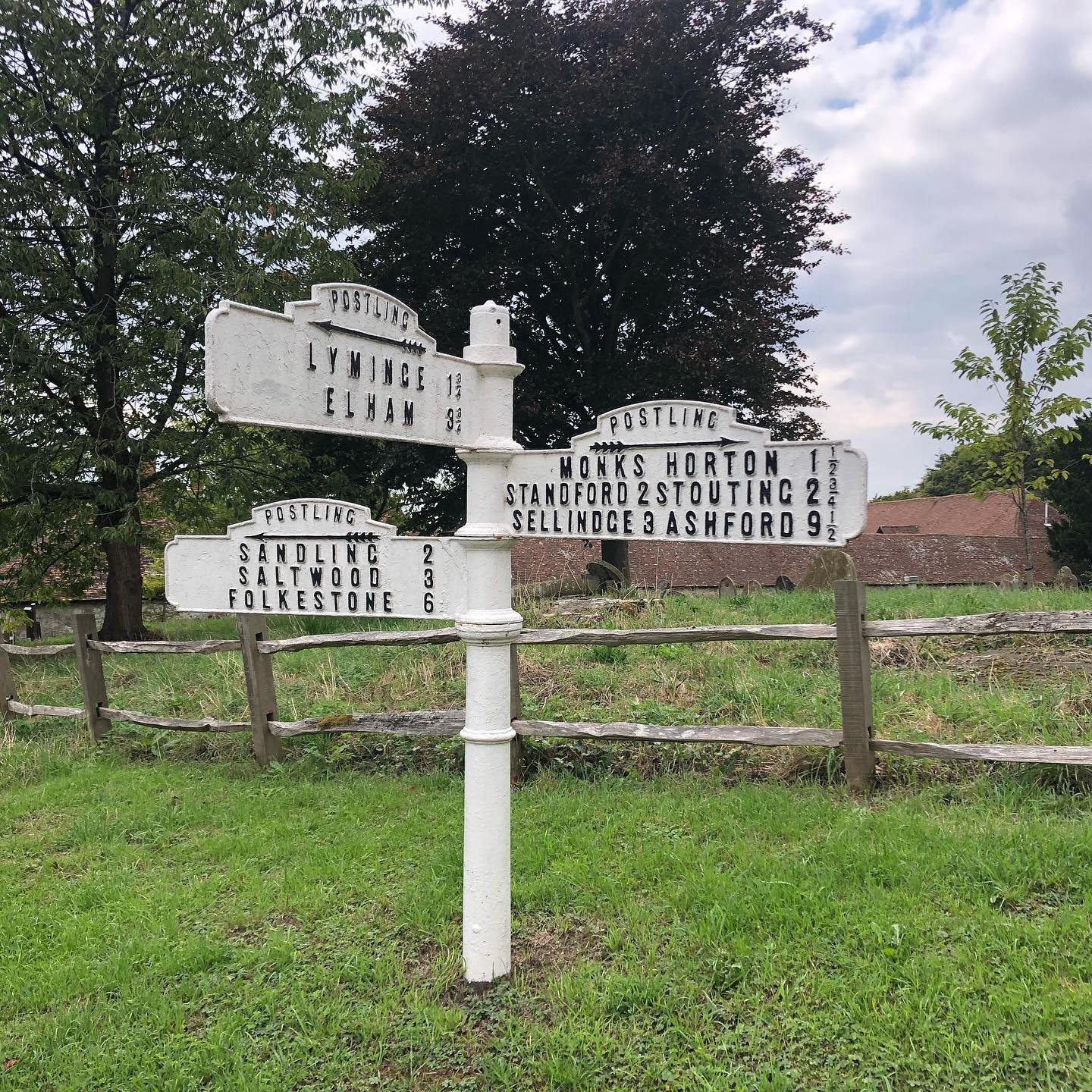
My route takes me uphill to Saltwood, where I get up close to a group of curious peacocks from the writer and broadcaster Kenneth Clark (and later, his right-wing politician son, Alan)’s castle, past the nursery where we used to go to pick out a Christmas tree every year from austere rows of pines, and over the M20 to Postling, a village that, while quite pretty, has no amenities except for a museum in a phone box. Joseph Conrad’s former home on the outskirts now has an airstrip outside, the fins of vintage planes peeking out of an old barn building.
Soon afterwards, I pick up the Pilgrims Way, the route once taken to Thomas Becket’s shrine in Canterbury cathedral, which crosses Stone Street, the former Roman Road. The narrow road looks over the flat landscape below; marsh sheep and oast houses are now joined by vineyards and wind turbines. I pass homemade produce signs and honesty boxes closely monitored by CCTV and The Tiger Inn, advertising Mackeson’s Hythe Ales in large letters on its frontage. Damsons line the side of the road and apples rot in large back gardens; no-one’s picking them. As I struggle uphill, a couple overtake me on electric bikes. They have the right idea, I think to myself.
As I reach Wye, I leave the road for an exposed, elevated footpath and the ground turns sandy and orange. The crown comes gradually into view, but the picture is partial and fragmented; close up it’s just a collection of white-painted rocks, enmeshed in wire. I follow a curve and try to picture the sections forming a crown in my head, then walk down the slope to see if I can get a better view. It’s impossible to see the whole from here – it’s best seen from the train line below, passing at speed, on the way to somewhere else.
This winter, a large bronze peacock appeared in the grounds of Ordsall Hall in Salford, on the banks of the Manchester Ship Canal.
Whilst a peacock might seem an unusual sight in inner-city Salford, the sculpture has a long history in Ordsall and plays an important part in the local community’s sense of identity.
The Ordsall peacock is the work of Gertrude Hermes, a major mid-twentieth century British artist who was elected to prestigious exhibiting society the Royal Academy. Although her name may not roll off the tongue as easily as that of her peers, such as Barbara Hepworth, Hermes’ work has attracted renewed art historical and public interest in recent years following an exhibition at the Hepworth in Wakefield in 2015. Working across industrial design, sculpture and finely detailed woodcuts and linocuts, Hermes drew animals and famous English landmarks such as Stonehenge. She also depicted elements of the natural world, such as rock formations and waterfalls, in stylised close-up.
Like many artists of her generation, Hermes did not just create work for galleries but made pieces for public places. After the Second World War, her artworks were purchased for numerous schools and teacher training schemes around the country. She also helped select prints for the annual Pictures for Schools exhibitions, held in London between 1947 and 1969, which aimed to provide affordable artworks for educational buyers.
Hermes’ peacock was installed at the new Ordsall Girls School in 1961, using money from the local authority and funds raised by pupils (another proposed facility, a swimming pool, was apparently too expensive). A frog was placed outside the boys’ school; its location is now unknown.
Ordsall High no longer exists, and the Ordsall of the early 1960s is unrecognisable from the Ordsall of today. Then, it was a densely populated area of Victorian housing, built for workers at the nearby docks. By the mid-1970s, the majority of the old housing stock had been knocked down as part of a slum clearance programme, and many of the residents had been moved to new housing in areas further out of the city. In the 1960s, film-maker Mike Goodger documented the run-down conditions in which many residents lived, lacking in basic facilities, whilst the bittersweet super-8 footage of local newsagent Ralph Brookes captured the final days of life and established social relationships in the old streets. Medieval stately home Ordsall Hall, whose long and interesting history included a stint as a working men’s club for a nearby mill, also fell into a state of disrepair.
Since then, the area has comprehensively rebuilt, at a far lower population density. The majority of homes are still socially owned, an increasing rarity following the right-to-buy policies initiated by Thatcher in the 1980s. Whilst the area is still home to families who remember the ‘old Ordsall’, the docks down the road are long gone and the site has been rebranded ‘MediaCity UK’. Manual work has been replaced with media and creative industry jobs for those with qualifications and connections, alongside a university campus, apartments, shopping outlet, bars and the Lowry arts centre. A place of industry has become a leisure destination for those with disposable income. Ordsall Hall is now a council-owned museum with a tranquil garden and even the once polluted waters of the ship canal are clean enough for swimming and watersports.
Hermes’ peacock remained at Ordsall High until the school closed in 1988 and the site became part of Salford College. The peacock was subsequently moved to a Salford College site in another inner-city area, Charlestown, a couple of miles away. Here, it was unceremoniously sunk into concrete and languished in what Gail Skelly, a volunteer and director of Ordsall Community Arts (OCA), describes as “an inauspicious place, full of weeds”. In 2012, the peacock was put into storage at the OCA’s headquarters whilst a new location was sought. Spearheaded by local man George Tapp, the community embarked on a campaign to bring the peacock home.
Enabled by Heritage Lottery Funding, OCA spent several years working with Noah Rose, an artist with a long track-record of working in public art focused on communities and heritage, both in the UK and internationally, who led on the restoration of the sculpture. In collaboration with consulting structural engineer Peter Hewitt, Noah also designed a new plinth in red sandstone, sourced from St Bees in Cumbria, for the grounds of Ordsall Hall.
Shortly before the completion of the completion of the restoration process, I visited Noah at his studio in a former printing works in Salford, where he outlined some of the challenges of restoring the peacock and remedying the damage done when it was removed from public display. I watched as Noah carefully cleaned away residue left when the artwork was embedded in concrete and showed me a heavy-walled bronze tube designed to secure the sculpture in its new home. “It’s been a big honour and responsibility to restore an iconic bronze sculpture by such an important artist,” Noah told me. “I want to honour the work, and it’s daunting, but by using the right materials I’m hoping to give it the best possible resurrection.”
Gail emphasises that the project hasn’t just been about bringing the sculpture back physically, but has sought to explore its social significance and celebrate the area’s shared history. “We just have to tell people the story and they are interested,” she says. “The peacock is quite famous around here and everyone over the age of thirty who grew up here remembers it. It was originally situated on a pedestrian through-way, so even people who didn’t go to the school had seen it. People would meet there for a fight, a fag or a photo. It was their peacock.”
Associated events have included school drama, a map, a film and a social history project to develop a personal timeline of Ordsall with long-term residents of the area. Gail has worked with young women from Salford Girls’ Club, using Hermes’ position as a woman artist – she notes that Ordsall is a community in which women are often the most active members – to reflect on their own lives and the challenges they face; in the 1960s, Hermes catalysed a rule change to allow women to attend Royal Academy dinners, following her exclusion solely on the basis of her gender.
In 2018, OCA marked its fortieth birthday with a peacock-themed lantern parade. A group of peahens were created for the peacock and hundreds of children were brought together in the dark to imagine what Gail calls a “daft love story”. In spring 2019, the peacock was celebrated with a light installation at the alternative arts festival Not Quite Light, which took place across Salford.
Salford continues to develop rapidly, particularly those areas within walking distance of Manchester city centre. Geographically relocated by estate agents to be part of ‘Manchester’, these areas are being built up with apartment blocks promoting aspirational city living, often funded through foreign investment. In spite of this, there is a huge gulf between the old and new populations. Whilst higher earners have taken advantage of the ability to commute in to MediaCity from Manchester and its surrounding towns, or live in Ordsall and use it as a convenient base for working and socialising in Manchester, longstanding communities have been hit hard by austerity policies and the loss of services and amenities. Existing residents are often isolated and disenfranchised.
Another peacock sculpture by Hermes was listed for £95,000 at auction in 2015. At a time when local authorities continue to sell off assets such as publicly owned artworks, this must seem a huge amount of money in Salford, a city which, despite its proximity to the cultural attractions of Manchester and Salford Quays, has one of the lowest levels of engagement with the arts in the country. Gail acknowledges the difficult balancing act between “money we desperately need to spend” and “the value of public art, whether that’s financial or cultural”.
In spite of this, there is a recognition that the peacock means a great deal to Ordsall. “People really feel personally for it,” reflects Gail. “It’s a real focal point.” Above all, she says, “It’s a symbol of resilience and toughness, a reminder of the past when so much has been lost. It’s a portal between the old and new areas.”
Watch a video about the peacock’s return to Salford online here.
A launch event and celebration will be held from 4-5pm on Thursday 17 February.
An exhibition of material relating to the project will be held at St Clement’s Church, Ordsall. The exhibition launches from 1-3pm on Sunday 20 February and will be open to visit on Sundays from 1-3pm until Sunday 13 March.
Archive photos courtesy Paul Blain/Ordsall High School.
I had never been to Winter Hill – an open expanse of moorland above the large industrial town of Bolton – before. As a committed urbanite, I hadn’t walked up many hills of any scale. It wasn’t until the summer of 2021 that I finally fulfilled a long-held ambition of climbing Kinder Scout in the Peak District. I was inspired by a longstanding interest in the famous Kinder trespass of 1932, which pitted the rights of working people against private landowners who sought to deny them the freedom to roam in the open countryside that surrounded polluted, overcrowded towns and cities. When I heard about ‘Winter Hill 125’, therefore – a march to commemorate another successful and significant, but lesser-known, mass trespass – it seemed like the perfect excuse to get on the train to Bolton and take another walk.
I didn’t expect it to be so far – or for this sunny Sunday in early September to be one of the last blazing hot days of the year. From the station, I walked alongside busy arterial roads to the start point of the march, a nondescript health centre a mile and a half out of Bolton town centre. Mingling with the crowd, I followed a colourful array of banners bearing socialist slogans and campaigning imagery, as the beats of the PCS union’s samba band buoyed us uphill through residential streets. Most of my fellow walkers seemed to know each other – and commented that I appeared to be the youngest on the walk by some distance! Many shared memories of taking part in similar commemorative walks, on previous anniversaries (including the centenary of the Winter Hill trespass in 1996).
As we passed through different neighbourhoods, people turned out to wave: everyone, young and old, seemed pleased to see us. Heading towards the outskirts of the town, the houses changed in character, from dense redbrick terraces to mellow stone. Eventually, the roads narrowed to a country lane. I ate handfuls of blackberries from the side of the road, and picked a few sloes – a woman of South Asian heritage, curious, asked me what I was doing.
As we left the town behind, the air began to clear and the samba band dispersed. For the first time, I stopped to look behind me, and saw the mass of people in the distance. There were hundreds – you don’t appreciate how many there are when you’re in the middle of it. I realised how high we were now, the town far below us.
I kept walking. As we picked our way across the moors, over rough stones and clumps of grass, my footing became less steady. What should have been panoramic views of the surrounding landscapes were obscured by haze, and sheep and moorland was all that could be seen. Climbing higher and higher, I began to wonder where we were actually aiming for – and if we would ever reach ‘the top’. Eventually, six miles out of town, we seemed to come to a natural pause at a TV transmitter, a giant aerial stretching into the deep blue skies above, almost too tall to comprehend.
Other walkers took out their sandwiches and made small talk with the Bolton Mountain Rescue team, parked up in a van. I wondered what going on. It turned out these were splinter groups, local rambling societies with plans to go in different directions and find their own routes across the moors. It appeared that I had, in my zeal, outpaced the rest of the organised march, and that we were now waiting for them to catch up. I felt truly as if I was in the middle of nowhere. It would be a long walk back down again and I began to panic, wondering how I would ever find my way back to the station.
‘There’ll be buses from San Marino,’ I was repeatedly reassured. But what was San Marino? A little bit of southern Europe in windswept, post-industrial Lancashire? It seemed unlikely. Eventually, and gratefully, I was rescued by some friendly faces. Two former colleagues from my past working in the co-operative movement (which felt like a lifetime ago) appeared, who I hadn’t seen in years, and who lived nearby.
We walked downhill together, a shorter and gentler route. San Marino was a Mediterranean restaurant in a picturesque spot overlooking a reservoir (one of many in the area, originally built in the Victorian era to service Bolton’s growing industries). There, we were met by local buses, which took us back to the town centre free of charge. The short journey back to town wasn’t just a welcome opportunity to rest my legs, but to catch up with others on the walk, find common ground and connections, and share stories. Winter Hill had brought us together.
Congratulations to Dr Morag Rose on the publication of her journal article in Gender, Place & Culture, ‘From an aviatrix to a eugenicist: walking with Manchester’s Modernist Heroines’, which documents Manchester’s Modernist Heroines, a joint local history project between the joint Loiterers Resistance Movement, Manchester Modernist Society and the Shrieking Violet in 2011. The article focuses on the alternative walking tour Morag developed, inspired by the ten twentieth-century women we highlighted through the project, and explores walking as feminist pedagogy; it's been great to see the project revisited, contextualised and reevaluated from a new perspective.
I'm pleased to be a contributor to a new book, Manchester: Something Rich and Strange (edited by Paul Dobraszczyk and Sarah Butler), published by Manchester University Press with a beautiful cover by Simon Buckley (Not Quite Light). Aiming to get under the skin of the city and offer alternative perspectives beyond the usual, tired narratives, writers, artists and academics have each taken a series of words as prompts for short essays. I have written about 'Newspaper', 'Loop', 'Co-operative', Sculpture' and 'Statue'.
Manchester: Something Rich and Strange is currently available for the bargain price of £7.79 (usual price £12.99). Buy here.
Listen to a short extract of me reading from my piece about the Loop lines, former railway lines converted to walking and cycling routes.
I'll be returning to Bradford School of Art on Wednesday 31 October to do another lecture in its Random Lecture series. The lectures take place at 12 noon in the Dye House Gallery; all welcome.
I'll be talking about my research into the twentieth-century co-operative women's magazine Woman's Outlook, published by the Co-operative Press from Manchester between 1919 and 1967, which combined political campaigning and information with domestic tips and knowledge.
After a long winter, the first sign I noticed that the seasons were changing was the regularity with which I was awoken at unsociable hours by the dawn chorus in the trees outside my window, loud enough to break through my sleep and punctuate my dreams, before finally waking me fully.
The rhythm and routine of bird call as part of city life, and the way in which it might coexist with or be altered by birds’ close proximity to humans in urban environments, is something that interests artist Rae Story.
She has spent nearly a year working with Manchester arts group St Luke’s on a participatory project mapping the quiet spaces of the city; one of her long-held ambitions has been to bring people together to listen to a dawn chorus in a publicly accessible green space.
An appropriate park or garden in which to gather participants safely and discreetly in the depths of night eluded her – until she was introduced to the Parrs Wood Environmental Centre, a hidden green space on the edges of Didsbury. Situated on the southern outskirts of Manchester, where the city meets the River Mersey on the boundary of Cheshire, the site could easily be missed. Although it forms part of a ‘green corridor’ of woodland and riverside paths that provide a pleasant off-road walking and cycling route between Stockport and south Manchester’s suburbs, the entrance is sandwiched between the nondescript architecture of a chain hotel and a huge multi-use leisure complex of the type that often characterise busy arterial routes.
Parrs Wood Environmental Centre has a long history as an educational outdoor space for the city’s children. Founded in the years immediately following the Second World War, and run for many years by the city council, school classes were given their own plots to tend. The site also provided adult education through the Workers’ Educational Association.
Initially part of a country estate, with the former stables, walled kitchen garden and gardener’s cottage still in evidence, the centre is now part of Parrs Wood High School, but continues to offer adults and children environmental education under the guidance of volunteers.
On International Dawn Chorus Day, fifteen of us meet shortly before 4am under a bright lopsided, yellow-tinged moon, sitting low in the sky. Although it’s been a balmy day the grass is sodden with dew; my summer plimsolls are quickly soaked through.
We’re led through an overgrown path in the woods to a clearing encircled by overturned logs which double as benches, and invited to forget everything else for the next forty minutes in order to focus fully on what we hear in the air surrounding us.
As the birds call from all sides, under a densely curtained canopy of leaves, it feels like we’re experiencing theatre in the round, in some kind of natural performance tent, the performers unseen. As time goes by, birds enter and leave, and come back; the low-toned call of the wood pigeon is a late entry against a patter of higher pitched trills. Although, we hear the occasional car on the road outside and the rumble of a lone night train, this is the birds’ space and time. Two sirens go past, shifting in and out of the chorus, which continues regardless.
I’m listening intently, in a way I’m not used to. My sense of smell becomes more acute, too; there’s a definite aroma of the warm, earthy smell of horses and, later, the sweet scent of crabapple blossom. It slowly grows lighter; perhaps our senses are adjusting, too.
What I feel most acutely, though, is my own illiteracy when it comes to knowledge of birds or the natural world. I can’t even find the words to describe the calls I’ve heard, in order to ask which birds they might belong to.
Mapping Manchester’s Quiet Spaces is a project by the artist Rae Story with St Luke’s Arts Project. A celebration event, with presentations from the workshops, will be held at Elizabeth Gaskell’s House on Tuesday 26 June at 3pm and 6pm. For more information about this and other events visit www.mappingmanchestersquietspaces.org.
I'm really delighted to have a chapter about the twentieth century co-operative women's magazine Woman's Outlook in the new collection Women's Periodicals and Print Culture in Britain, 1918-1939: The Interwar Period, published by Edinburgh University Press (I'm also really pleased that the book features an image of Woman's Outlook on its cover!).
This blog is one of the places where I have explored my interest in Woman's Outlook, a magazine for the campaigning women of the co-operative movement, which was published by the Co-operative Press in Manchester between 1919 and 1967 and combined information about political and social issues with domestic tips and advice. The chapter is based on research into the magazine in the National Co-operative Archive in Manchester, which holds a complete set of the publication.
Deep in the former Yugloslavia are a series of strange, silent monuments known as spomeniks. Out of scale to their surroundings, many are remote, hidden and accessible only on foot. Commemorating long-forgotten battles and scenes of atrocity, they’ve been brought back into view for glossy, coffee table consumption by photographer Jan Kempenaers, who invites us to revel in their strangeness and unfamiliarity in picture book form as part of the aestheticisation of modern ruins.
Unlike many monuments, these huge concrete sculptures are not representational, and are deliberately devoid of any religious associations. Instead, they as act as viewing points for the landscape, framing the sun, clouds and stars, or tower over it, remote and untouchable, arms outstretched as if about to take flight. Distanced from politics, memory and culture, this leaves room for imagination, as Icelandic composer Jóhann Jóhannsson demonstrates in Last and First Men, which revisits the spomeniks to construct new stories, narratives and associations. Taking its title from Olaf Stapledon’s 1930 sci-fi book,Jóhannsson uses the last two chapters as the basis for a dystopian tale that explores what it means to be human, how we communicate through physical and cultural distances, and the rise and fall of civilisations. Last and First Men is primarily a film work, using black and white 16mm film to document the spomeniks and their relation to earth, landscape, light and sky. Often, our view is partial, abstracted and deliberately disoriented – close-up the sculptures could just as easily be fossils, ancient rock forms, rock carvings or primitive totems. There’s something of Paul Nash about the way Jóhannsson presents them; suggesting organic forms such as wood, seeds and bones, they take on the anthropomorphic qualities of surrealism.
Jóhannsson is well-known for his work scoring films and his soundtrack, performed by the BBC Philharmonic, is a minimal and slow-moving exploration of the landscape on screen. It roves not just through space but through time, suggesting ageing, loss and decay. The familiar textures and instrumentation of the orchestra lend themselves to this grandiose tale told on a vast scale. Jóhannsson's score is at once heroic, romantic and fragile, conjuring the drama of entering into a battle – against the passage of time, against the inevitable entropy of the universe – that’s already lost.
Taken by themselves, the visuals have a formality that reads like a slideshow or set of textbook illustrations, freed from their captions, but it’s Tilda Swinton’s calm, authoritative narration that binds Last and First Men together. Swinton imbues it with the air of a nature documentary or anthropological report, but Jóhannsson’s orchestral soundtrack restores a sense of humanity, communality and emotion to these man-made monoliths in a way that's rooted in the enveloping, escapist fantasy of the sci-fi genre.
Premiering in the week that North Korea claimed a successful intercontinental missile test, and the columnist Owen Jones sparked a social media row by suggesting the British people should present large-scale public resistance if the President of the United States visited the UK, What If Women Ruled the World? feels scarily prescient and necessary for an art performance.
Rather than a hackneyed invitation to smash the patriarchy – although the need to replace established hierarchies is, unsurprisingly, a recurrent theme – What If Women Ruled the World? uses a creative platform to imagine a situation in which humanity is forced to start anew, and to learn the lessons of the past (and the present).
Israeli artist Yael Bartana’s commission for Manchester International Festival takes the ambiguous end point of Stanley Kubrick’s classic film Dr Strangelove as its starting point, positing a female-led world in which women outnumber men ten to one and asking what would happen next if the slate was wiped clean and we could start again – with women in charge.
To start with, the piece has an air of amateur dramatics about it – think stick-on-moustaches, exaggerated accents, women in drag and ‘survival kits’ containing lipstick and nylons alongside sustenance and weapons – but the piece convincingly navigates between fact and storytelling, entertainment and debate, information and polemic. It’s both historically grounded and contemporary, incorporating possibly the first literary reference to ‘covfefe’, to knowing audience laughter.
What If Women Ruled the World? comes into its own when the five actors in the war room are brought together with five women who are real-life international experts in their fields, ranging from economics and development to archaeology and feminism. The women discuss major and recognisable challenges facing the world outside – from climate change, the threat of nuclear war, pandemics and the depletion of natural resources to ongoing conflict and systemised violence against women. Behind them the Doomsday Clock ticks away, offering archival glimpses into natural and manmade disasters, with both personal and global impacts, as a rapidly deteriorating post-bomb landscape is alluded to, building a very real sense of urgency.
What If Women Ruled the World? is an invitation to imagine things done differently, and to ask questions of our actions and priorities as individuals, as city dwellers, and as British, European and global citizens. It starts with a lighthearted premise, exploring serious issues with personality and humour, but it’s a simplistic title for a piece that suggests not just overthrowing the patriarchy, but our entire economic, social and political systems and fundamentally rethinking the way we relate to each other and to the planet. At a time when socialist ideas such as equitable taxation and economic redistribution are apparently back in vogue, much of the discussion captures the zeitgeist, but ultimately, it serves as a warning about bigger dangers such as the power of individuals and the cult of personality. It poses not just the titular question, but asks who should be allowed a seat at the table of power, whose knowledge and expertise we take on board, and what measures we need to take to ensure those voices are heard.
Either publication would make an ideal Christmas present (to buy direct send £4 to Natalie.rose.bradbury@googlemail.com via Paypal with your address). Feedback on the first (sold out) print run of He's Leaving Home included:
"The cookbook is great! Cheap, vegetarian and and all simple/practical. I was surprised how many recipes you included also." James, Berlin "Brilliant present, thanks!" Ed, Kent "Just used your recipe for roast potatoes, was delicious - used the rosemary we found last night on a bike ride near Salford Quays. Can't wait to try the baked beans pie! Could I order one of your recipe books for my friend please? she's vegan too and is moving back to Canada soon so would make a great leaving present to remind her of English food!" Rae, Salford
Fold will be selling intelligent, thoughtful pocket-sized publications bringing together essay on topical political and cultural issues, by authors including Steve Hanson and JD Taylor.
.jpg)