Birmingham has seven designated city quarters1, Sheffield eleven2. In Manchester, the well-known Northern Quarter (and slightly less well-known Green, Civic and Millennium Quarters) will soon be joined by a co-operative quarter (although the Co-op Group hopes the public will take to its official name, NOMA, speculated to be a reference to its geographical position just north of the city centre3) and another, a Medieval Quarter, is proposed. Add to that other well-defined areas of the city which are not officially designated quarters, but could be seen as such – Canal Street and surrounding Gay Village as a gay quarter, Chinatown as a Chinese quarter, a university quarter around Oxford Road – and there are a lot of slices that make up Manchester.
 There is a bewildering away of terms for dividing up the city into convenient chunks: corridors (the area around the universities and university hospitals is packaged as the corridor, Manchester's “economic and knowledge powerhouse”4), gateways (Southern Gateway, a new residential and business district in an area which had suffered from "a lack of identity and economic purpose"5), an urban village (Ancoats), the UK's first Urban Heritage Park6 (Castlefield) and even a curry mile. The language and concepts used to describe quarters is similar to that applied to these other corridors, gateways and urban villages, and they share many of the same attributes and aims – rejuvenating an area through mixed-use developments that will attract business and investment to the city and help raise its profile beyond the city boundaries.
 Quarters often reflect the aspirations of a place, and are used as a way of conveniently packaging and marketing the different types of activities that make up the diverse life of a town or city. If a town or city has a well-defined creative quarter, for example, a hub of cultural industries, it will not just attract creative people but will also catch the eye of tourists and shoppers eager for an alternative retail or leisure experience. This provides customers for other facilities such as hotels and transport, and therefore acts as an incentive for business investment. Likewise, a heritage or tourist quarter puts a city's attractions conveniently into one place for visitors – and attracts the sort of retail or dining experiences that go with it.
The use of quarters to define areas of a city is nothing new. Think of Paris's quartiers – meaning living quarters. Cities have long had designated areas based on ethnicity – Jewish Quarters being a widespread example – and Birmingham, to name just one city, still has Irish and Chinese Quarters. Other quarters grew up around shared characteristics uniting the people who lived or worked in an area, such as speaking a common language (Latin around the universities in Paris' famous Latin Quarter, during the Middle Ages, a name which struck). Other quarters were named after the industry that was prevalent in an area, for example Birmingham's renowned Jewellery Quarter, catchily marketed as 'Birmingham's Gem'7. Or they may simply be descriptive of what's there, like Altrincham's Market Quarter, or what goes on there, such as Leicester's Business Quarter. Others are defined in geographical terms, including Manchester's Northern Quarter, which also goes by the postcode N4, or based on obvious physical attributes, such as Stoke-on-Trent's Canal Quarter. Others reflect the type of people the area has come to attract, or wishes to attract, or tells members of a certain demographic they will find likeminded people there – for example Liverpool's Gay Quarter. They can also be a tool in conservation, if a number of noteworthy buildings are clustered in one area. Manchester's Civic Quarter, outlined in 2009's Civic Quarter – Manchester Central Regeneration Framework, aims to use Manchester's heritage, including some of its key buildings – the town hall, central library, Manchester central and St Peter's Square – as well as its transport links and infrastructure, to attract business and institutions to Manchester in “a new meeting place in the city centre”. Its goal is to extend both the city centre and business district and: “Bring together the values of civic pride and civic leadership, with international trade and commerce, world class innovation and research, at the heart of an entrepreneurial community.”8It also acts as a link between the various other districts that comprise the city centre: Spinningfields, the corridor etc.
 The proliferation of quarters all over the country today, some based on a logical connection with an area and some more tenuous, often coincides with redevelopment and regeneration. Manchester's Millennium Quarter (there are also Millennium Quarters/Villages in London) refers to the redevelopment that took place around Manchester Cathedral after the area was destroyed by an IRA bomb in 1996. Its name reflects that rebuilding took place in the lead-up to the Millennium as well as the fact it incorporated one of a number of national projects funded by the National Lottery through the Millennium Commission9.
Typically, quarters incorporate new or improved public space (Cathedral Gardens, check), retail (Selfridges, Harvey Nichols, the Triangle, check), leisure (the Printworks, check) and residential opportunities. Often, refurbishments of traditional buildings sit alongside eye-catching new builds. The Millennium Quarter acknowledges Manchester's past, containing some of its most historic buildings (the cathedral, Chetham's Library), but it also contains new flagship development such as Ian Simpson's Urbis building, which was conceived as a museum for the city.
 Soon, the area could have another quarter, currently dubbed the Medieval Quarter10 by local media, that will straddle two city centres, linking to the Greengate development in Salford. Plans include a new cathedral square, as well as a redesign of Cathedral Gardens, new memorials to the anti-slavery movement, the suffragette movement and firefighters. A statue of Oliver Cromwell, currently in exile in the suburbs, could also be moved there.
 Just down the road is NOMA – colloquially dubbed the Co-op Quarter to reflect the fact that the Manchester-based Co-operative Group is redeveloping a huge, 20 acre site11 near its new headquarters. The £1 billion plan, funded by the Co-operative Group with some investment from the Council, will see the makeup of the area fundamentally changed to attract new up-market shops, offices and cafes, potentially generating thousands of jobs. New public spaces will be created and the inner ring road will be moved. The Co-operative Group will be hoping that the quarter can be seen as a physical manifestation of its values, which include commitment to community and environment.
Quarters can create a sense of place. Put a name on it and people can feel an affinity with a place and identify with the characteristics associated with it. As people are increasingly encouraged to live in city centres as opposed to the suburbs, residing within a distinct quarter makes it a lot easier to see yourself as part of a neighbourhood. When asked where you're from you might no longer have an area such as 'Chorlton' or 'Withington' on the tip of your tongue, but being able to say you live in 'the Northern Quarter' or 'the Green Quarter' helps whoever you are talking to identify a more specific locale than the more general term 'city centre', which encompasses a wider geographical area.

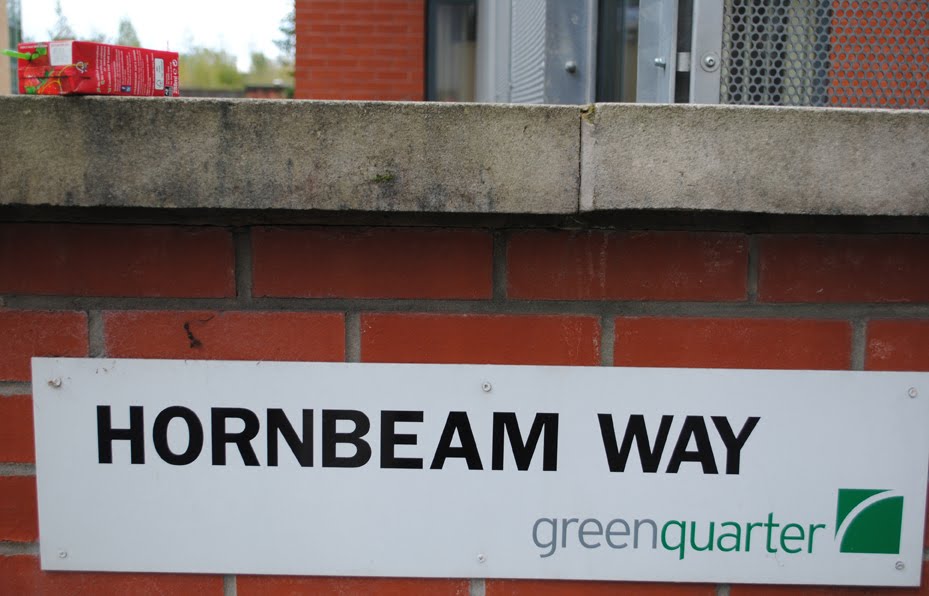
 The advantages of this for developers are clear: from 2004 onwards, the Green Quarter was created just outside of Manchester City Centre, referring to the largest ever housing development in the city. Developers Crosby Homes promised a “self-contained urban oasis, combining 10 cutting-edge apartment blocks, business accommodation, hotel, leisure and retail facilities set against the precious commodity of lush landscaped open green space”. Sold on its close proximity to Victoria Station, the MEN Arena, the Printworks and leisure and retail opportunities, the developers highlight “the convenience factor of a lifestyle on their doorstep”. They tempt: “Are you addicted to city living, yet yearn for more than a splash of greenery? Do you enjoy the buzz of the urban social whirl and the spark of metropolitan business, but would relish having a haven to escape to?”12The green part? It was envisaged that more than half of the area would be public open space with lawns, tree-lined walkways, water features and landscaping.
 A common example of the adoption of quarters as a regeneration strategy can be seen in cathedral quarters, which are found in towns and cities around the country, including Sheffield. Blackburn's town centre strategy13 works with “the inherent and distinct uses of existing areas”, including the cathedral quarter, which has “one of the most established identities in the town centre”, to “encourage a unique sense of place”. Heritage quarters are being established in towns and cities including Gravesend and around the harbour in Sunderland. University quarters include Stoke-on-Trent's catchily-named UniQ, a partnership between local education providers that aims to raise aspiration and increase skills in the town.
 One of the most prominent types of quarters is the creative, or cultural quarter, which can be found in towns and cities around the country including: Southampton, Brighton, Folkestone, Birmingham, Sheffield, Leicester, Oldham, Liverpool, Stoke-on-Trent, Doncaster, Boston, Colchester, Leamington Spa, Wolverhampton, Bedford, Bury and Warrington14. The Local Government (LG) Improvement and Development Group put together a guide to cultural quarters, which it defines as “an existing cluster of creative and cultural industries, or the desire to create a cluster of creative and cultural industries”15. Quarters give creative people the opportunity to “work, live and socialise in one environment”, and the LG foresees the associated networks and facilities growing up around them. In Folkestone, Kent, the Creative Quarter was initiated by a charitable Trust buying and refurbishing, then letting, empty properties to creative businesses and artists, supplemented by events such as a book festival and art triennial16.
 Whilst there is debate over how desirable it is to set out to create a creative area, as opposed to letting it evolve naturally over time (and there are also concerns about the knock-on effects of 'gentrifying' an area, including pricing out its previous occupants), Manchester's Northern Quarter, which was one of the first cultural quarters in the country along with Sheffield's Creative Industries Quarter, is seen as a successful example of what a cultural quarter should be and do. As the LG site observes, “the most successful examples of cultural quarters usually had some longstanding cultural activity or venues”. The Northern Quarter became established as an alternative to mainstream shops such as the Arndale Centre, its lower rents attracting a mix of cafes, bars, vintage clothes shops, independent book shops, record shops and galleries. It also has a distinctive nightlife, with a reputation for alternative gigs and club nights. Its proximity to the city centre shops, as well as transport interchanges such as Shudehill and Piccadilly, means the Northern Quarter is described in the Northern Quarter Development Framework Report of 2003 as: “A key piece in the city centre jigsaw, an area different in character and function to any other part of the city centre and of great strategic importance to Manchester as a city of distinctive quarters.”17
 Councils are honing in on quarters and creating visions and plans for areas at postcode level, but quarters are part of a bigger strategy to put cities like Manchester on the world-map. Ensuring certain quarters cover specific functions ensures that Manchester is seen to possess everything you would expect to find in a world city. The Northern Quarter Development Framework Report explicitly states of the Northern Quarter: “This non mainstream offer is important for any ‘global’ city.”19

Cities change and evolve up over time. The name 'Northern Quarter' entered popular use because it referred to an area which already had a distinct identity and role in the city. Few people outside those who live in the Green Quarter refer to it as such (or would even have reason to think about it as a 'place'), and it remains to be seen whether the other quarters, or even the name NOMA, will enter popular conversation as place-markers.
 Quarters have been at the back of my mind for a while as something I would like to know more about. Above is merely a collection of things I found interesting about them. If I had had more time and space I would have liked to have also thought about the creation of Spinningfields as a 'luxury shopping quarter', and thought more about other concepts such as urban villages and had a closer look at the overlap with quarters and the language that is used to define and sell them.
1 For a list of the seven city quarters outlined in Birmingham's Big City Plan see http://bigcityplan.birmingham.gov.uk/tag/seven-quarters/
2 For a list of Sheffield's eleven quarters see http://sccplugins.sheffield.gov.uk/urban_design/quarters_city_centre.htm
4 For more on Corridor Manchester visit http://www.corridormanchester.com/
8 Download the Civic Quarter – Manchester Central Regeneration Framework from http://www.corridormanchester.com/_filestore/corridormanchester/civicquarter-manchester-central-regeneration-framework-1-pdf/original/CivicQuarter_Manchester_Central_Regeneration_Framework[1].pdf
9 For more on Millennium Projects, including Urbis, see http://www.millennium.gov.uk/cgi-site/awards.cgi?action=detail&id=87&t=2
10 See http://menmedia.co.uk/manchestereveningnews/news/s/1435585_cromwells-new-stand-plan-for-statue-to-move-to-manchesters-new-medieval-quarter
11 See http://www.noma53.com/ for more information on what's proposed.
12 Visit the Green Quarter's web page at http://crosbylendlease.co.uk/?u=48_Welcome%2Bto%2Bgreenquarter
13 See http://www.blackburn.gov.uk/server.php?show=ConWebDoc.2472 for more information on the town centre strategy.
14 I came across this map of the UK's cultural quarters via a blog post on taCity (http://tacity.co.uk/2011/03/01/the-uks-cultural-quarters/): http://maps.google.co.uk/maps/ms?ie=UTF8&hl=en&msa=0&msid=206639182478297374758.00049c3bf7eb53f1c8a72&z=7
17 Northern Quarter Development Framework Report, 2003
18 Northern Quarter Development Framework Report, 2003
19 Northern Quarter Development Framework Report, 2003

It's often too easy to conflate place with music, and vice versa. It's tempting to view a city through a lens of its cultural prod...