Showing posts with label Damson gin. Show all posts

Sunday, 18 December 2022

Pilgrims Way damson gin

Thursday 15 September. The Queen is Dead and it’s day ten of national mourning. The weather is changing from summer into autumn and it feels like the mood – in fact the world – is changing, too, from an era of relative stability into an uncertain and unsettled future. There’s a chill to the wind and the sun is struggling to break through, only occasionally piercing the low, grey, moody Kentish skies to diffuse weakly outwards. I decide to set out from Hythe by bicycle to Wye crown, carved into the North Kent Downs high above Wye in 1902 to celebrate the coronation of King Edward VII, by students from the town’s agricultural college. I first spotted the giant crown from the train earlier in the year, en route from London to Margate, and was intrigued, wondering what on earth had made them to go all that effort. 
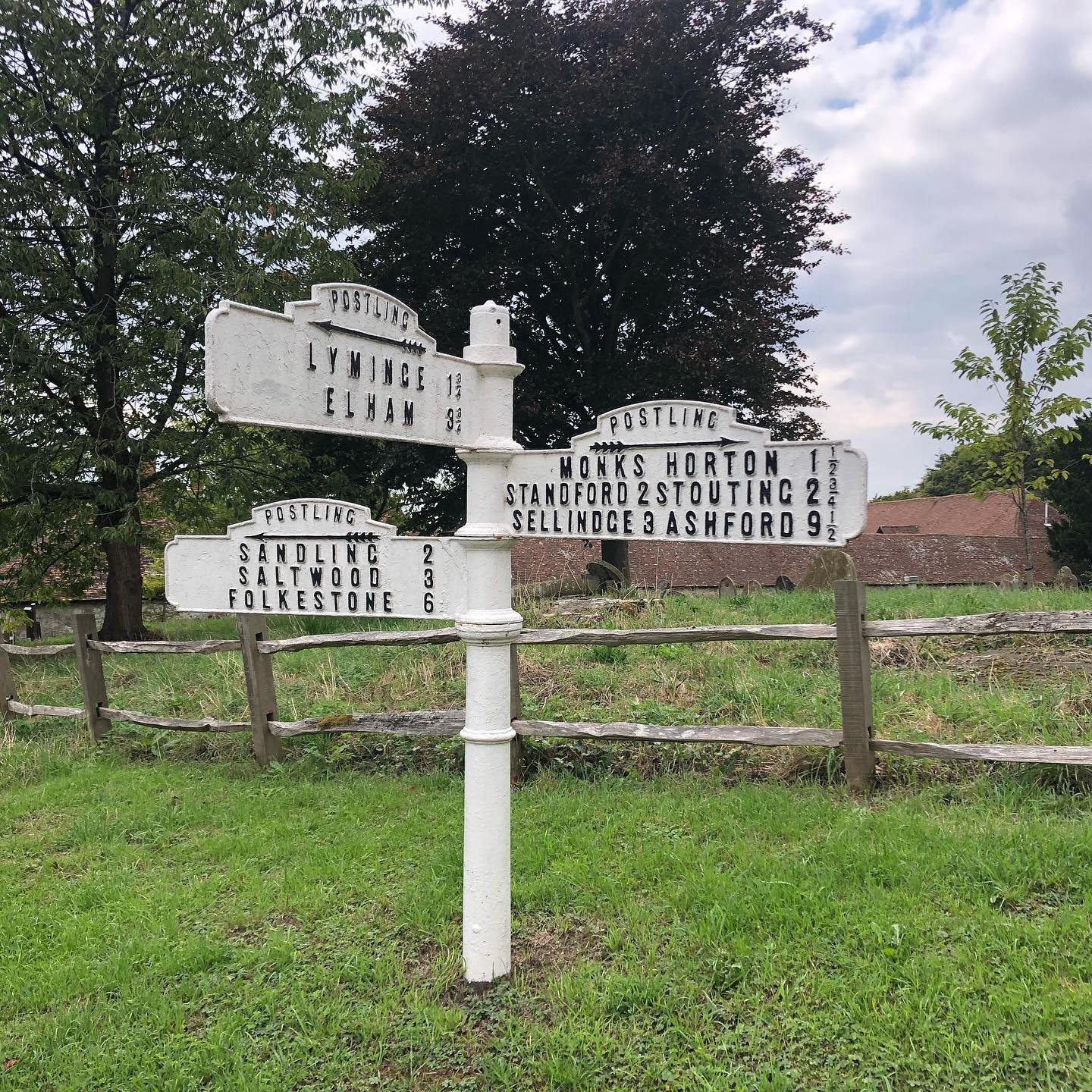
My route takes me uphill to Saltwood, where I get up close to a group of curious peacocks from the writer and broadcaster Kenneth Clark (and later, his right-wing politician son, Alan)’s castle, past the nursery where we used to go to pick out a Christmas tree every year from austere rows of pines, and over the M20 to Postling, a village that, while quite pretty, has no amenities except for a museum in a phone box. Joseph Conrad’s former home on the outskirts now has an airstrip outside, the fins of vintage planes peeking out of an old barn building. 
Soon afterwards, I pick up the Pilgrims Way, the route once taken to Thomas Becket’s shrine in Canterbury cathedral, which crosses Stone Street, the former Roman Road. The narrow road looks over the flat landscape below; marsh sheep and oast houses are now joined by vineyards and wind turbines. I pass homemade produce signs and honesty boxes closely monitored by CCTV and The Tiger Inn, advertising Mackeson’s Hythe Ales in large letters on its frontage. Damsons line the side of the road and apples rot in large back gardens; no-one’s picking them. As I struggle uphill, a couple overtake me on electric bikes. They have the right idea, I think to myself. 
As I reach Wye, I leave the road for an exposed, elevated footpath and the ground turns sandy and orange. The crown comes gradually into view, but the picture is partial and fragmented; close up it’s just a collection of white-painted rocks, enmeshed in wire. I follow a curve and try to picture the sections forming a crown in my head, then walk down the slope to see if I can get a better view. It’s impossible to see the whole from here – it’s best seen from the train line below, passing at speed, on the way to somewhere else.

Friday, 15 December 2017

Fallowfield Loop damson gin

In the 1960s, Dr Beeching paved the way for the reduction of the British rail network, closing small village stations and branch lines and catalysing the ascendancy of the motorcar as the dominant mode of transport in Britain*.

Some of long-closed lines are now reopening, after decades dormant. Others, their tracks removed permanently and their station buildings now converted into shops and supermarket cafes (as is the case with the former suburban Manchester stations of Levenshulme and Fallowfield), offer cyclists miles of dedicated bike path free from the traffic and aggressive motoring that increasingly chokes our towns and cities.

Manchester’s Fallowfield Loop stretches around eight miles, looping around the south and east of the city. Beginning in inner-city Openshaw in east Manchester and ending in leafy Chorlton in south Manchester, it undulates through the former industrial dormitories of Gorton and Levenshulme, passes picturesque Debdale Reservoir, skirts the boundary of Stockport at Reddish, and cuts through studenty Fallowfield and leafy Whalley Range.
The Loop has the feel of a linear park, offering a backdoor view of the city and its patchwork of official and unofficial green spaces. The Loop itself is an underacknowledged green space. In spring and summer it’s overgrown with branches forming a green tunnel, although in autumn the slipperiness of the accumulated layers of leaves can be treacherous. In winter, the foliage drops right back to reveal numerous back gardens, allotments, recreation grounds, school playing fields, overgrown brownfield sites and industrial land reclaimed as country parks. It links up with other traffic-free routes, too, from the Ashton Canal, with its miles of recently resurfaced towpath, to former branch canals such as the Stockport canal.
The Fallowfield Loop has become a place of community activism and communal litter-picks. It’s also a place of memorial, to young people who have killed themselves. Recently, it’s become a site of protest, with large EU flags unfurled unmissably from road and railway bridges; when removed, they reappear again soon afterwards, imported en masse from China. Pro-EU graffiti sprayed along the path places the UK at the heart of the EU, and the Manchester bee motif is placed centrally within the circle of stars that represent the EU member states; it’s a reminder that Manchester, along with the neighbouring local authorities of Stockport and Trafford, which the Loop passes close-by, voted remain in the EU referendum, in common with several other northern cities. It’s also a place for creativity, from street art murals celebrating the city’s architecture, to hand-written personal declarations (and accusations – ‘Louis K has a tiny penis’). It’s a place to encounter culture, from bicycle theatre troupes offering outdoor Shakespeare performances to public artworks sponsored by the cycle charity Sustrans, which document and draw attention to the flora and fauna of the route. It’s a place of learning and instruction, for small children to gain confidence and practise their bike skills away from the road. It’s also a place for family time: on father’s day, it’s noticeable how the number of men with small children increases.
Not all is benign – once or twice a year the ambush of women or opportunistic robberies make the deadlines, and mounted police undertake regular patrols. However, generally it’s a place of conviviality and sharing: if a cyclist stops at the side of the path, the next to pass will stop to see if all’s okay, and offer help fixing a chain or a spare inner tube.

Although cyclists benefit the most from a safe cycling environment uninterrupted by the frequent stops and starts of traffic lights, the Fallowfield Loop is also well-used by walkers, joggers, dogwalkers, students, and schoolchildren on their way to and from school, as well as shoppers just getting from A to B. It’s a meeting place, too, particularly for groups of teenagers.
These looplines are also fruitful places for the urban forager. Depending on the season, edible mushrooms, horseradish, strawberries, raspberries, cherries, plums, damsons, sloes and apples can all be found along the Loop, whilst in late-summer individuals and groups of people of all ages gather with an assortment of receptacles, from large yoghurt tubs to seaside buckets, Tupperware tubs and carrier bags, to gather blackberries, and offer hints on the best spots.

This year’s damsons were picked along the Fallowfield Loop, in a year that was unusually fallow for apples, yet plums and damsons of varying hues were in abundance.

* For a more detailed account of cuts to train services in Manchester see https://mancunian1001.wordpress.com/2013/03/26/the-reshaping-of-our-railways-1-before-beeching.

Sunday, 1 August 2010

The Shrieking Violet is one! Issue 10 food special

The Shrieking Violet is one! Today is the first anniversary of the Shrieking Violet fanzine, and to celebrate I've made a food special. Issue 10 features all sorts of food related articles and recipes.

The beautiful cover is by David Bailey of Mount Pleasant, who also runs the Good Grief fanzine/comic/record/cassette tape shop in Afflecks Palace, which is a good place to pick up copies of The Shrieking Violet. Inside, Hayley Flynn reviews the Manchester Egg. Morag Rose of the Loiterers Resistance Movement explains why she (and friends) made an edible vegan cake map of Manchester. Alan Smith (also of the Loiterers Resistance Movement) has produced an urban foraging guide explaining what berries to pick and what to do with them. I have written about when I decided to eat stinging nettles. Rachel Cranshaw recounts a recent trip to China, explaining how central food is to their culture. Lauren Velvick has beautifully illustrated and written instructions for making damson gin. Aziza Mills discusses the opportunity for dining out as a vegan. Rebecca Willmott talks about a food co-operative that is being set up at Manchester Metropolitan University. In addition, there is creative writing by Kate Thorburn, poetry by Andrew Beswick and short stories by Craig Lochhead, as well as photography by Chris Vaughan and illustration by Alex Boswell.

Copies will be left in places such as Oklahoma, Cornerhouse, Manchester Craft Centre, An Outlet, Koffee Pot, Nexus Art Cafe, Piccadilly Records etc. Paper copies also feature an attempt at lino cutting.


The Shrieking Violet issue 10 can be read online here with all the pages in the right order.


To print and fold your own copy, click here.

Back issues of the Shrieking Violet can be downloaded here.

To obtain a paper copy of this zine or any back issues, email your name and address to Natalie.Rose.Bradbury@googlemail.com.

To contribute to future issues email Natalie.Rose.Bradbury@googlemail.com or join The Shrieking Violet fanzine facebook group.

Best enjoyed whilst eating blackberries!