Showing posts with label Folkestone Triennial. Show all posts

Saturday, 15 December 2018

Folkestone Warren sloe gin

Fight your way through tangles of brambles, nettles and blackthorn bushes, and keep your footing on the narrow, uneven paths that lead down to Folkestone’s Warren, and you’re rewarded with access to the town’s most attractive beach.

The Warren is a bay at the foot of the white cliffs, looking across to the low-lying coast of France on a clear day. Despite being geographically close, it feels a world away from the Folkestone’s most popular beach, Sunny Sands, where the raw bodied and raw faced holiday people observed in Ted Hughes’ poem Work and Play

Are laid out like wounded
Flat as in ovens
Roasting and basting
With faces of torment as space burns them blue.

Although out of town, the Warren is well worth the trip. As part of an exposed coastal landscape that has been remade by landslips over the years, the cliffs are shored up by a wide concrete apron constructed after the Second World War. When the tide is right, regular rows of concrete groynes create the impression of a series of private beaches, both separated from the promenade above and cut off by gently lapping waves to the side. At low tide, the concrete is coated in a springy carpet of vivid green moss that’s treacherous under foot. At high tide, fishermen cast their rods out to sea and concrete steps provide the perfect entry point for swimming in the English Channel, which turns a Mediterranean turquoise under the summer sun. In winter, when stormy grey waves slap unpredictably against the edge, it’s wise to keep your distance.
Although the Warren is home to a small campsite – and the occasional illicit camper and hermit residing in shacks built into the cliffs – it’s mercifully free of crowds. It’s overlooked only by a couple of Martello Towers, a lone clifftop café at Capel-le-Ferne and a clifftop artwork, Siren, by Marc Schmitz and Dolgor Ser-Od, inspired by the improbable early twentieth-century wartime technology of concrete listening ears, and installed as part of the 2017 Folkestone Triennial.

It wasn’t always this way. The Warren, which had a reputation as Folkestone’s ‘Little Switzerland’, was once a destination for daytrippers and pleasure seekers, served by its own train station.

The Warren is separated from touristy Sunny Sands by an expanse of rocks, popular with fossil hunters. Sifting idly through the beach’s mixture of sand and pebbles reveals its own treasures, though: pebbles made from brick in various shades of red and yellow, worn smooth over the years, and translucent, gem-like ‘sea glass’, delicately frosted ovals of white, green, brown and blue glass created from decades of discarded bottles being thrown around and ground down by the tide.

Follow the cliffs in the other direction, past Abbot’s Cliff nudist beach, and eventually you’ll reach the port of Dover. The Folkestone to Dover trainline, too, takes this route, through the cliffs and past the Warren. Though short, it’s a dramatic ride, as the train emerges suddenly alongside the sea. Although spectacular, the route has its perils. In December 2015, storm damage closed the trainline for a full nine months, a reminder that the conceit of man’s control over our island coastline is illusory at best, and that its shape, form and the nature of our relationship with it is something we should never take for granted.

Friday, 1 September 2017

Folkestone Triennial: a town transformed by art?

“It’s the best job in the world,” enthuses Folkestone Triennial curator Lewis Biggs, as he bounds along the Leas promenade in a straw hat and tropical shirt. The Victorian seaside splendour of the Leas, lined with grand hotels and mansion blocks, is one of the locations currently displaying new artworks for the fourth instalment of the town’s triennial. Some require the viewer to look hard to spot them – David Shrigley and Camille Biddell recreated one of the Leas’ traditional, ornate lampposts from memory and installed it on the Leas, where it differs only slightly in height and colour from those around it – whereas Richard Woods’ brightly coloured holiday chalets stand out garishly around the town. His fantasy structures float in the harbour and perch on the top of the cliffs, aiming to highlight the impact of second home ownership on the south east’s overheated property market. 
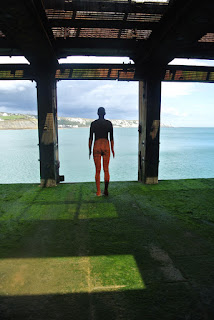
Across the town, the triennial opens up new spaces to residents and visitors alike. This includes a former Baptist burial ground, hidden among a huge redbrick railway viaduct and tall, austere rows of terraces. Accessed via a steep row of steps, it hosts sensor-activated sound compositions by Emily Peasgood. Antony Gormley invites visitors to descend into the dank, cavernous space under the Harbour Arm, where one of his characteristic figures surveys the dramatic white cliffs of Dover and the passing of cross-channel traffic. Hoycheong Wong makes the invisible visible, giving a new façade to an otherwise anonymous Islamic cultural centre, which for 28 years has served the area’s 300 Muslims from a nondescript industrial building. Other pieces blur the boundaries between the private and the public, as in Amalia Pica’s seashell sculptures, positioned in people’s front windows, which reference souvenirs, kitsch and collecting. Other work literally illuminates, in the case of a lamppost in the dingy market square, powered by an experimental mushroom battery, installed by Nomeda and Gediminas Urbonas. Some of the work highlights familiar locations or landmarks. Alex Hartley’s 'Wall' appears to balance precariously at the edge of the white cliffs, constantly at risk of erosion. Other artists bring attention to aspects of the town’s history and economy, as in Jonathan Wright’s small-scale replicas of Folkestone’s fishing fleet – only ten of which remain in operation – developed in collaboration with local fishermen and suspended on posts around the town. Lubaina Himid, meanwhile, suggests an alternative history in her beachfront jelly mould pavilion, that encourages us to think about the links between leisure and pleasure, slavery and sugar.
This is Biggs’ second triennial – he took over from Andrea Schlieker for the 2014 edition – and it’s clear that he considers it a job for life. His enthusiasm stems partly from the opportunities offered by Folkestone’s architecture and geography – “I’m obsessed with art and place,” he explains. “They are constructed in the same way – through material and stories.” The process of choosing work for the triennial starts, Biggs explains, “with a list of places I want to illuminate”.
In large part, too, Biggs is driven by working “in a town small enough to see a difference”. As much as the excitement of opening up places and bringing artists to work in the town, Biggs is interested in urbanism, civic life, democracy and the long-term effect of the triennial. “It’s really important that art is seen as part of life,” says Biggs. “It’s the glue between people in society.” He explains: “I believe that if we get better at constructing art then we get better at constructing place.”
Biggs’ concern with place-making and transformation is shared by Alastair Upton, Chief Executive of the Creative Foundation. The Creative Foundation was formed in 2002 by the philanthropist Roger De Haan, founder of Saga, a major local employer based in nearby Sandgate (De Haan is still chair of the Creative Foundation). The Creative Foundation set out to explore the potential for creative-led regeneration in a town that had “lost its economic purpose” following the decline of tourism in the second half of the twentieth century and the loss of its channel crossing in 2000. For Upton, the raison d'être of the Creative Foundation, which he joined in 2011, is to ask: “How can creative activities make Folkestone a better place to live, work, study and visit?” The answer, for Upton, is by creating a place that has “interesting architecture, buildings and things going on – a cultural life”. 
Both Upton and Biggs previously worked in Liverpool, Biggs as curator of Liverpool Biennial from 2000-2011, before which he led Tate Liverpool, and Upton as Director of the Bluecoat in Liverpool. Upton explains that “historically all the stories about Liverpool were negative”. Liverpool’s designation as the Capital of Culture in 2008 was an opportunity to change the way the city was perceived, both by residents and by outsiders. “The defensive pride that people felt has became positive,” says Upton. 

Biggs, too, explains that he learnt a lot in Liverpool: “I found that I needed to relearn and think again, because art and audiences behave differently in and outside of the institution. In the gallery, the primary reference is always to other art – you are always working in the parameters of art history and it is circular, as it appeals to people who are already interested in art.”
Having seen how art can change places in Liverpool, Upton and Biggs share a sense that there is potential to “make more of a difference” in Folkestone, a medium-sized town of around 50,000 people. In the nine years since the first Folkestone Triennial took place in 2008 the town has undeniably undergone something of a transformation. When the work of the Foundation started, the town had been subject to decades of decline. Like town centres across the country, the high street has been in a sorry state for years: one of the largest retailers, M&S, abandoned the town in 2006, leaving empty shops in its wake. Although community arts company Strange Cargo was long-established in the town, there was little in the way of contemporary art of national or international quality in Kent. For many years the Metropole Gallery, founded in 1961 with the support of the critic and broadcaster Sir Kenneth Clark – a resident of Saltwood Castle in nearby Hythe – brought a varied programme of changing exhibitions by emerging and established artists to the town. However, constrained by its base in an old-fashioned Victorian building dominated by parquet floors, large windows and wooden panelling, it finally wound down in 2008.
One catalyst for the revival of the Folkestone’s fortunes has been the opening of the high-speed train route from London. In 2007, the Kent coast was connected to St Pancras by high-speed train: the journey from Folkestone to London, which previously took around an hour and fifty minutes, can now be done in under an hour. This has had the effect of bringing the Kent coast closer to London; it has also prompted an influx of incomers, including artists, attracted by cheaper property and a better quality of life, still within commuting distance of the capital.

The cultural offering in the county, too, has improved dramatically in the past five to ten years, with the opening of the Turner Contemporary in Margate in 2011 and the Beaney in Canterbury in 2012 (as well as the Jerwood Gallery in Hastings, East Sussex in 2012), as well as new music venues along the coast, from Ramsgate Music Hall to Dover’s new Booking Hall venue.
However, Upton sees the Creative Foundation as offering an alternative to the “concept or consumption-led” gallery model, which relies on a landmark building to create a trickle-down effect in the town’s economy. Instead, Upton sees a need to “make a place for people to make”, believing that it offers a “firmer base for development” and a “change that brings the whole economy with it”. The Creative Foundation started this process by “making a place for artists to live and work, a production base”. It bought, did up and hired out ninety buildings in a derelict and unloved area of town; these spaces are now at full capacity.
Today, the old town is almost unrecognisable. In the picturesque old high street, derelict shops have been smartened up and painted bright colours. The cobbled streets are now lined with coffee shops, small galleries and boutiques. The triennial is just one aspect of this transformation. Alongside the triennial is an established fringe festival, and independent galleries and artist spaces proliferate in the old town. These include the Brewery Tap, which showcases work by artists and academics from the University of the Creative Arts. Folkestone Museum has recently reopened in a new space in the former town hall, telling the stories from the town’s natural and archaeological history, as well as hosting changing exhibitions.
One of the biggest transformations of all has been the reopening of the Harbour Arm, in a run-down part of town that few had any reason to venture into following the demolition of the Rotunda amusement park and the closure of the ferry crossing. Until recently, the Harbour Arm station connected Folkestone to the continent via the Orient Express; although trains no longer run there, it’s been reinvented as a leisure destination, with pop-up bars and food stalls in the former station buildings. Snaking dramatically out into the sea, it offers views out to France and the white cliffs of Dover in one direction, and around the bay to Dungeness power station in the other.
For Upton, another of the big success stories is the Quarterhouse, which hosts gigs, film screenings, comedy and spoken word and other events. Unlike many arts venues, whose subsidised programme is patronised mainly by those in the upper socioeconomic groups, he says its audience represents a very similar demographic to that of the town. Upton also emphasises the Foundation’s work with young people. For example, “every single child” from the town’s schools visits Folkestone Book Festival, there is a drop-in arts club, and there are opportunities for work experience.

There’s still work to be done, for example in promoting and developing jobs and livelihoods for local people in the creative industries. There are opportunities for further connections to be made with projects exploring digital futures. There’s also a need for the art scene to be more visible in between triennials, and for Folkestone to be linked up more with other cultural initiatives across the South East: neighbouring East Sussex, separated from Folkestone by Romney Marsh, now has a Coastal Cultural Trail connecting up the Towner Art Gallery in Eastbourne, the De La Warr Pavilion in Bexhill-on-Sea and the Jerwood Gallery in Hastings.
The main challenge now, though, says Upton, is “How do you make it inclusive? How do you make sure it remains for everyone?” Upton regards the changes that have taken place so far as “rebalancing” as much as “gentrification”, but the town will change considerably again over the next ten years, as a large area surrounding the harbour area is redeveloped with a much-discussed and long-stalled residential and commercial development. The challenge, says Upton, is that, “as Folkestone changes we’ve got to make sure artists are involved in the very fabric of the town and how it sees itself”. As Biggs puts it: “Folkestone is changing at such a rate. We need feedback between development and the arts. People are now in conversation.”
Upton highlights that “lots of artists in the triennial describe themselves as socially engaged”, and some of the most interesting work at the triennial is that which encourages interaction, or provides spaces for people to come together to talk, think and play. This ranges from Sol Calero’s brightly-painted and participatory 'Casa Anacaona' beach pavilion, which is filled with movable furniture and acts as a social space for young people, to Bob and Roberta Smith’s ‘Folkestone is an art school’, which is working with ten local young people as well as celebrating the artistic activity that already goes on in the area: as Biggs explains, “Folkestone is an art school already – you need to change your attitude so you can see it”. A new ‘Urban Room’ in the recently restored former Customs House at the Harbour Arm houses a library of books about the history of the town, alongside texts on urbanism, art and citizenship, as well as maps and drawings showing the ways the town’s landscape and its uses have changed over time. It’s a place not just to learn about the past, but to add to, to imagine and to discuss the future.
Folkestone Triennial: Double Edge takes place at various venues in Folkestone from Saturday 2 September until Sunday 5 November. For more information, including locations, opening times and the accompanying programme of events visit www.folkestonetriennial.org.uk.

Friday, 25 August 2017

Phyllida Barlow and the seaside architecture of the south coast


Phyllida Barlow, untitled: dunce (2015)

One of the defining features of Phyllida Barlow’s sculptures is their scale. Often reminiscent of natural forms such as rock formations, they tower over you, sometimes with immersive effect. This was the case, for example, at her 2015 solo show at Fruitmarket Gallery in Edinburgh, which transformed the space into a claustrophobic series of close-up encounters with her work as the viewer navigated through various pinch-points.

Rock formations are an apt starting point for Barlow’s work, which could be placed in a lineage of twentieth century British sculptors who have referenced organic forms such as the beach pebble – most obviously the modernism of Barbara Hepworth and Henry Moore. Whereas their sculpture takes the humble seaside stone and transforms it into something sleek and abstracted, carved from stone or cast in heavyweight bronze, Barlow’s sculptural forms are rough, messy, eroded, often showing the material or process of their making and incorporating appropriated and ephemeral materials.

Barlow’s work has been brought to Margate as part of the ‘Artist’s Rooms’ series of touring exhibitions. This places a regional spotlight on Barlow’s five-decade career at the same time as she represents Britain internationally at the Venice Biennale; her work is shown alongside that of the British-Kenyan artist Michael Armitage, a former student of Barlow’s at the Slade. Armitage incorporates imagery from African mythology and current social and cultural issues into a series of remarkable narrative paintings in densely worked, luminous paint on textural lubugo bark fabric.

Phyllida Barlow, untitled: holder (2014)
Building

Designed by David Chipperfield, the Turner Contemporary is an iconic building overlooking Margate harbour, which created a new physical and cultural landmark in the town when it opened in 2011. The self-consciously modern development stands alone at the harbour’s edge; it is made particularly striking by its setting in a Victorian townscape of tall, narrow terraces.


Phyllida Barlow, untitled: upturnedhouse, 2 (2012)

A strong architectural influence is apparent in Barlow’s work. This runs through her work on paper, in particular her pencil drawings, which have an air of the study or plan about them, all angles and perspectives. Sometimes they suggest interiors, at others a maze or labyrinth, or the footprint or outline of a building. It’s also apparent in the materiality of her work, which uses material such as wood, sand and mesh frames, overlaid with crude and thick layers of paint. Most of all, it’s visible in her sculptures, which suggest the Colosseum in Rome (‘untitled: holder’, 2014), at one extreme, and the garden shed at the other (‘upturnedhouse 2’, 2012).

Richard Wilson, 18 Holes (2008)

‘upturnedhouse, 2’ also brings to mind Richard Wilson’s ‘18 Holes’, commissioned for the first Folkestone Triennial in 2008. For this large-scale public work, in another former seaside resort looking to art for regeneration and reinvention, Wilson recycled large slabs of crazy golf surfacing from the nearby Rotunda amusement park, demolished to make way for a residential, retail and leisure development, in order to build a trio of new beach huts. In doing so, he brought together two archetypal forms of seaside recreation, inserted into a uniform row of standard issue concrete huts to be stumbled across as an unexpected encounter with art.

The constituent parts of Barlow’s sculptures often resemble building blocks; they appear unstable, as if in a state of perpetual assembly and dismantling, caught between balance and stability, strength and fragility, much like the architectural and natural landscape of this stretch of coast.


Collapsed Martello tower, Hythe, Kent

Defences

One of the Turner Contemporary’s selling points is its panoramic views out to sea. Seen in this setting, Barlow’s sculptures invite comparison to the defensive architecture of this area, which acted both as deterrent and as vantage point from which to spot any potential attackers. From Essex in the north to Sussex in the East via Kent and Romney Marsh, these largely flat lands have been subject to successive layers of attack, from anticipated Napoleonic invasion to wartime bombing raids to the ongoing onslaught of the sea. The response to these threats has left its mark in the landscape, from solid brick Martello towers and redoubts, some still standing and other crumbling slowly into the sea, to modern rock groynes and concrete sea walls. Barlow’s 2015 work ‘Tryst’, though not shown here, resembles the monumental Maunsell Sea forts, fortresses built during the Second World War and raised high on stilts above the sands off the coast of Kent. Others make more utilitarian references, suggesting steps, staircases and stacks, as seen in ‘Untitled (Yellow Racks)’ (2006). ‘Awnings’ meanwhile, suggests a series of flags: a coded message or warning.

Phyllida Barlow, Untitled: (Yellow Racks) (2006)

More than any sculptor, the reference point that seems closest to Barlow’s work is the painter and photographer Paul Nash. It’s easy to return to Nash, yet his depictions of Romney Marsh are still unequalled, and he found much inspiration in the Kentish landscape. Just as Turner is celebrated for drawing on the particular qualities of light and skies that characterise Margate, Nash’s recognisable brand of British Surrealism conveys the ultra-vivid strangeness of Romney Marsh, 35 miles to the west. In a muted palette of dusty, desert colours, Nash depicted the expansive vistas around the bay, the luridness of its light, and a landscape still punctuated with defensive architecture, from sea walls to pillarboxes now silted up neck-high with shingle. Like Barlow, his paintings suggest layering and stacking: the steps that separate the promenade from the beach below, the wall that guards the farmland from an encroaching sea, and the overlapping waves that stretch out like ominous slabs towards the moon.

Pill box, Hythe, Kent

Transforming

Like the work of Nash and other British surrealists, Barlow’s work transforms our perception of forms and materials, and the nature of sculpture. It suggests a negotiation between the familiar and the mystical, and an ability to transform the everyday. In ‘Hoard’, a tube is suspended above an uneven surface of tables, stacked like crazy paving or stepping stones. It could be a pipeline, a piece of functional infrastructure, or it could be the moon, illuminating anew in its particular way a landscape below.


Phyllida Barlow, Hoard  

Phyllida Barlow: Artist Rooms is at Turner Contemporary, Margate as part of Every Day is a new Day (with the paintings of Michael Armitage) until Sunday 24 September. For more information visit www.turnercontemporary.org/exhibitions/phyllida-barlow-artists-rooms.

Wednesday, 7 December 2016

Sugarloaf Hill sloe gin

The hills of the Folkestone downs – Sugarloaf Hill, Castle Hill, Hoywell, Cheriton Hill and Round Hill – rise out of the gently undulating Kent countryside like green bowling balls, left by some giant en route to the channel. If they were to crouch down, survey their target, flex their arm and roll them across the flat landscape they’d hit the cliff-top town of Folkestone, which diffuses out from the sea in dense avenues of former redbrick mansion blocks and neat semis, rarely letting up to allow in parks or open spaces.
From a distance, the blueness of English Channel intensifies. The steps of an ancient earthwork ripple like the sea below; a more contemporary artwork, the white horse of Invicta, spreads out across the downs. It’s Folkestone’s answer to the Hollywood sign, a bit of modern-day branding for a town which has for many years seemed relegated to a comfort break on the side of a motorway, a stop on the train line between the coast and the capital. Folkestone was hit hard by the twentieth century decline of domestic tourism and the closure of its ferry and hovercraft links.
From up on Sugarloaf Hill the town’s former grandeur as a tourist destination is apparent in a way it might not be at street level. The Grand and the Metropole hotels are lumbering redbrick footprints teetering at the edge of the cliff like non-identical twins. The high-rise offices of the town’s newspaper, the Herald, rise above the empty shops of the town centre. The premises of an insurer that’s long since left town – now a curry house – offer a rare bit of streamlined modernist glamour. A tall Victorian railway viaduct tiptoes across terraced houses, bringing daytrippers in and connecting commuters with better-paid, higher status employment outside. Up high are wartime ditches built to defend the south coast. Below, two Martello towers represent an earlier era of threatened invasion, one pristine, one overgrown. Close up, the town becomes more anonymous, a familiar scene of grey out-of-town retail sheds and the teen haunts of drive-thru fast food joints. Then, the landscape begins to empty out, towards the eerie remoteness of Romney Marsh and Dungeness in the distance.
Straight ahead, the French coastline hides behind a hanging mist or smog, but it’s only a train ride away: Eurostar speeds past, trains and wires sloping across the countryside. Trains no longer stop at the Folkestone Harbour train station, stretching out into the sea like a tentacle feeling its way to the continent, but visitors are now greeted by a text work by Ian Hamilton Finlay at the end of the harbour arm, a legacy of the Folkestone Triennial’s attempts to reinvent and inject some poetry back into the town.
Sugarloaf Hill and its neighbouring rotundas feel like the countryside, but it’s an illusion. Highway cattle roam woods and scrubland, fields of wheat, hay and wild marjoram, and thick passageways of blackthorn bushes, but the motorway's hum is hard to ignore. We pass through these hills in polluting metal boxes – an A-road on stilts goes in at Folkestone and comes out at Dover – and drink its water, from hidden reservoirs. In summer, runners puff up and down and young lovers picnic in relative privacy. Sugarloaf Hill is both of the town and a place to escape from it, to watch it from a distance, to bring a bit back with us, as sloes to mix with sugar for winter sloe gin.

Tuesday, 1 November 2011

How many quarters make a city? Clue: it's not four

Birmingham has seven designated city quarters1, Sheffield eleven2. In Manchester, the well-known Northern Quarter (and slightly less well-known Green, Civic and Millennium Quarters) will soon be joined by a co-operative quarter (although the Co-op Group hopes the public will take to its official name, NOMA, speculated to be a reference to its geographical position just north of the city centre3) and another, a Medieval Quarter, is proposed. Add to that other well-defined areas of the city which are not officially designated quarters, but could be seen as such – Canal Street and surrounding Gay Village as a gay quarter, Chinatown as a Chinese quarter, a university quarter around Oxford Road – and there are a lot of slices that make up Manchester.

There is a bewildering away of terms for dividing up the city into convenient chunks: corridors (the area around the universities and university hospitals is packaged as the corridor, Manchester's “economic and knowledge powerhouse”4), gateways (Southern Gateway, a new residential and business district in an area which had suffered from "a lack of identity and economic purpose"5), an urban village (Ancoats), the UK's first Urban Heritage Park6 (Castlefield) and even a curry mile. The language and concepts used to describe quarters is similar to that applied to these other corridors, gateways and urban villages, and they share many of the same attributes and aims – rejuvenating an area through mixed-use developments that will attract business and investment to the city and help raise its profile beyond the city boundaries.

Quarters often reflect the aspirations of a place, and are used as a way of conveniently packaging and marketing the different types of activities that make up the diverse life of a town or city. If a town or city has a well-defined creative quarter, for example, a hub of cultural industries, it will not just attract creative people but will also catch the eye of tourists and shoppers eager for an alternative retail or leisure experience. This provides customers for other facilities such as hotels and transport, and therefore acts as an incentive for business investment. Likewise, a heritage or tourist quarter puts a city's attractions conveniently into one place for visitors – and attracts the sort of retail or dining experiences that go with it.


The use of quarters to define areas of a city is nothing new. Think of Paris's quartiers – meaning living quarters. Cities have long had designated areas based on ethnicity – Jewish Quarters being a widespread example – and Birmingham, to name just one city, still has Irish and Chinese Quarters. Other quarters grew up around shared characteristics uniting the people who lived or worked in an area, such as speaking a common language (Latin around the universities in Paris' famous Latin Quarter, during the Middle Ages, a name which struck). Other quarters were named after the industry that was prevalent in an area, for example Birmingham's renowned Jewellery Quarter, catchily marketed as 'Birmingham's Gem'7. Or they may simply be descriptive of what's there, like Altrincham's Market Quarter, or what goes on there, such as Leicester's Business Quarter. Others are defined in geographical terms, including Manchester's Northern Quarter, which also goes by the postcode N4, or based on obvious physical attributes, such as Stoke-on-Trent's Canal Quarter. Others reflect the type of people the area has come to attract, or wishes to attract, or tells members of a certain demographic they will find likeminded people there – for example Liverpool's Gay Quarter. They can also be a tool in conservation, if a number of noteworthy buildings are clustered in one area.

Manchester's Civic Quarter, outlined in 2009's Civic Quarter – Manchester Central Regeneration Framework, aims to use Manchester's heritage, including some of its key buildings – the town hall, central library, Manchester central and St Peter's Square – as well as its transport links and infrastructure, to attract business and institutions to Manchester in “a new meeting place in the city centre”. Its goal is to extend both the city centre and business district and: “Bring together the values of civic pride and civic leadership, with international trade and commerce, world class innovation and research, at the heart of an entrepreneurial community.”8It also acts as a link between the various other districts that comprise the city centre: Spinningfields, the corridor etc.

The proliferation of quarters all over the country today, some based on a logical connection with an area and some more tenuous, often coincides with redevelopment and regeneration. Manchester's Millennium Quarter (there are also Millennium Quarters/Villages in London) refers to the redevelopment that took place around Manchester Cathedral after the area was destroyed by an IRA bomb in 1996. Its name reflects that rebuilding took place in the lead-up to the Millennium as well as the fact it incorporated one of a number of national projects funded by the National Lottery through the Millennium Commission9.


Typically, quarters incorporate new or improved public space (Cathedral Gardens, check), retail (Selfridges, Harvey Nichols, the Triangle, check), leisure (the Printworks, check) and residential opportunities. Often, refurbishments of traditional buildings sit alongside eye-catching new builds. The Millennium Quarter acknowledges Manchester's past, containing some of its most historic buildings (the cathedral, Chetham's Library), but it also contains new flagship development such as Ian Simpson's Urbis building, which was conceived as a museum for the city.

Soon, the area could have another quarter, currently dubbed the Medieval Quarter10 by local media, that will straddle two city centres, linking to the Greengate development in Salford. Plans include a new cathedral square, as well as a redesign of Cathedral Gardens, new memorials to the anti-slavery movement, the suffragette movement and firefighters. A statue of Oliver Cromwell, currently in exile in the suburbs, could also be moved there.

Just down the road is NOMA – colloquially dubbed the Co-op Quarter to reflect the fact that the Manchester-based Co-operative Group is redeveloping a huge, 20 acre site11 near its new headquarters. The £1 billion plan, funded by the Co-operative Group with some investment from the Council, will see the makeup of the area fundamentally changed to attract new up-market shops, offices and cafes, potentially generating thousands of jobs. New public spaces will be created and the inner ring road will be moved. The Co-operative Group will be hoping that the quarter can be seen as a physical manifestation of its values, which include commitment to community and environment.


Quarters can create a sense of place. Put a name on it and people can feel an affinity with a place and identify with the characteristics associated with it. As people are increasingly encouraged to live in city centres as opposed to the suburbs, residing within a distinct quarter makes it a lot easier to see yourself as part of a neighbourhood. When asked where you're from you might no longer have an area such as 'Chorlton' or 'Withington' on the tip of your tongue, but being able to say you live in 'the Northern Quarter' or 'the Green Quarter' helps whoever you are talking to identify a more specific locale than the more general term 'city centre', which encompasses a wider geographical area.

The advantages of this for developers are clear: from 2004 onwards, the Green Quarter was created just outside of Manchester City Centre, referring to the largest ever housing development in the city. Developers Crosby Homes promised a “self-contained urban oasis, combining 10 cutting-edge apartment blocks, business accommodation, hotel, leisure and retail facilities set against the precious commodity of lush landscaped open green space”. Sold on its close proximity to Victoria Station, the MEN Arena, the Printworks and leisure and retail opportunities, the developers highlight “the convenience factor of a lifestyle on their doorstep”. They tempt: “Are you addicted to city living, yet yearn for more than a splash of greenery? Do you enjoy the buzz of the urban social whirl and the spark of metropolitan business, but would relish having a haven to escape to?”12The green part? It was envisaged that more than half of the area would be public open space with lawns, tree-lined walkways, water features and landscaping.

A common example of the adoption of quarters as a regeneration strategy can be seen in cathedral quarters, which are found in towns and cities around the country, including Sheffield. Blackburn's town centre strategy13 works with “the inherent and distinct uses of existing areas”, including the cathedral quarter, which has “one of the most established identities in the town centre”, to “encourage a unique sense of place”. Heritage quarters are being established in towns and cities including Gravesend and around the harbour in Sunderland. University quarters include Stoke-on-Trent's catchily-named UniQ, a partnership between local education providers that aims to raise aspiration and increase skills in the town.


One of the most prominent types of quarters is the creative, or cultural quarter, which can be found in towns and cities around the country including: Southampton, Brighton, Folkestone, Birmingham, Sheffield, Leicester, Oldham, Liverpool, Stoke-on-Trent, Doncaster, Boston, Colchester, Leamington Spa, Wolverhampton, Bedford, Bury and Warrington14. The Local Government (LG) Improvement and Development Group put together a guide to cultural quarters, which it defines as “an existing cluster of creative and cultural industries, or the desire to create a cluster of creative and cultural industries”15. Quarters give creative people the opportunity to “work, live and socialise in one environment”, and the LG foresees the associated networks and facilities growing up around them. In Folkestone, Kent, the Creative Quarter was initiated by a charitable Trust buying and refurbishing, then letting, empty properties to creative businesses and artists, supplemented by events such as a book festival and art triennial16.

Whilst there is debate over how desirable it is to set out to create a creative area, as opposed to letting it evolve naturally over time (and there are also concerns about the knock-on effects of 'gentrifying' an area, including pricing out its previous occupants), Manchester's Northern Quarter, which was one of the first cultural quarters in the country along with Sheffield's Creative Industries Quarter, is seen as a successful example of what a cultural quarter should be and do. As the LG site observes, “the most successful examples of cultural quarters usually had some longstanding cultural activity or venues”. The Northern Quarter became established as an alternative to mainstream shops such as the Arndale Centre, its lower rents attracting a mix of cafes, bars, vintage clothes shops, independent book shops, record shops and galleries. It also has a distinctive nightlife, with a reputation for alternative gigs and club nights. Its proximity to the city centre shops, as well as transport interchanges such as Shudehill and Piccadilly, means the Northern Quarter is described in the Northern Quarter Development Framework Report of 2003 as: “A key piece in the city centre jigsaw, an area different in character and function to any other part of the city centre and of great strategic importance to Manchester as a city of distinctive quarters.”17


Increased investment in and focus on the Northern Quarter as an area came about after Manchester City Council commissioned a Northern Quarter Regeneration Strategy in the mid-nineties. This set out a vision for a mixed-use area, including increased residential space, as the Northern Quarter's role shifted from housing traditional industries such as textile manufacture to incubating new creative industries. The Northern Quarter Association was formed, a voluntary body comprising residents, representatives of trade and users of the area, and various environmental changes were made such as commissioning public art to make clear the area's identity as a cultural hot-spot. Around a decade later, the Northern Quarter Development Framework Report observed: “The individuality of the N4 remains – it is not currently a ‘corporate’ location, a place for large firms or for retail or leisure chains. It is the place for the independent sector, where residents of Manchester and visitors can buy high quality, unusual products and soak up the atmosphere of a truly ‘working quarter’.”1

Councils are honing in on quarters and creating visions and plans for areas at postcode level, but quarters are part of a bigger strategy to put cities like Manchester on the world-map. Ensuring certain quarters cover specific functions ensures that Manchester is seen to possess everything you would expect to find in a world city. The Northern Quarter Development Framework Report explicitly states of the Northern Quarter: “This non mainstream offer is important for any ‘global’ city.”19


Cities change and evolve up over time. The name 'Northern Quarter' entered popular use because it referred to an area which already had a distinct identity and role in the city. Few people outside those who live in the Green Quarter refer to it as such (or would even have reason to think about it as a 'place'), and it remains to be seen whether the other quarters, or even the name NOMA, will enter popular conversation as place-markers.


Quarters have been at the back of my mind for a while as something I would like to know more about. Above is merely a collection of things I found interesting about them. If I had had more time and space I would have liked to have also thought about the creation of Spinningfields as a 'luxury shopping quarter', and thought more about other concepts such as urban villages and had a closer look at the overlap with quarters and the language that is used to define and sell them.

1 For a list of the seven city quarters outlined in Birmingham's Big City Plan see http://bigcityplan.birmingham.gov.uk/tag/seven-quarters/

2 For a list of Sheffield's eleven quarters see http://sccplugins.sheffield.gov.uk/urban_design/quarters_city_centre.htm

4 For more on Corridor Manchester visit http://www.corridormanchester.com/

9 For more on Millennium Projects, including Urbis, see http://www.millennium.gov.uk/cgi-site/awards.cgi?action=detail&id=87&t=2

11 See http://www.noma53.com/ for more information on what's proposed.

13 See http://www.blackburn.gov.uk/server.php?show=ConWebDoc.2472 for more information on the town centre strategy.

17 Northern Quarter Development Framework Report, 2003

18 Northern Quarter Development Framework Report, 2003

19 Northern Quarter Development Framework Report, 2003

There are some great videos on Glasgow School of Art's Vimeo channel, including a lecture on culture-led regeneration, which looks at creative or cultural quarters in Manchester/Salford, Sheffield, Newcastle/Gateshead and Glasgow:


There is also a good lecture on the idea of creative cities and creative classes, and the differing experiences of big cities and small/medium size cities: