Showing posts with label DIY. Show all posts

Monday, 21 December 2015

The Shrieking Violets on Bandcamp

I recently digitised the first album I ever made, on cassette tape, when I was 16, during the summer holidays after my GCSEs. It was recorded in my parents' attic, in a very rudimentary fashion, on a Sony shoebox recorder. It can now be listened to at https://theshriekingviolets.bandcamp.com/album/first-album. I'm not sure why I felt the need to put it online, except that I guess it's the first thing I ever made, by myself, just got on with, produced, because I had to, needed to. For that reason it's still my most treasured possession.


By way of introduction, here is a piece I wrote about my teenage music-making for Black Dogs' publication Hope From Dead End Town a few years ago.


'A View from (under) the Bridge': a short story about growing up weird

I grew up in a small town called Hythe on the south coast of England, a picturesque and pleasant, yet quiet, town nestled between the English Channel and rolling Kent countryside which is populated predominantly by two groups of people: pensioners and Conservative voters. Hythe is in the south eastern corner of England, not really on the way to anywhere, and it's a place where time passes slowly; when I was a teenager, the social life of one group of old men consisted of sitting in a row on one of the town's bridges for a chat at the same time every day, resting halfway between home and the shops, their walking sticks propped up on the pavement. As a child who was never conventionally pretty, girly or interested in subjects deemed fitting topics for discussion by teenage girls, I didn't really fit in there, or at my all girls' school a twenty minute bus-ride away, and as much as I tried to make friends my overall experience was of overwhelming loneliness, from which I tried doggedly to distract myself by making music and art.

In my early teens I became obsessed with playing the guitar, both as an outlet for my creative frustration and as something to do to pass the time. I asked for an acoustic guitar for my fourteenth birthday, and when my mum and dad took me to a guitar shop in the nearest city, Canterbury, I knew that the black Fender I picked up, so shiny I could see my face in its surface, was the guitar for me; it was love at first sight. Later, I talked them into buying me a hard, black guitar case lined with what looked liked luxurious red velvet, a fitting home for my precious instrument, and was given a hippyish, rainbow-woven guitar strap which contrasted nicely with its stylish, unbroken blackness.

I took to lugging the guitar everywhere with me as if it was my best friend, the awkward, slippery handle of the heavy case wearing red marks into my hands as I wandered around the town from spot to spot, an unlikely, roving busker singing songs no-one else knew the words to. I tried to play songs like Shake Some Action by Californian band Flamin Groovies (with lyrics like "If you don't dig what I say/Then I will go away/And I won't come back this again. No/'Cause I don't need a friend”, Shake Some Action was the rousing, defiant anthem of my teenage disaffection, and it's a song I still play from time to time today), and underage romance 13 by Big Star, little realising that potential listeners wanted something familiar they could hum along to like the Beatles or Oasis. I clung onto the hope, however, that if only someone who shared my love of sixties and seventies American power pop would walk past one day and stop and talk to me, I'd finally meet someone with whom I had something in common, and find a companion.

I used to sit and play on a smooth worn step in front of the town hall, my legs dangling down onto the paving slabs of the High Street, struggling to make my voice heard over the uninterested shoppers, or on the uncomfortable, stony beach and the distinctive, pink-painted promenade which ran alongside it, and sometimes on the gently sloping banks of the historic, tranquil Royal Military Canal which meanders placidly through the town, built centuries ago to defend the Kent coast from the threat of invasion by Napoleon, amid daffodils and swans and under the shade of weeping willow trees.

One day I decided to take this to its logical conclusion and go and sit and play under one of the bridges which takes cars and pedestrians over the canal, to find out how it echoed, and make some recordings on my portable 'shoebox-style' recorder. I was inspired partly by my favourite guitarist at the time, John Fahey, who wrote a piece of music based on a 'singing bridge' in Memphis, Tennessee (as a teenager, I spent a disproportionate amount of time daydreaming about visiting the Southern States of the United States, inspired both by its completely alien landscape and the potential for adventures suggested to me by its literature and music), and in part by the episode of the Simpsons in which Lisa Simpson, another hero of mine, joins saxophonist Bleeding Gums Murphy in a jam on a moonlit bridge, an homage to the famous story of jazz musician Sonny Rollins practising on the Williamsburg Bridge in New York over on the equally remote, exciting and exotic East coast of America. Despite my parents' concern – they teasingly called me 'troll', and warned me of vermin and the dangers of waterborne Weil's disease – I became obsessed with going and sitting, alternating depending on whichever took my fancy that day, under two facing bridges at opposite ends of the town centre. I found the bridges to be perfect practice rooms to experiment with different sounds and try out the metal and glass slides and capo I'd bought from the nearby music shop in the High Street, which was run by one eccentric, opinionated man who would talk your ear off if given half a chance. Eventually, I put voice to my own songs and lyrics.

For me, the bridges were both private and a magical places, giving me space to sit, think and watch the world go by. In sunshine, I watched elusive ripples of light dance above me, reflected on the bridges' low roofs, trying again and again to capture the fleeting dashes of sunlight and recreate the essence of the place as short films on my digital camera. In stormy weather, rain and hail fell onto the surface of the water in small circles and the bridges became my refuge from thunder and lightning, an experience I found more exciting than frightening. I was usually undisturbed, save from occasional hired rowing boats going past bearing noisy families and the occasional sunburnt couple, some of whom appeared to be pleased by my music, which must have broken up the physical monotony of their oar strokes, and some of whom didn't seem sure how to react.

For a couple of years, it felt like I spent all my weekends and summer holidays under bridges – so much so that I even had my sixteenth birthday party down there and convinced some of my classmates to get the bus into Hythe to join me, eating cake and sheltering from the half-hearted rain of a mid-May day.

Tuesday, 6 May 2014

Introducing the Exhibition Centre for the Life and Use of Books, Salford, opening Thursday May 8

Books are an integral part of our communications and culture, from education and learning to enjoyment and leisure, but the content within them isn't always finished with as soon as the last page has been turned. A new library and publishing project in Salford goes beyond the idea of books as a closed matter, where the author has the definitive last word on the subject, by placing publications at the heart of an ongoing conversation and dialogue around words, images and ideas.

Based at Islington Mill, Salford, in May and June, before it moves on to other venues around Manchester and Salford for the duration of a six-month pilot programme, The Exhibition Centre for the Life and Use of Books is part reading-room, part-library and part publishing house, revolving around two-month cycles of collaborative residencies by artists, designers, writers and curators. Visitors will be invited in two days a week – each Thursday and Friday starting from Thursday May 8 – to browse a permanent reference library dealing with “books about books and books about collections of books”, as well as temporary libraries curated by practitioners from different fields, with the space also bookable by reading and discussion groups. This opportunity to read and share ideas will be complemented by information about the books as well as talks and other events which will provide a way to approach the ideas under consideration, as well as an exhibition or new piece of writing commissioned at the end of each residency. “It's a way of building up materials but it's also a feedback loop, rather than just regurgitating content,” explains artist Daniel Fogarty, a co-founder and director of the project. “Publishing takes in everything from the Sun newspaper to academic articles, so it's the perfect tool.”

Kicking off the programme is a library and series of talks selected by Manchester-based writer and promoter Marcus Barnett, which celebrate “all sorts of things relevant to what a 'DIY culture' could mean”. Selections include books published by Zer0 and Unkant, which Marcus describes as “shoestring operations run by really thrilling people who care”, with three books being launched during Marcus's residency: Robert Dellar's Splitting in Two: Mad Pride and Punk Rock Oblivion and Esther Leslie's Derelicts: Thought Worms from the Wreckage (Saturday May 10) and Agata Pyzik's Poor But Sexy (Wednesday May 14). Marcus explains that each author covers “with palpable excitedness post-punk, communism, cultural clashes and exchanges”, and that “all want another, better world from the mire of the old based on creation and excitement”. For Marcus, part of the appeal of the The Exhibition Centre for the Life and Use of Books was helping to address a perceived atomisation among different areas of DIY culture. “We're all in agreement that the type of people who create art, put on shows, play in the DIY music scene, write 'zines or read communist books are rarely in the same rooms and rarely deal with or socialise with each other, when generally speaking all of their creative output stems from similar desires of collective excitement and wanting things to be better,” he explains. Another event taking place is the second annual SPRING conference (Saturday May 17, £10/5), which brings together people from around the country to discuss the current status of leftist politics and provide another experience of the Left than “self-righteous idiot guys being smarmy at each other all day in empty rooms”. Among the speakers are Mark Fisher, Julian Stallabrass and Yassamine Mather, who Marcus describes as “really interesting people with colourful lives and perspectives”.

This bringing together of writers and artists, both from the local area and further afield, to forge connections between often disparate groups of practitioners and creators, is a key aim of the The Exhibition Centre for the Life and Use of Books. “Artists and activists usually talk about things in completely different ways, so we hope they can have a more productive conversation,” explains curator, writer and co-director Lauren Velvick. “We're going to be facilitating dialogue and not just waiting for it to happen.” Designer and curator Robert Carter, the third director, added that is hoped that a crossover in interests can be found: “We want to attract an audience based on the content of the books and events, not on loyalty,” he explains. “The first curated library, chosen by Marcus, is about ways of functioning and thinking about things and making things work, so it's going to attract critical writers and people who are politically active – but we are going to be inviting the same people to come to an exhibition of Daniel's work later in the project.”

The Exhibition for the Life and Use of Books initially grew out of a feeling that the Manchester art scene was too 'predictable and safe', lacked an impulse for critical conversation (perhaps inevitably given that exhibitions are often attended, curated and written about by people drawn from a relatively small group of friends, colleagues and peers) and did not provide a place for these kinds of ideas to express themselves. “There is a lot of art in Manchester that is either very grassroots, or museum and gallery-based,” explains Daniel, “but there is nothing in the middle and nothing that is supportive of activity on that level – the Manchester art scene doesn't do a good job at reaching out to other people, groups and institutions. There is a lot of that kind of activity in London but it sometimes doesn't feel like it is an option for people up here. The Lionel Dobie project set a good precedent, but you got the same people there who went to all the shows. We're bringing a critical dialogue to Manchester that's not immediate in some exhibitions.” Lauren added: “We're not afraid to be more politically committed and go beyond art and theory. We're bringing in people from outside who can be more critical and who aren't completely ensconced in the Manchester art scene where you have to support each other.”

The first six months of the project are very much about “a series of experiments to uncover unknowns” so the founders can encounter new people and ideas and “find out what kind of platform we want to make for artists and writers”, before a framework is found for the future of the project. Although one inspiration is London's X Marks the Bokship, which Rob says “created a type of accessible, common space where the material published occupied the grey area between exhibition, magazine, live event and thing you put on your shelf”, the organisers admit they don't know what's going to happen and say it's a case of trying out a number of different things and seeing what works. As Rob explains, “you can't just adopt a model from London and bring it to a different city. Its an excuse to do something different outside all the noise of London.” Lauren adds: “We will set set up a few boundaries and things that are definitely going to happen and the rest is just left to chance and who turns up. Quite a few people have already said they're looking forward to it and have been looking out for something like this.”

There will be an opportunity to get involved in the library at a Hackathon at Islington Mill (Saturday June 7). Also in June, Daniel will have an exhibition at nearby Artwork Salford (Thursday June 19-Thursday June 26), coinciding with a publication looking at design language. Later in the summer the second temporary library will be drawn from the collection of Manchester-based publisher Michael Butterworth and his science-fiction imprint Savoy Books, bringing together visual art and writing to discuss questions around creativity. Alongside this will be a residency by artist and designer Ann-Marie Milward, who uses weaving to translate sound and text into visuals. The final curator will be chosen following an open call.

As the project progresses, it is anticipated that it will move from pure text to more visually-engaged work, with Rob explaining that “people are becoming more sensitive to graphicacy – the visual equivalent of literacy” as people increasingly read online, and that the project is hoping to understand how shifts such as this affect learning. The Exhibition Centre for the Life and Use of Books aims to strike a balance between publishing digital and physical material, with Rob observing that even in the digital age publishing is more important than ever. “I know a lot of people who access material online but print it before reading it, he explains. “Everyone has got their own private publishing and editing process and journal, even if it's just bookmarking pages and links. Everyone organises their own collection of books in a way. We are creating a physical space, not just an online archive, and physically our presence will inform that process.”

The Exhibition Centre for the Life and Use of Books can be visited by appointment in the first floor common room at Islington Mill, James Street, Salford on Thursday May 8 and Friday May 9, and will be opening on the following Fridays and Saturdays throughout May and June. For more information about how to visit and get involved contact info@lifeanduseofbooks.org, visit www.lifeanduseofbooks.org or follow on Twitter @ECLUB_.

Saturday, 12 October 2013

The hills are alive with the sound of Mahler: 50 years of Oldham Symphony Orchestra

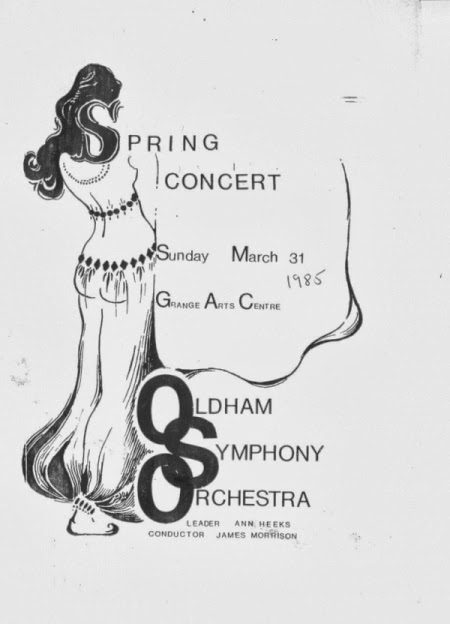
In 1963, a young man from Oldham decided that the town needed an orchestra, so that local musicians and the public had the opportunity to play and hear challenging, interesting music. Oldham had been without an orchestra for more than twenty years after its orchestra disbanded during the war, never to reform, but 23-year-old clarinettist Tom Whittaker, then working for his family's long-established construction and joinery business in Oldham and travelling to play in an orchestra in Slaithwaite, West Yorkshire in his spare time, felt that it was an essential part of the cultural life of a town the size of Oldham, alongside theatres, cinemas, art galleries, choirs and amateur dramatic societies. And so Oldham Amateur Orchestra was born, recruiting an initial group of around fifteen local musicians to play concerts in schools, public halls and arts centres and growing from there. Fittingly, the orchestra started out with a programme that included Spitfire Prelude and Fugue by one of its patrons, the distinguished Oldham-born and bred composer William Walton.

Founder member Tom spent the next four decades on the committee of the orchestra and, fifty years on, is principal clarinettist, soon to be putting tongue to reed for his 123rd concert with the group (known as Oldham Symphony Orchestra since 1973). The concert, which takes place in the grand surroundings of prestigious Oldham Hulme Grammar School in November, will include a piece which is notoriously difficult for clarinets, George Gershwin's Rhapsody in Blue, a glamorous, slinky, cinematic, jazz-age piece which changes tempo and dashes around as a piano dances a lively, teasing solo. Also on the programme, in complete contrast to bold, brash Rhapsody in Blue, is Gustav Mahler's brooding, slow-burning First symphony. Tom admits that “what's on the stand for the next concert is very tough”, but says: “I think it's wonderful music and it's important not to just play stuff like Eine kleine Nachtmusik. If we were playing Strauss waltzes and Mozart they wouldn't appeal to the orchestra so they wouldn't bother to come to rehearsals.” He elaborates: “We need music that is interesting and stimulating to play. I wouldn't still be playing in the orchestra fifty years later if I hadn't found it to be of great interest and enjoyment.”

Richard Waldock, Oldham Symphony Orchestra's conductor of 11 years, shares Tom's desire to attempt interesting, challenging music. “We don't stay with one particular type of music,” he explains. “We try and choose stuff because it's good.” A double bass player, teacher and composer, Richard has played with the Manchester Camerata as well as other orchestras regionally and nationally including the Halle, Liverpool Philharmonic and BBC Philharmonic, and first tried out his skills as a conductor with his peers while studying at the Royal Northern College of Music. Although he has conducted youth and student orchestras, Oldham Symphony Orchestra was Richard's first regular conducting job. “It's good fun,” he enthuses. “When you're a double bass player you don't get to flex your interpretive muscles very much. There's not much challenging music – no Brahms sonata, nothing by Mozart or Beethoven, so there's not much opportunity to get your teeth into really, really good music and really, really get into the structure and interpretation.” However, he acknowledges that conducting has its challenges, saying: “I know how much conductors are generally hated by performers so there is a need to keep integrity and not get carried away. It's an interesting art and it is hard to keep everyone happy. Sometimes you have got to work a lot with the strings. Sometimes with challenging pieces you have got to really know it inside out or you become a hindrance rather than a help.” On the flip side, he admits: “Sometimes it feels like the easiest thing in the world. After all it's the orchestra who has got to play the music – all I've got to do is wave my arms around.”
Richard also plays in noisy punk bands, and is passionate about trying to attract a wider audience for classical art music. “Classical music doesn't really reach out,” he muses. “It's amazing how much really mind-blowing music there is that most people in the world have no knowledge of at all, and it's a shame that classical art music is a bit of a museum piece. The stronger and more healthy it is the better people will find ways of keeping art music alive, but classical music as an industry is very much in a cul-de-sac of its own making. All the music I liked when I was younger seems so alien from classical orchestral music.” He gives an example: “Orchestras will always have an assistant conductor, who is straight out of college and very academic. Nine times out of ten they are kind of posh and kind of boring. There's no way in a million years they are going to compete with David Bowie or anything in the popular genres – they just aren't interesting enough.”

Richard sees Gershwin as coming from a very similar place to him, believing passionately in crossover, and describes him as “a jazz man who wanted to reach out to the classical world, and did it very effectively”. He explains: “Gershwin was a fantastic pianist who wrote fantastic, incredibly glamorous pieces which seem to straddle both worlds – jazz/music hall and classical concert hall. It's strange that since then there haven't been examples of people trying to do that crossover.”
For Richard, the orchestra is as much for its members as the audience, and is part of a musical education. Richard thinks that it can help both performers and audience gain a better understanding and appreciation of classical music. “One of the problems with classical music is it is on such a big scale,” he explains. “It is attention span-testing. When you play it you get hold of it a lot better and can understand the underlying harmonic structure, which gives it what it does to you. If you just listen to snippets on Classic FM you don't get that at all – if you are playing you expose yourself to it much more.” Richard wanted the orchestra to attempt Stravinsky for ages, a wish which was fulfilled at the most recent summer concert, which included a rendition of The Fairy's Kiss. “Stravinsky was doing things compositionally which people in popular genres started doing later on with samplers,” he argues. “Stravinsky opened a lot of doors for the way modern music is produced, and opened people's ears to the cut and paste style. He was a musical magpie who used lots of different genres.”

Richard is also a big admirer of Mahler, who he describes as a “mind-blowing, absolutely amazing composer”, and rhapsodises about Mahler's First Symphony. “Symphony No 1 really pushed the boundaries in terms of what you can do expressively with an orchestra,” he explains. “He goes through much more expressive acrobatics than what had gone before and uses a huge orchestra with the widest palette of colours and incredible variety. The dynamic range is incredible.” He adds: “Even though Mahler used huge orchestras lots of his most effective moments are very simple and intimately scored, building and building and building to apocalyptically huge endings. Lots of people think of Mahler as being very tortured but Symphony No 1 is quite triumphant and positive. Lots of the tunes are taken from Songs of a Wayfarer, which give you an interesting idea into what he was thinking about when composing and where he was coming from. It's traditionally Viennese with a natural way with melody. It's very engaging melodically and great to play – very complex music but simple at the same time.”

Mahler's Symphony No 1 is also one of orchestra leader Andy Marshall's favourite pieces. Andy, a former leader of Rochdale Youth Orchestra, who has now been playing violin for 29 years, joined the orchestra after attending a concert in 2001 and being impressed by its performance of Carl Orff's Carmina Burana. He took over as leader this summer after the death of Ann Heeks, leader of the orchestra for many years who, together with her musician husband Ken, performed many solos. Ann lost her fight with cancer earlier this year, so Andy is keen to carry on Ann's legacy and see the orchestra grow for the future. “It's great to be a member of an orchestra which tackles challenging works,” he explains, “as this aids the educational aspect of all becoming better players.” He admits: “The Mahler in particular is going to be challenging, but I think its already coming together nicely.”

Today, around half the members of Oldham Symphony Orchestra are drawn from the town, with the rest travelling to rehearsals from the surrounding area including Todmorden, Rochdale, Ashton-under-Lyne and Manchester. The orchestra plays three concerts a year, in Easter, summer and winter, including family concerts aimed at introducing the instruments of the orchestra and inspiring the next generation of musicians. The orchestra also supports young composers and players by performing new compositions and offering opportunities for up-and-coming musicians to perform solos. Many members regard playing with musicians who have gone on to do big things as a highlight of being in the orchestra.

An exhibition at Gallery Oldham celebrating the orchestra's fiftieth birthday, starting in October, will present panels on some of the soloists, players and conductors who have been associated with the orchestra over the decades, alongside a display of musical instruments and other artefacts relating to the orchestra's history. Second violin Ann Jones, the second longest-serving member of the orchestra after Tom Whittaker, who joined in the 1970s after living locally and having her arm twisted by Ann Heeks, has been busy rooting through the orchestra's archives, from concert programmes to newspaper cuttings to old tape recordings. Together with quotes and pictures from current members of the orchestra, the exhibition will give a sense of what the orchestra means to its members. Ann is also going to borrow a bronze statue presented to James Morrison, conductor of nearly thirty years, at his last concert before retirement in 2001. The statue has an important place in the collective memory of the orchestra, Ann reminisces, because “there was a fire alarm but instead of downing tools we carried on playing and then all trooped out and presented the statue in the car park!”
This fighting spirit is typical of the orchestra, which has stayed together for a half a century despite the problems facing amateur orchestras everywhere, from falling audience figures, declining interest in classical music and the cost of staging concerts, to the difficulty of striking a balance between what the orchestra wants to play and what the public wants to hear, the ongoing difficulty of attracting and maintaining members, and the challenges of pulling off difficult pieces of music. But for those in the orchestra, it's a part of life. The orchestra provides a weekly routine, a chance to socialise, to keep up and develop skills, to learn new things. Most importantly, it's a chance to get out for a few hours and play a small part in making one giant, collective noise. As Richard Waldock sums up: “It's important for people to be able to have these things.” And Tom Whittaker: “We have made a moderately good job of most things and I have found it to be a tremendously good hobby.”
Fifty Years of Oldham Symphony Orchestra is at Gallery Oldham from Saturday October 26 2013-Saturday January 4 2014. 
Oldham Golden Anniversary Concert takes place at Oldham Hulme Grammar School on Saturday November 16 at 7.30pm, featuring soloist David Daniels. Tickets cost £10/6/3.

Oldham Symphony Orchestra practises at Turf Lane Lifelong Learning Centre, Chadderton, Oldham, from 7.30pm-9.30pm each Monday evening during term time. For more information about current vacancies and concerts visit www.oldhamsymphonyorchestra.org.uk.

Sort of related: I really enjoyed this recent Guardian article by Stuart Maconie about classical music and Manchester's radical music tradition.

Friday, 12 July 2013

“The beauty is in the possibility”: Jen Wu's 'The Wall'

Halfway up Chapel Street, a busy car, bus and pedestrian route which links the city of Salford with Manchester city centre, a motley assortment of old buildings punctuate empty stretches of rubble and high fencing, a familiar sight in many post-industrial cities. The bricked-up pubs, burnt-out office buildings and an old theatre covered with 'danger' signs are suggestive of a time when the street was a busy shopping hub, before abandonment was forced by the area's subsequent decline. With details like bell towers, faded signs and curved frontages these buildings capture the imagination, standing out in a landscape dominated by vacant sites and new-build apartment blocks (so much so that it is possible to buy postcards featuring unconventional landmarks such as the derelict Old Nelson pub from Salford Museum and Art Gallery up the road, hoardings and all). Appreciating these buildings aesthetically, though, is ignoring the inevitable: Chapel Street is due to be transformed with extensive residential and commercial development over the next few years, aimed at attracting new residents into the area. Many of the existing buildings will be demolished.
As the demolition crews finally move in this summer, it is hoped that one wall from the Old Bank building, which was used as a community theatre in the 1950s and 1960s, will remain standing as a readymade sculptural artwork, a 'barometer' which will remain constant as the area changes around it. Working with bricklayers and structural engineers, artist Jen Wu will stabilise the wall before inviting the local community, which ranges from tower block tenants and artists to 'young professionals' resident in newer flats, to take part in dismantling and then moving and rebuilding the wall in an act of 'creative DIY', soundtracked by free and open 'demolition' and 'reconstruction' rave parties. For Jen, who has a background curating projects in London such as transforming major art gallery the ICA into a nightclub, the focus of the project is not just on demolition, but on action, creating a cycle of activity that will help bring people together to celebrate the past at the same time as looking to the future and channelling the DIY spirit which drives places such as nearby arts venue Islington Mill.

At least that's the idea. Jen conceived the work in collaboration with Islington Mill directors Bill Campbell and Maurice Carlin in early 2012, and in December started discussions with English Cities Fund and Urban Vision, which is responsible for overseeing the regeneration of the area. She says the regeneration firms “took a leap of faith” in supporting her ideas, seeing the project as a positive way of empowering and involving local people in the changes taking place their immediate environment. The buildings were due to come down in February 2013, but demolition was delayed – and then around May time the council started to get cold feet due to health and safety concerns and the changes it would entail to the original demolition contract. Now the fences have gone up and demolition is imminent, meaning Jen faces a race against time. She has been meeting with Salford City Council and Bagnall, the demolition contractor, to find a solution so that the events can take place in September rather than July as originally planned, but the future of The Wall is still uncertain; the latest news is that it looks like Bagnall will have to take down the wall and save Jen the bricks, meaning the community action will be just the reconstruction. Jen says:“A compromise, but at least it can still happen!”
Jen's interest in the process of demolition initially grew out of a three-month residency at the Chinese Arts Centre in Manchester which started late in 2011, where she researched the history of Manchester's former musical landmarks which have been demolished, such as the Hacienda nightclub (now rebuilt as apartments – Jen “kept wondering why I couldn't recognise it – it's depressing”) and the notorious Hulme Crescents, which were once the venue for famous parties. She also went out on Manchester's club scene and met those suffused with DIY energy in Manchester today, from Unity Radio and Islington Mill to Kraak space and the Volkov Commanders, finding that “there is something real about it. It's not like it's just setting itself up as an alternative”. Jen became interested in the ways in which spaces where people used to come together, such as nightclubs, have been destroyed and started to explore narratives of regeneration, demolition and starting over again. She documented the demolition of buildings such as the former seaman's mission and Salvation Army centre Stella Maris, which stood just behind Chapel Street next to Islington Mill, becoming interested in both the material process of demolition and the communal psyche of what the building meant to its former users. Despite both Islington Mill and Manchester Modernist Society proposing future uses for the building, which once boasted facilities such as a sprung dance floor, the council was insistent on its demolition, and it is now used as a storage space for building work in the area. Jen made a film about the demolition which was shown at suitably avant-noise band Gnod's Gesamtkunstwerk night at Islington Mill, and Gnod will reciprocate by playing at the parties accompanying The Wall events, closing the circle of Jen's convergent interests in rave and regeneration.

By holding rave parties, Jen hopes to resurrect the spirit of rave in a positive way, bringing together some of the protagonists of the 1980s rave scene in Manchester with musicians who are influenced by their music today and connecting them with the creativity and energy flourishing in Salford now. The Wall is also an opportunity for people to reconnect with the materiality of what's around them, and appreciate the solid sturdiness of brick in a city which is, after all, built predominantly of the material. Jen explains: “Everything is so virtual now, but if you help to take down a wall and rebuild a wall you are contributing to something longer-lasting. People will be able to walk past and say 'I built that'. It doesn't take specialist skills or support any ideology.” Jen has met with representatives from community newspaper M3, and the local residents' association, to gauge interest in the project, and it is hoped that the wall, rebuilt nearby, may then become the starting point of something new, such as a community centre (in an interesting parallel, one local resident was involved in a similar project to save a wall in an old aircraft hangar, which contained a half-finished wartime mural, interrupted by its artist being called up to fight, and succeeded in moving the wall to a museum).

The parameters of The Wall are constantly shifting, and the development of the area is gathering pace. As Jen says, “It's extraordinary what's been happening. Every day something new is there or something is no longer there.” Sometimes The Wall seems impossible to realise, but Jen sees Manchester as an ideal space to try things out and doesn't think The Wall could take place anywhere else. She has now been in Manchester far beyond her original residency period, doggedly trying to see the project through. She explains: “I just want to do something truthful and that I can stand behind as an artist. I didn't give up, because it could happen. Because I got a glimpse of it happening I had to carry it through. So many people said yes and got excited that I couldn't go back.” Jen has convinced those around her of the beauty to be found in a brick wall, and The Wall still exists as a possibility, just in reach of being realised. As she says: “The beauty is in the possibility. I'm always optimistic. If I'm not then who's going to be?”

For the latest news on The Wall keep an eye on www.islingtonmill.com/visual-arts-events.php.

Jen is hosting a 'supper' at Islington Mill on Saturday 13 July from 6-9pm. She will be talking about The Wall for around 45 minutes, then use the rest of the time to get feedback from people about how to re-think the work. For more information visit www.facebook.com/events/467844653307944.

Wednesday, 8 May 2013

Shrieking Violet talk in Bradford, Tuesday 14 May, 6pm followed by DIY discussion with Black Dogs

I've been invited to repeat my talk about the Shrieking Violet during Bradford Zine Week (Monday 13-Sunday 19 May) at the Bradford Baked Zines Pop Up shop, 13 Market Street, as part of a series talks, events and workshops.

The talk will take place on Tuesday 14 May between 6pm and 6.30pm, and will be followed by a discussion on DIY culture featuring other self-publishers, including locally-based artists' collective Black Dogs, whose work I am a big fan of, from 6.30pm-7.30pm.

Monday, 22 April 2013

Interview with Castles Built in Sand, directors of Helpyourself Manchester (screening at Victoria Baths on Sunday May 5)

Helpyourself Manchester, a recent film telling the story of Manchester’s unsung DIY music promoters, will be screening at this year's Victoria Baths Fanzine Fair (Sunday May 5), accompanied by an exhibition of original fliers from gigs featured in the film. The documentary focuses on a group of friends who found new and creative means of organising and promoting gigs in the mid- to late years of the previous decade, featuring bands such as Burnst, Cat on Form, the Enablers and McWat. From living rooms to basements, the promoters shown in the film put exciting and unheard bands on not for financial reward, but because they loved the music. The film, which makes uses of animation, photography, interviews and archive footage in a cut-and-paste style appropriate to the subject matter, is the work of Castles Built in Sand, a Manchester-based documentary film collective working on a DIY, not-for-profit and copyleft basis. The Shrieking Violet spoke to Castles Built in Sand to find out more about how they formed as a group and their collaborative approach to film-making.

SV: Tell me a bit about Castles Built in Sand – who are you and how did you come together as a collective? 

CBIS: We are a group of visual anthropologists, artists and musicians. Paddy, Huw, Insa, Yas and Birgitta met through their studies (some of us did an MA of Visual Anthropology at the University of Manchester). Simon joined us later.

SV: Why did you decide to start a film-making collective? 

CBIS: After our graduation we all wanted to continue making films and to improve our skills. That's why we decided to start working together as a collective – to share skills, equipment and to motivate each other.

SV: You've also collaborated with some of the participants in your films. What do you gain from working collaboratively, both within the collective and with other groups of people such as interviewees, that you don't get working alone? 

CBIS: Working collaboratively allows us to gain different perspectives on the topics we are working on. It also ensures that everyone feels engaged and represented. This is especially important for us in regards to the people we are working with. We want to ensure they feel like they had a say and are portrayed in a way that leaves them empowered. Filmmaking for us is a mutual process, a give and take and learning from each other.

SV: How does the filmmaking process work – how do you set the theme and direction of where your projects are going? Is every project a joint project, or are there some films where certain people take the lead based on their interests or choose to adopt a lesser role?

CBIS: If we work on a project together there is a lot of discussion involved. We are never quite sure what exactly a project will end up as, because of the collaborative approach, everyone has an input which means a project can change quite a bit in the process of making. For our next project we are going to define our roles a bit more, which will be an interesting new approach for us.

However, we are also not always all working together on a project. Sometimes some of us decide not to be engaged in a project due to time constraints or varying interests or because it doesn't make sense to have too many people involved.

SV: How do you choose your subjects? Is there anything that ties all your projects together, either thematically or in the approach taken to filmmaking? 

CBIS: Our projects are not necessary linked in any way, we choose them according to what we are interested in or think is an important topic to portray.

SV: How did Helpyourself Manchester come about? What's your involvement with that scene, why did the film need to be made and why make the film now – in retrospect? 

CBIS: The idea to make a film about Helpyourself Manchester and this part of Manchester's DIY scene came out of conversations Paddy had with Lee, one of our friends who was involved with Helpyourself Manchester. Huw was around for the last few gigs, whereas Insa and Paddy came to Manchester in 2009, a few years after Helpyourself. We wanted to look at the way people had used space in Manchester to organise culture outside of the mainstream. With all the government cuts and the current debates about gentrification it seemed like a topic that is actually quite timeless and important to discuss.

SV: How did you go about making the film and how long did it take? 

CBIS: From start to finish it took us about one and a half years to complete the film. We collected material on the way, interviewed our friends and tried to get as much info as possible. Then we edited separate sequences which we thought should be in the film and which we joined up eventually. Once we had a first watchable version of the fllm (which at the time was about two hours long) we showed it to the people who we had filmed and to friends who hadn't heard about Helpyourself Manchester before. These sessions provided us with a lot of different opinions as to what would work and what wouldn't and suggestions for changes. In the end we cut the film down to 54 minutes.

SV: Your projects seem to have a political dimension running through them to do with power, voice and representation. Do you consciously try to make films from that perspective?

CBIS: It's less a conscious choice to make films which might be considered political, but it rather comes out of our interests and ways of looking at the things going on around us. So it happens naturally rather than us trying to provide a political stance.

SV: Whether focusing on DIY promoters, the residents of a temporary care home, protestors or young people affected by cuts to education, your films quite often depict the type of subjects and people that might not normally have a film made about them. What do the subjects get out of being part of the filmmaking process – and what do we get out of it as viewers? 

CBIS: It is important to show what wouldn't be shown otherwise and to make people conscious of what is going on around them. Film, photography and sound are powerful tools which offer people outside the media focus a way to express themselves. The collaborative way in which we are working hopefully leaves the people we are working with with a feeling of actually having had a possibility to say what they wanted to say.

SV: You've collaborated with bands like Levenshulme Bicycle Orchestra and Tubers in the past; can you explain the importance of sound in your work?

CBIS: Sound lets us see things differently. When the sound is good, the images seem more powerful and engaging.

SV: There is also a really strong sense of place in your films. How would you describe your approach to representing and describing place? 

CBIS: We try to engage with the place or space we portray – you could almost say we let it speak to us. Using different media is very important for this approach. We don't confine ourselves to one medium but use whatever medium we think best conveys a sense of the place. That's where sound is also very important – if we listen we discover different aspects of what contributes to our notion of a place.

SV: Your webpage has quite a few texts as well as films, which seem to stand together – what is the relationship between the texts and the films, and do you find it to be a useful process to write about the processes of making and conceiving films?

CBIS: What we tend to forget is that each medium has its own qualities and its own place in the context of representing a topic. We try to use different methods and media depending on their usefulness to portray a topic as complete and from as many perspectives as possible. Film can't express or explain everything but it gives a good sense of place and people's personalities. Sound lets us experience place from another standpoint. And texts can help us putting everything into a greater context or to deconstruct the images we present. It is important to question different methods of representation and using mixed media allows us to bear the construction of these representations in mind.

SV: What are you working on at the moment and what are you planning to do next? 

CBIS: We have just started working on a trailer for our next project, which will be an apocalyptic photo essay film. This should keep us busy for a while.

SV: Where can people see your work? 

CBIS: We have a blog which we update as regularly as possible. There you can also find a list of upcoming screenings, the next one being Helpyourself Manchester at Victoria Baths on 5 May, as part of the Victoria Baths Fanzine Fair (12-14pm).

Helpyourself Manchester trailer:

.

Sunday, 1 July 2012

House gig: Trust Fund, Two White Cranes and Ratfangs, Saturday July 7

Clock Flavour and the Shrieking Violet present:

TRUST FUND (Bristol)

Melancholic yet anthemic electronica – like a bedroom disco for one.
http://trustfund.bandcamp.com

TWO WHITE CRANES (Bristol)

Dreamy folk-pop: wistful melodies and a battered guitar.
http://twowhitecranes.bandcamp.com

RATFANGS (Manchester)

'Manchester's answer to Ariel Pink'...genre roulette for people with hefty attention spans. http://ratfangs.blogspot.co.uk

Saturday July 7
7.45pm Chapeltown Street
Entry by donation 

For more information visit: http://clockflavour.tumblr.com
http://tinyurl.com/clockflavour

Facebook event: www.facebook.com/events/425386704149803

For directions email housegig@dogzilla.co.uk

Poster by Elizabeth Murray Jones

The Shrieking Violet made a guest appearance on Liam Astley (one half of Clock Flavour)'s great monthly podcast Deadbeat Escapement, which plays one song from each of the past ten decades each episode. I picked my favourite tracks from the 1940s, 1950s, and1980s, and one from this decade, and we talked about the gig among other things. Download it here.

Friday, 1 June 2012

Three zines and two films from the Victoria Baths Fanzine Convention

Thanks to everyone who came another packed and inspiring Victoria Baths Fanzine Convention and browsed and bought fanzines, talked to self-publishers about their work, watched the film, came to the talks and asked questions, studied Melanie Maddison's poster exhibition, made pages for the giant Victoria Baths fanzine and helped sell out Deerly Beloved Bakery's stall of vegan delights!
Visitors and self-publishers of all ages came from all over the country, showing the diversity of the publications encompassed by the term: from an artist's book responding to oranges to poetry and avant garde objects, from a new, alternative guide to Manchester to a zine inspired by growing up in crap towns. One zine named after a cat called Elvis got on the train all by itself at Newcastle and was picked up at the other end in Manchester!

Watch Wild Bees Productions' short film, made throughout the Fanzine Convention, which sums up the day beautifully:


A number of new zines were made on the day, including a giant, collaborative Victoria Baths fanzine compiled by visitors who took part in lino cutting/relief printing, button book binding and collaging workshops in the former superintendent's flat.

Visitors dived into the history of the building and were inspired by its beautiful decorative tiles and stained glass windows, as well as their own feelings about swimming, to each produce a page for the finished zine, which was stitched together at the end of the day.
 
Photocopied images and memories from the Victoria Baths archive were available to cut and paste. Swimmers associated with the building, such as members of the South Manchester swimming club and channel swimmer Sunny Lowry, who trained at the baths, feature highly, along with old-fashioned signs!


View the Victoria Baths fanzine below as a PDF:

Open publication - Free publishing - More archive

Ten year old Louis D. Rogers from South Yorkshire wrote 5 Futuristic Machines, a zine about 'a future space war, but written in the past tense as a history book'. The zine was duplicated using Footprint Workers' Co-operative's risograph machine which had made the journey over from Leeds for the day. The risograph looked like it would be defeated by the stairs, but made it up to the balcony with the help of four strong Future Everything volunteers! Merrick from Footprint demonstrated how the risograph works:

Read 5 Futuristic Machines online:

Open publication - Free publishing - More fanzines

Meanwhile, feminist duo Vapid Kitten invited visitors to help make a special edition of the zine at their stall around the balcony area, in a workshop entitled Vapid in a Day!

Contributors on the day were joined by international contributors, who sent their work in via email. View the finished PDF at:

Open publication - Free publishing - More kitten

Elsewhere at the Convention, visitors found out more about self-publishers and their motivations with a screening of Salford Zine Library's 2011 film Self-Publishers of the World Take Over in the former committee room.
Orla Foster and Peter Martin, formerly of Rotherham Zine Library, talked about their new publications inspired by found material and their Closed Caption project.
PhD researcher and writer David Wilkinson brought back memories for Mancunians of a certain age with his talk on post-punk countercultural publication City Fun. He described how publications like City Fun and record labels like New Hormones were "very much the more politicised yet actually more lighthearted underdog to Factory Records in post-punk Manchester".

David started his talk by playing New Hormones band Ludus's brilliantly catchy pop song Breaking the Rules, which he feels epitomises the spirit of City Fun as being
"political yet whimsical, and outsider yet collectivist...the perfect song to accompany a talk about co-operation and an irreverent, amusing, politicised post-punk fanzine run by two gay women". Linder Sterling from Ludus was managed by City Fun's Liz Naylor and Cath Carroll (as Crone Management) and also designed some covers for City Fun.

Later, Cazz Blase, music reviews editor of Shrieking Violet favourite The F-Word, talked about the significance of zines to the punk and riot grrrl movements.
Visitors flocked to Melanie Maddison's poster exhibition around the balcony of the female pool, comprising 80 posters of inspirational European women taken from the zine Shape & Situate, including some of the makers of the posters!
Technology enthusiasts and zine-makers Chris Watson and Logan Holmes from Sheffield's Shift Space collective piloted the use of an augmented reality app which allowed people to explore the local area and point their smartphones at the building to receive visual and audio content, for example visitors could view how the baths looked in the past, in the exact spot where they were standing, just by holding their phone at eye level.


More photos from the day:

Friday, 23 March 2012

Have zines, will travel: Caribou caravan at Victoria Baths Fanzine Convention


Visitors to the Victoria Baths Fanzine Convention in May will be able to step inside one of the country's more unusual zine stores – a zine shop inside a vintage caravan, which will be pulling up outside Victoria Baths for the day.

Nottingham-based artist and zine-maker Annie Atkinson set up Caribou in 2011 as a shop and gallery inside a small vintage caravan to showcase and sell the work of artists, writers and musicians working with an independent and DIY ethic. Annie makes the zine Flick my Ankle, as well as other mini-zine boxes such as Ultra Horse Fags and an ET mini-comic box.

Annie was originally going to open a bookshop in Nottingham selling unique art books, zines and furniture but decided to scale down the project and go back down to an idea she'd had a few years before of opening a teashop in a caravan. She explains: “I saw some other people in Canada, Australia and America were doing a similar thing and I thought it’s okay to do it now, because if there are others doing it then I’m not completely insane…so instead of a teashop it’s become a travelling art shop! But the potential for tea will never die.”

The caravan was acquired after a long hunt. Annie admits: “I wish it was a romantic story but I bought the caravan from a man on Gumtree! I had been looking for ages for the perfect one and this one came along and so we drove across the country to get it.”

Caribou is filled with artists' work, records, found mix tapes and a ‘listening booth’ in the form of a Fisher Price tape player. Annie also has an illustration photo booth, where visitors can sit and, instead of having their picture taken, have a picture of their face hand drawn by Annie. The caravan is kitted out to incorporate seating when the shelves are folded away, so there is room to do small workshops and activities such as zine-making. As well as stocking fanzines, hand made books, cards, jewellery, mix tapes, records, prints and ceramics, Annie sells reconditioned typewriters that she has lovingly repainted.

Among the more unusual items are flexagons: small, illustrated paper pieces that fold in on themselves three times to reveal different images. Annie says: “No-one seems to really get them! I have one with the characters of the Royal Tenenbaums, with different hairstyles in each folded image. You have to see it really to understand what I mean. Come into the caravan and you’ll see!” Annie's best seller is the Plastic Knife series comprising zines sent from Australia which come with a plastic knife stuck to the front cover. Annie says: “People go wild for them!” Japanese cut and paste zine Kosho Kosho, where the reader can cut out and make things like an illustrated paper iPhone, is also popular. Other big sellers are moustache teacups Annie paints herself.

The caravan was based inside Hopkinson Gallery in Nottingham until February, and since then it has been to various locations around Nottingham, including North Sherwood Street on Sundays, where it is open to passers by. Annie says: “We’re hoping to take it to more places around the UK, and then hopefully conquer Europe (in a non war sense)!”

Annie describes the experience of running Caribou as “immense”. She says: “People have got in touch from all over the world wanting to sell things in the shop, help out with volunteering and get involved in other ways. I’ve been invited to do talks about the zines at writers' clubs, and I’ve been invited to book festivals and events. It’s been really great and I hope it continues to get people excited!”

Visit Annie's blog at http://caricaribou.tumblr.com.

Step inside Caribou caravan at the Victoria Baths Fanzine Convention, Hathersage Road, Manchester, Saturday May 19 between 10am and 5pm.

Thursday, 21 October 2010

$100 & A T-Shirt — A Documentary about Zines in the Northwest US

A few years ago, a documentary was made about the Portland Zine Symposium, which takes place in Portland, Oregon, every year. As well as showing footage of the event, including a seminar conducted by Calvin Johnson, the film compiles interviews with zine makers from the city’s Independent Publishing Resource Centre, covering such fundamental questions as ‘What is a zine’, and concluding ‘zines are a visual medium we should try our hardest to make them look good’, ‘Who makes zines’ (’99% of us are all nerds’), ‘Why make zines’ not to make profit, but to have fun, educate and ‘alter people‘s perceptions', ‘How do you make zines?’ — something to have in the back of your mind is that ‘everything needs to be a multiple of four’, ‘Where have zines taken us and what’s next’ and, perhaps most importantly of all, ‘Why do people spend all their time in front of Xerox machines?’.

It’s a thorough introduction to zines, suggesting their spirit goes as far back as Martin Luther nailing his words to a church door, and can be identified in publications as diverse as the pamphlets of Thomas Paine, publications from the Labor movement, satirical magazine the Realist, the poetry anthologies of the Beats, and the punk and Riot Grrrl movements, when women made zines in their ‘hundreds and hundreds’.

The interviewees leaf through a zine library, picking out their favourite zines or the strangest, which range from the niche zines about collecting shoes and a publication about substitute teachers to the practical from a pamphlet dedicated to fonts to feminist zines offering advice on rape, sexual assault, the law, where to go for abortion advice and insight into mental health problems and the downright grotesque a zine about ‘the use of bodily fluids for revenge’.

There’s a strong community element, with zine makers sending zines all over in the post and receiving detailed critiques in return. The documentary’s charm is the enthusiasm everyone shows towards what they do, with one participant describing it as a ‘co-dependent relationship I couldn't break up even if I wanted to’ and others concurring ‘You have to find a way to produce it no matter what it takes’ because if you didn’t ‘you’d be standing yelling on street corners’.