Showing posts with label Public transport. Show all posts

Friday, 15 December 2017

Fallowfield Loop damson gin

In the 1960s, Dr Beeching paved the way for the reduction of the British rail network, closing small village stations and branch lines and catalysing the ascendancy of the motorcar as the dominant mode of transport in Britain*.

Some of long-closed lines are now reopening, after decades dormant. Others, their tracks removed permanently and their station buildings now converted into shops and supermarket cafes (as is the case with the former suburban Manchester stations of Levenshulme and Fallowfield), offer cyclists miles of dedicated bike path free from the traffic and aggressive motoring that increasingly chokes our towns and cities.

Manchester’s Fallowfield Loop stretches around eight miles, looping around the south and east of the city. Beginning in inner-city Openshaw in east Manchester and ending in leafy Chorlton in south Manchester, it undulates through the former industrial dormitories of Gorton and Levenshulme, passes picturesque Debdale Reservoir, skirts the boundary of Stockport at Reddish, and cuts through studenty Fallowfield and leafy Whalley Range.
The Loop has the feel of a linear park, offering a backdoor view of the city and its patchwork of official and unofficial green spaces. The Loop itself is an underacknowledged green space. In spring and summer it’s overgrown with branches forming a green tunnel, although in autumn the slipperiness of the accumulated layers of leaves can be treacherous. In winter, the foliage drops right back to reveal numerous back gardens, allotments, recreation grounds, school playing fields, overgrown brownfield sites and industrial land reclaimed as country parks. It links up with other traffic-free routes, too, from the Ashton Canal, with its miles of recently resurfaced towpath, to former branch canals such as the Stockport canal.
The Fallowfield Loop has become a place of community activism and communal litter-picks. It’s also a place of memorial, to young people who have killed themselves. Recently, it’s become a site of protest, with large EU flags unfurled unmissably from road and railway bridges; when removed, they reappear again soon afterwards, imported en masse from China. Pro-EU graffiti sprayed along the path places the UK at the heart of the EU, and the Manchester bee motif is placed centrally within the circle of stars that represent the EU member states; it’s a reminder that Manchester, along with the neighbouring local authorities of Stockport and Trafford, which the Loop passes close-by, voted remain in the EU referendum, in common with several other northern cities. It’s also a place for creativity, from street art murals celebrating the city’s architecture, to hand-written personal declarations (and accusations – ‘Louis K has a tiny penis’). It’s a place to encounter culture, from bicycle theatre troupes offering outdoor Shakespeare performances to public artworks sponsored by the cycle charity Sustrans, which document and draw attention to the flora and fauna of the route. It’s a place of learning and instruction, for small children to gain confidence and practise their bike skills away from the road. It’s also a place for family time: on father’s day, it’s noticeable how the number of men with small children increases.
Not all is benign – once or twice a year the ambush of women or opportunistic robberies make the deadlines, and mounted police undertake regular patrols. However, generally it’s a place of conviviality and sharing: if a cyclist stops at the side of the path, the next to pass will stop to see if all’s okay, and offer help fixing a chain or a spare inner tube.

Although cyclists benefit the most from a safe cycling environment uninterrupted by the frequent stops and starts of traffic lights, the Fallowfield Loop is also well-used by walkers, joggers, dogwalkers, students, and schoolchildren on their way to and from school, as well as shoppers just getting from A to B. It’s a meeting place, too, particularly for groups of teenagers.
These looplines are also fruitful places for the urban forager. Depending on the season, edible mushrooms, horseradish, strawberries, raspberries, cherries, plums, damsons, sloes and apples can all be found along the Loop, whilst in late-summer individuals and groups of people of all ages gather with an assortment of receptacles, from large yoghurt tubs to seaside buckets, Tupperware tubs and carrier bags, to gather blackberries, and offer hints on the best spots.

This year’s damsons were picked along the Fallowfield Loop, in a year that was unusually fallow for apples, yet plums and damsons of varying hues were in abundance.

* For a more detailed account of cuts to train services in Manchester see https://mancunian1001.wordpress.com/2013/03/26/the-reshaping-of-our-railways-1-before-beeching.

Monday, 6 April 2015

'Doing the Longsight dash': Manchester Left Writers 'Precarious Passages' collaboration on cycling the A6

Last year I started attending the meetings of a new publishing and discussion group called Manchester Left Writers and I recently, finally did my first piece of writing. It's a collaboration with Steve Hanson focused on our experiences of the A6, one of the busiest roads in and out of Manchester and the main link between Manchester and Stockport, as part of a series called 'Precarious Passages'. Precarious Passages act as poetic call and responses between two writers, reflecting on the everyday lived experiences of our times and our cities. I spent about six months thinking about my experiences of the A6, which I cycle down between two and five times a week to and from Manchester (it's pretty central to the way I experience and pass through the city), and compiling my thoughts and observations (some of this is now out-of-date, eg Tesco Metro's been back in action a while now, and the Arcadia's gone). As a result what I wrote (posted in full below) was inevitably far too long and rambling. A heavily edited version appears side by side with Steve Hanson's musings on experiencing the same road on the 192 bus, one of Manchester's major (and notorious) bus routes. The full version, PP002, can be accessed online here. There are also paper copies available, which will eventually be distributed at various points along the A6.

Although the piece might seem slightly negative in tone, I find cycling exhilarating and it's generally the high point of any day, when I feel most alive, and it's also my time for thinking and working things out in my head. I find it to be a very intense experience, both psychologically and physically, but I think it's one that always does me a lot of good. (My entry to the recent #MCRWomenbike competition is at the bottom.)

A6

2015 started, like so many nights have ended in this city, with me dancing by myself on a near-empty dance floor in a night-club where music never got much better than the 1980s. The club faces the furthest platform of the city’s mainline railway station; indeed, it looks likely that the station’s imminent expansion will be the end point of the venue’s years of decline. Past the station runs the A6, London Road, heading out of the city for the south. As it goes beyond edge of the city centre, the A6 becomes Stockport Road, heading for the suburbs, crossing the imperceptible line from Lancashire to Cheshire, passing through the centre of the next large town along, Stockport, then on towards the hills of Cheshire and Derbyshire.

Tell people you live in Stockport and the A6 is your route into town and other cyclists – and drivers – wince. “Rather you than me,” their faces say. “Be careful,” they say to your face, particularly, as tonight, when they realise that you fully intend to cycle home, post-dance at 3am, having weighed it up and decided that cycling is the cheapest, safest, most direct and quickest option (the local rail operator is unofficially known as ‘Northern Fail’).

To leave the city you pass under the Mancunian Way. Manchester is more than a city of mills and textiles, redbrick and the humble terrace. Yes, Manchester is a Victorian city, but it could, it should, be seen as so much more than this. Manchester’s ‘highway in the sky’ won a 1968 Concrete Society Award, commemorated in block, almost Pop, lettering on its own unlikely concrete plaque. It soars over Oxford Road and Upper Brook Street as the bustle of student life goes on below, coming down to land at the heart of UMIST (aka North Campus, once the University of Manchester Institute of Science and Technology). At UMIST, the white-painted labs and towers, complete with subtly abstract murals by the likes of Victor Pasmore, have become grubby through the fumes of arterial roads like the A6, which pass by. Today, these monuments to science, education, industry and technology are static and empty as the university concentrates its resources on the southern campus areas. This is now prime city centre real estate awaiting redevelopment, probably to contribute to the sacred industry in Manchester today: hotels. More hotels. Manchester is becoming a city built on hotels: convert old buildings or flatten. The sweeping, office-like Macdonald hotel on the A6 was once a piece of the communications industry but is now a hotel. The old Twisted Wheel Northern Soul nightclub back down the A6 in the city centre, a modest redbrick, wasn't so lucky.

If the rest goes, the Hollaway Wall, at the London Road end of the A6, is all that will stand of UMIST. Blink and you’ll miss it as you whizz past on wheels. A grubby chunk of jagged concrete wall which has both a sculptural and a functional role as a sound buffer, it’s listed due to its association with modernist sculptor Antony Hollaway, who was innovative in his time but not a household name. This was the future, but it was cut short. The Mancunian Way comes to an abrupt stop just past the threshold of the city centre, a diving board going nowhere. Today, its underpasses provide havens for skaters and the homeless as the city goes on overhead at a different speed.

Then on past Downing Street, a far cry from its London namesake. This is the inner-city. The A6 leads into Ardwick, and a small green patch among the fumes, Ardwick Green, with its erratic boulder, a remnant of an ancient time. Georgian, genteel, tranquil and elegant, the Green and its surrounding streets feel like a lagooned island from a different age. Once, this was the edge of the city’s sprawl and not a triangle caught between a petrol station with a Tesco appended onto the side, derelict industrial buildings, and an insalubrious-looking nightclub.

Past Big Bird, the local Jamaican takeaway van, and Ardwick turns into Longsight, with modern St Luke’s Church standing like a sail on the border between the two. In 2012, conceptual artist Martin Creed tried to herald the start of the London Olympics by getting the entire country ringing with bells for three minutes from 8.12am on a Friday morning. It is fair to say that Manchester did not ring with bells. St Luke’s was the only church in the city to take part, and it turns out St Luke’s doesn’t even possess its own bells. At 8am the vicar reached into a wooden cupboard, pulled out a cassette tape marked ‘Births and marriages’ on one side and ‘Deaths’ on the other, and a portable player was set to blast out the sounds of a dying format and a dwindling institution. A couple of ladies emerged in pink fluffy dressing gowns, venturing onto the front door steps of nearby houses, more confused and affronted than aware they were taking part in what was meant to be a mass, participatory public art project. The non-event was celebrated unofficially with a Twitter hashtag: #noneofthebells. Conceptual art doesn't often venture this far out of town.

Across the road is Sunny Lowry Way, not a street but a passageway leading into an estate, named after a local heroine associated with nearby High Street Baths who swam the channel and taught many schoolchildren to swim. Famous for a training regime of 8-egg omelettes, and press images showing her brawn cutting through the waves, a larger than life personality has been reduced to a high-up sign on a nondescript road. Sunny’s generation would find much of this area unrecognisable. Slum clearance. Moving out to Cheshire. On the left stands Daisy Mill, one of the few reminders of the mills and factories that once dominated the skyline. One hulking mass of a building survives, still hoarding all that land, which the council hopes can soon be knocked down to make room for a new school. There’s a population boom. Manchester is a fast-growing city.

I feel for Sunny. Cycling the A6 feels like a feat of endurance too, at times, a gradual uphill slog. I’m never quite the fastest, overtaken by the hi-vis, year-round shorts wearing brigade. Stickers on buses warn ‘Do not overtake on the left’: hang back, or stick your arm out to pass. Buses have ploughed these roads for years, leaving ridges like black volcanic lava which has melted and set in strange formations. This combines with pot holes, broken glass and hub caps to make it a bumpy ride, with bits of old carpet and abandoned umbrellas, scrunched up like the defensive position of a dead spider, gathering at the side of the road. Other bikes crawl along, black clothes and no lights. Do they have a careless attitude to safety or are they just ignorant? Many glide through the red lights but for me, on this stretch of road, traffic lights provide a welcome respite. A chance to stop, to blow my nose and breathe. You lurch to a stop and wheedle towards the Advance stop line, a dedicated space for cyclists to make themselves seen by positioning themselves ahead of the traffic at junctions: there are supposedly fines for those whose wheel crosses the line. However, it’s something taxi drivers need not observe, exempt, as they are, from all the rules of the road.

A man at the junction has stopped too, buffered from the cold and wind in corduroy, a wool hat and a puffer jacket. He holds up a sign, “Jesus Christ: the same today, yesterday and forever.” Optimism, obliviousness – or sheer blind faith? Past Plymouth Grove, where Elizabeth Gaskell's house once stood at the edge of the city. Where we now walk was once all farms and opposite is the Plymouth Grove pub, once home to a modern-day cannabis farm. It’s next to Grove Village, New Labour’'s flagship PFI, where new homes back right up to the main road. You get the sense that these too were political ideas just passing through.

On the main strip in Longsight, the confetti of city life – the rainbow hues of free advertising inserts for discounters like Asda and nearby Lidl – blows across the pavements, and skitters across the road. Foreign language communications dance with local news, but nobody's paying any attention to any of them. In high winds, a carrier bag blows into my back wheel. I stop and spend a good ten minutes disentangling disintegrating plastic fragments from my greasy chain. A number of shops offer threading and waxing,the beauty industry making money off women's insecurities, but it’s also a place for a spot of shopping for those in the know. Authenticity. “Go to Longsight for the best coriander,” I’m told. They sell it by the bunch. Better than the flat, sad, plasticky leaves sold by the greengrocers or the supermarket down the road. The smell of fresh produce mingles with the dingy street smell of grease and grime, incense mixed in with clay ovens.

The locals use a method of crossing, particularly when emerging from the spaces in between parked cars, or from behind buses, I mentally term the ‘Longsight dash'. It’s practised by those with no time nor energy to walk to the crossing: young men, groups in religious dress, mothers and grandmothers clutching tiny hands in oversized uniforms, and the pushers of prams. We all know the pedestrian code: look both ways before crossing the road. They look. They see you, and decide to cross anyway. The young men in particular have perfected the move: head down, body bent slightly, ready for a dash propelled partly by shame, partly by defiance.

A large sign advertises Elliot's Car, van and helicopter hire. This area is transitory, a place that is passed through by a changing population. As you get into Levenshulme you pass numerous buildings reappropriated as ‘colleges’ offering 'ESOL for a diploma’ and, more importantly ‘ESOL for citizenship', ‘Home Office-approved’. “Welcome to your new job.” An arts and technology college, a school for business, performance and music, in what appears to be a converted pub, for those who don’t know what they want to do but know they that they should do something. At one, above fast-food joint ‘Foodies’, English learning takes place with the pungent smell of onions and what increasingly seems to be the national dish of choice, fried chicken, in the background. Knife and fork cross arms in a defiant gesture with a sticker in each window urging: ‘Don't Cook, Just Eat.’ The local Tesco Metro has been ‘closed for refurbishment’ for some time, though this is the understatement of the year. The roof was rendered a skeleton by fire, and the front was been hidden behind hoardings for several months, meaning the groups of schoolgirls waiting to cross the road in hijabs every morning had to find somewhere else to get their pre-class snack.

Nearby the former Arcadia skating rink, being flattened for a new sports centre and swimming pool, has a hidden claim to fame. The most famous tramp of them all, Charlie Chaplin, may have once attended Bennett Primary School down the road in Ardwick. Chaplin's Wikipedia page neither corroborates nor denies this. It merits no mention – a passage from his life brushed from memory, or urban myth, local wishful thinking? What's certain is that he was drawn back later, to skate at the Arcadia. The site of the suburb's current baths sits opposite Levenshulme Library, incubator for one of Levenshulme’s more famous sons, architect Sir Norman Foster who, too, seems to dwell little on his Mancunian past. He too just passed through. Local to global. Global to local.

The area is seen as up-and-coming now, but many of the shops are still improbably specialist: ‘Snooker & Pool tables and accessories’. Manchester might be seen as a big city to some, but to me it feel like a village. I receive emails from colleagues saying they saw me ‘whizz past’, exchange a fleeting smile with acquaintances, get shouted at from moving cars and say a quick ‘hi’ as friends out walking their dog stop at the traffic lights. But there’s still a near-constant sound of sirens. It’s disorientating as they creep up behind you, sounding like they’re coming at you from all angles. I’ve started to feel like I hear them at all times now, a kind of sensory perception before the even start, like an early warning, a phantom limb. Another sensory overload comes from the party car, pulling up alongside you at the junction with its blacked out windows, emitting the rich, spicy smell of cannabis and hip-hop rhythms over bass-heavy beats. You hope the driver's not high off passive smoking. The lights change. The streamline shape is already straight off the mark, zooming off into the distance, as the cars behind struggle to jerk and splutter back into gear.

As the A6 creeps into suburbia, the road widens, a gradual incline towards those hills in the distance. Victorian house conversions, flat piled on top of flat, thin out into neat, polite 1930s semis for families in cul-de-sacs and back routes, with the odd solid detached. The houses start to retreat further back from the road. No-one is going in or out. They never do. Their lives are lived to the rhythm of commuter jobs – and perhaps they get all their shopping delivered too. The street signs change as you leave Manchester to enter another town. Stockport Road becomes Wellington Road North. But it's the smell that says, more than any municipal road sign: 'You are now in Stockport.' As you pass the McVitie’s factory on the edge of Stockport, industrial strengths and quantities of classic baking ingredients mingle in the most intense olfactory hit of sugar, butter and chocolate chips you'll ever experience. Digestives, the nation's favourite, heightened into a smell that is overpowering and all-pervasive.

The next day I read in the Manchester Evening News that there was a new year’s drama on the Stagecoach bus I’d nearly caught. Held up by a gunman in Longsight. Perhaps it’s better I took the bike after all.

Sunday, 13 April 2014

The Star and Garter: secret history of a nightclub

I can vividly remember the first time I went to a nightclub. I was 18, had recently moved to Manchester and followed the flow of freshers to 'indie' club 5th Avenue, where I had my bum pinched and objected to a lanky youth 'playfully' stealing the hat off my head: not the greatest introduction to going out at night. I can also remember the second time I went to a nightclub, because I went alone, unable to convince fellow students to walk five minutes down the road to the Star and Garter, in the bleak and unprepossessing red light district behind Piccadilly Station. I spent the rest of the evening talking to strangers, engaging in what I probably thought at the time were deep conversations about things like the influence of Albert Camus' The Outsider on 'Killing an Arab' by the Cure.

At the Star and Garter's flagship night Smile, billed as the longest-running indie night in Manchester, I realised for the first time that other people of my age liked the same kind of music as me – and what's more, that it was actually possible to dance to this kind of music (or in my case, shuffle awkwardly whilst staring at the floor and/or jump clumsily up and down to more energetic songs). As a club for people like me, who might not otherwise go out, it's been sad to see the venue gradually wind down Smile after the night celebrated its twentieth birthday last year, with the long-term future of the building looking uncertain. Proposals to add a platform to the east of Piccadilly Station as part of the Northern Hub scheme – construction is due to start in 2016 – would see trains pass window-rattlingly close to the already ramshackle Victorian building, leaving its future as a club unviable. Although several different proposals have been put forward for the distinctive triangular building's place in the development, from relocation (urban legend has it that the building was already moved once, in the mid-nineteenth century, although the council disputes this), to rebuilding, to extending the station around it, none seem feasible in the long-term. As current licensee and upstairs resident Andy Martin says: “You can't hide us behind a station and expect to have passing trade. It will either fall down or be out of business within a year of the platform opening – and if it closes Wetherspoon or another chain will take it over (although no big business in their right mind would).”

Andy, a former computer game reviewer, grew up under the influence of bands like the Smiths in Blackley, on the northern fringes of the city, surrounded by his siblings' record collections. Like mine, his first memories of Smile conjure the joy that comes from realising that there are other people who feel the same way as you about the songs that have soundtracked your life. “There was a circle of us all jumping up and down to 'Teenage Kicks',” he reminisces. “I'd never had that in a club before – a load of people who didn't know each other just loving a song. We all shook hands at the end. It was very polite.” However, he also admits that, like any other club, its basic function is the same: “It's a meat market. You go out and notice people and the guys wear cheap aftershave.” He observes that the traditional pub layout of the Star and Garter, with seating downstairs and a function room upstairs, helps facilitate this: “A massive USP is the club being on two floors. You can go upstairs in a darkened room and dance around and come downstairs with whoever you've pulled and realise you've made a massive mistake and go upstairs again.” The only difference to other clubs is the clientele. “We attract intelligent people here,” says Andy. “People who are now GPs, archaeologists, psychologists and who work for the CPS. I've helped every single one of them into a taxi. Thick people stick out here like a sore thumb.”

Andy's involvement with the Star and Garter initially came about through another cult band, Nigel Blackwell's Half Man Half Biscuit, following a gig at long-departed Manchester venue the Boardwalk in 1996, where he got talking to the band's manager, a “cantankerous old Scouser” selling t-shirts. To cut a long story short, Andy “fluked it with Half Man Half Biscuit” and ended up putting the band on the following year. A friend had heard good things about the Star and Garter, which could be hired out for £50, and the gig attracted a gaggle of “forty-something-year-old men forming mosh pits”.

Andy later started working behind the bar and, when the Star and Garter's owner started looking for someone else to run the pub, Andy and sound engineer Dermot O'Dea took it over. Andy made a few changes such as extending the opening hours of Smile, replacing skittering vinyl with CDs, employing long-running DJ Andy Woods and hosting one-offs such as album launches; previously, says Andy, “every night was like a Manic Street Preachers fan night – City Life said it was like gatecrashing a house party, just playing songs to mates”. Then followed the “halcyon days” of Smile, when the NME made it club of the week, there were queues around the block by 9.30pm and the club got so crowded that Andy had to operate a one-in-one-out policy. “Our USP has always been that we're off the beaten track,” says Andy. “There's no passing trade so it's an effort to make it. You have to know what you are going for and what night is on. You don't go for the massive selection of craft ales at the bar or the cocktail list – you go because you like the Smiths or the band playing.”

However, the Star and Garter has always been far more than just Smile. It's had its own line in nights dedicated solely to one artist – from the Belle and Sebastian disco started by Roxanne, who later moved to Glasgow and now plays in Veronica Falls, to evenings dedicated to Depeche Mode and Pixies. Most famous is the Smiths night, which has now been going for twenty years and attracts everyone from teens to hardcore fans in their sixties.

The Star and Garter has also been a place for unsigned bands to get onto lineups with more established punk and metal bands. It's been a stepping stone, too, for several bands who now sell out far bigger venues, from hosting Low twice in the 1990s – where everyone sat down – to Jeffrey Lewis. Even Status Quo played there in 1999, after the venue was shortlisted for their Under the Influence tour. “It was the most surreal experience of my life,” recalls Andy. “150 people dancing to the Quo – it was like something out of a Michael Jackson video. And I had to record United versus Juventus for Parfitt and Rossi while they played.” A similarly surreal experience was heavy rock band ArnoCorps' 2012 gig, where 150 fans arrived dressed as Arnold Schwarzenegger. “It was like really good Smile party – everyone happy,” remembers Andy.

The Star and Garter has also acted as a showcase for local musicians and comedians, including at an open mic run by Akoustik Anarkhy which was attended by Manchester luminaries such as Badly Drawn Boy, the Longcut and Nine Black Alps. Andy remembers it as “glorified karaoke without the words on the screen and just mates doing cover versions on guitar” – including Andy's own renditions of Half Man Half Biscuit songs. Another night, Anti-Hoot, played host to unknown comics as well as fondly-remembered Bolton poet Hovis Presley. A poster paying tribute to Presley, who died prematurely in 2005, now hangs on the wall, featuring excepts from his wryly romantic poem 'I Rely On You', which pops up as a reading in local wedding services.


Pre-social media, the Star and Garter also functioned as a meeting place for unlikely special interest groups, from holding Anti-Nazi League meetings in the 1980s, to accommodating the 30-strong West Bromwich Albion supporters' club of Manchester, to hosting a PSV and HGV drivers' club which “used to show slides of 1950s buses to a ripple of applause”. With its haunted house looks, the Star and Garter must have provided a particularly fitting venue for the Vampire Society, whose members sat and read excerpts of Dracula. Most recently, the venue hosted Smiler, a spin-off group from the Rod Stewart fan club, with special guest Don Stewart (brother of Rod) making an appearance. And he's not the only person with a claim to fame to have visited. Andy has a special Smile poster signed by Pete Shelley of the Buzzcocks as well as members of Half Man Half Biscuit, TV stars and, most obscurely, people who made music for vintage computer games.

The Star and Garter has also itself been a screen star. Although it's purported, probably incorrectly, to have featured in Manchester film noir classic Hell is A City, it has definitely appeared in Cracker and the Body Farm as well providing as the locale for a John Simm fight scene in Prey and a murder in Prime Suspect. Unfortunately, though, its seedy location could well be the Star and Garter's downfall. Big plans have been proposed for decades for this area, hemmed in by a train station, a taxi rank, a major bus route into the city and a collection of forbidding, slime-ridden railway viaducts, from the Whitehall of the North to an inter-city hub at derelict Mayfield station to an urban park. None have yet materialised, although Andy says, “there's nothing wrong with the area other than that it's never been invested in”. The Grade II listed status of the building, too, doesn't help, with the building suffering from damp and work needed on the roof yet no grants for like-for-like building work forthcoming. But it's part of the fabric of the area, and Andy's picked up snippets of information about its history and former inhabitants over the years, from its first licensee, a Miss Wetherspoon, to being a hotel with its own living quarters and dumb waiter, to housing a brewery and, later, a “trainee MASH type place for the home guard during the war”.

The Star and Garter's recent decline has coincided with the ascendancy of other areas of the city such as the Northern Quarter. Part of the problem, says Andy, is that Smile's audience has grown up – and “the new generation suddenly got hit by a massive choice of places to go, so Smile became a fallback”. Andy explains: “When we first started there was the Night & Day, us and the Roadhouse – we were the small venues. Then the council threw a load of money at the Northern Quarter and every Tom, Dick and Harry started opening a bar. It was even mentioned on the news.”

In the meantime, as both the Northern Hub and, further down the line, HS2 loom over its future, the Star and Garter soldiers on, continuing to host regular "cheap and cheerful" punk gigs. Alternative karaoke night Guts for Garters is proving popular, along with new music showcase and indie-pop disco Light it Up (Saturday May 10), '90s nights A Different Class and This is Uncool, queer party Bollox (Friday April 18) and guilty pleasures rock night Party Hard (Saturday May 3). Other upcoming events include a fundraiser by online Morrissey fanclub the Mozarmy (Saturday April 26), with special guests including Hayley from Coronation Street. It's also hoped that Smile can be resurrected for doorman Ian's 70th birthday in June.

As Andy says, the Star and Garter might not be renowned for its cocktail list or craft beer, but as the city gains in sophistication it's all too easy to lose out on opportunities for genuinely life-affirming communal music experiences. What we lose if we lose the Star and Garter is the bread and butter of Manchester's night life, the type of place where you can go just for the sheer joy of the music and any pretensions to post-industrial glamour or the array of drinks behind the bar are only a secondary concern.

Monday, 18 February 2013

The Shrieking Violet issue 20

After a hiatus of six months or so whilst life got in the way, the Shrieking Violet has finally reached issue 20.

Issue 20's cover is by Manchester-based freelance illustrator and designer Catherine Chialton. Her work is generally inspired by science, nature and food, and is split between using ink and vectors. Continuing Catherine's normal linear and patterned aesthetic, this piece was inspired by the usually grim Manchester weather, but with a brighter finish to it.

Manchester-based filmmaker Richard Howe continues his series on mental health in the movies by looking at Betty Blue, which he fell in love with at the tender age of nine. Check out Richard's films at https://vimeo.com/18599252, www.youtube.com/watch?v=hhye0hzz72Q and www.youtube.com/watch?v=Qj6H_eCz_4s and tweet Richard about films @rikurichard.

Artist, writer and arts administrator Jack Welsh has contributed an article about old and new public artworks by Eduardo Paolozzi and Daniel Buren in Tottenham Court Road tube station, London, which has been undergoing extensive renovation. Jack is based in Liverpool, but frequently works in Manchester. He recently completed a Masters in Arts Management, Policy and Practice at the University of Manchester. His dissertation, examining how the Art on the Underground programme contributes to the economic development of London, is part of a longstanding research interest in the role of art and design in underground transport networks.

Joe Austin writes in praise of twentieth century artist Frank Dobson, sometimes referred to as the first truly British Modern sculptor. His interest was sparked by the discovery of a sculpture by Dobson in his local park. Joe is a qualified architect, originally from the Midlands but a naturalised Londoner for the last 23 years or so. Joe's interests are wide (his blog best illustrates his scattergun mind), but generally revolve around writing, design, architecture, art, culture and history. He likes nothing better than learning new aspects of things he thought he knew about.

Midlands-based writer, musician and occasional wrestler JT Wilson has written about the Mystery Castle, a folly in the Arizona desert. JT first heard about the Mystery Castle while researching his forthcoming novel (about cryptozoology, love and other animals). He shares the hero's fondness for grandiloquent gestures, but not his architectural talent. Say hello to JT @jt_stories.

Sam Lewis, a London-based musician, and occasional music writer, interviewed Michael Azzerad, author of Our Band Could be Your Life, as part of his Master's dissertation on how technology affects music. Listen to Being There at http://beingthere.bandcamp.com.

Freelance illustrator Fuchsia MacAree has contributed two drawings, one of Queen Victoria and her border collie, and one repeat pattern originally created for a fundraising Movember exhibition. After degrees in graphic design and illustration, she is now doing a year-long residency in Dublin.

Rebecca Willmott has written a children's story about the January Blues, hoping this will become a longer story in time. Rebecca graduated from Manchester Metropolitan University in 2011, specialising in Children's Literature in her final year. The story shows how baking (in particular, gingerbread men) brings the two characters together whilst mourning a great loss. It is influenced by the Shrieking Violet and Rebecca's many culinary experiments. Rebecca also submitted a gingerbread man recipe for the Shrieking Violet's third issue.

Richard Bilsborough, who has spent the past 14 years being told he should take up cookery, has contributed a recipe for pork, barley and apple stew. He is from Preston, plays guitar for a band called Fighting and has a very dull administrative job.

Valentina Orrù has recently completed a MA in Arts Management, Policy and Practice at the University of Manchester, researching urban regeneration and cultural planning. In love with Manchester and with a passion for cities, cultures and travelling, she loves discovering new worlds without forgetting her origins. Valentina is very pleased to contribute a traditional recipe from her Italian region of origin Sardinia, translated into the Sardinian dialect of her home village Mogoro, to this edition of the Shrieking Violet.

Read issue 20 online here:


Download and print your own copy as a PDF here. To request a free paper copy email your name and address to Natalie.rose.bradbury@googlemail.com.

I have been asked to do a guest lecture about self-publishing and the Shrieking Violet blog/zine for undergraduate students on Manchester Metropolitan University's interdisciplinary Unit X in April.

Read about issue 20 of the Shrieking Violet on Creative Tourist here.

Wednesday, 1 August 2012

The Shrieking Violet issue 19 (and third birthday party!)

The Shrieking Violet is three, and issue 19, a bumper edition, can be read online now! The printed version, printed by marc the printers (b/w with f/c cover) will be launched at a special birthday party at Atelier[zero], Manchester's pop-up canalside Olympic village, at 2pm on Saturday August 11. Come along for rowing boats, a ball pool, a 'library with no books', purple (Angel Meadows blackberries) cake and more! Event invitation.

This edition's cover is by Hannah Bitowski, who lives and works in Liverpool and is based in artist-led gallery the Royal Standard. She works in a variety of media, with a penchant for screen-printing and mask-making. This illustration was inspired by a selection of themes Hannah currently draws from: masks, the abstraction of portraiture, facial geometry and the cosmos – particularly inspired by Johannes Kepler, a 17th century mathematician and astronomer who was infatuated with the idea of God existing in geometry, with all answers of the universe coming from there. Even though his theory of the platonic solid solar system was wrong, Hannah thinks the theory in itself, and his attempt to fit geometry into all things, great and small, is enough to warrant praise. This piece attempts to merge the similarities between ritual and reality, myth with maths.

Here's what you'll find inside:

Manchester-based filmmaker Richard Howe continues his series on mental health in the movies by looking at Jesus' Son, directed by Alison Maclean. Richard is currently editing the film Realitease, which touches on mental health. Watch the teaser at https://vimeo.com/45743438 and tweet Richard about films @rikurichard.

I visited the National Football Museum to find out how it compares to Urbis, and see what it has to offer a non-sports fan.

Anouska Smith, a crafter and maker with a beady eye for sparkly things at www.junkieloversboutique.com, offers a guide to her favourite Manchester tea-places. Spot her somewhere in the Manchester suburbs finishing up those cups of tea or trying to avoid the puddles on the side of the road.

Simon Sheppard has contributed an article about a very eccentric fellow named Pierre Baume. Following a career change, allowing him to indulge his passion for modern history, Simon qualified from Liverpool University as an Archivist in 2008 having previously gaining a BA Hons in History from UCLAN. Simon hails from Bolton, but is currently living in Manchester, where he spends his spare time partaking in his new ‘hobby’, Real Ale.  To accompany Simon's article, Manchester-based illustrator, musician and DJ Dominic Oliver has imagined what Baume might have looked like...

Liverpool-based writer and journalist Kenn Taylor, who has a particular interest in the relationship between culture and the urban environment, considers some of the implications of the privatisation and fragmentation of our railway system.

James Robinson is a photographer and dabbling videographer. He studied philosophy in Manchester and now lives in London, where he plays bass for indie pop-rock band Being There. James is very proud to provide the Shrieking Violet with its first animal feature. The title, Perros y gatos, was inspired by a sticker album he bought on a school trip to Spain.

Joe Austin has written a tribute to three post-war murals in London and Coventry, by Dorothy Annan, Gordon Cullen and William Mitchell, and highlights the often-uncertain future of public artworks like these. Joe is a qualified architect, originally from the Midlands but a naturalised Londoner for the last 22 years or so. Joe's interests are wide (his blog best illustrates his scattergun mind), but generally revolve around writing, design, architecture, art, culture and history.

Liz Buckley has reviewed Stanya Kahn's exhibition It's Cool, I'm Good in the Cornerhouse galleries. Liz is an Art History graduate living in Salford, and will be starting an MA in Gallery Studies in September at Manchester University.

Godfrey is a rough excerpt from a novel by Matthew Duncan Taylor that may or may not be published next year. Matthew is a journalist who currently works for the Winsford and Crewe Guardian newspapers. He plays in the south Manchester-based bands Former Bullies and Great Grand Suns. Some short stories he has written can be found at matthewduncantaylor.blogspot.co.uk.

Sarah Hill is a Manchester-based artist, and the founder and creative director of Video Jam. Sarah has written an introduction to the project. If you are interested in getting involved, contact her at sarahfrhill@gmail.com.

Issue 19 finishes with a recipe for delicious apricot and poppy seed bread from Shrieking Violet favourite Bakerie in the Northern Quarter.

Read it online here:

Open publication - Free publishing - More architecture

Download and print your own copy here. Printed copies can also be picked up from the Working Class Movement Library on the Crescent, Salford, and the Bakerie tasting store (the Hive building), Lever Street, Manchester and Piccadilly Records.

To request a copy in the post (free) or to contribute to future editions email Natalie.Rose.Bradbury@googlemail.com or join the Shrieking Violet Facebook group.

Friday, 18 May 2012

Victoria Baths Fanzine Convention souvenir programme fanzine and timings

The Victoria Baths Fanzine Convention souvenir programme will be available on the day, printed by Footprint Workers Co-operative. It starts with an introduction to what fanzines are by Manchester-based graphic designer Jenn Trethewey and contains information on talks, stallholders and workshops, as well as interviews with people involved in the day and an insight from Footprint on why they are a co-operative, what it means and what they do. Find out about Friends of Victoria Baths' swimming trips to other historic pools around the country, and how to get involved. Finally, Norwich's Deerly Beloved Bakery, which will be catering the day, has contributed a recipe for vegan triple layer chocolate brownie cake!

Read it online here:

Download and print a copy here.

The Victoria Baths Fanzine Convention will take place on the first floor of Victoria Baths on Saturday 19 May from 10am-5pm. Map, designed by artist Daniel Fogarty (click for larger image):

Timings for the day:

10.30am Guided tour of the building
11am 'Workshop: Alice in apps land: explore your smart phone and your environment', meet in the superintendent's flat (upstairs)
12pm Guided tour of the building
12.30pm Film screening: Self-Publishers of the World Take Over by Salford Zine Library, followed by Q and A, committee room (upstairs)
1.30pm, Talk: Rotherham Zine Library/Closed Caption (title tbc), committee room (upstairs)
2.30pm Talk: David Wilkinson, Pam Ponders Paul Morley's Cat: The Wired and Wonderful World of City Fun, committee room (upstairs)
3.30pm Talk: Cazz Blase, Making a noise: an express ride through the world of punk and riot grrrl fanzines and the UK feminist underground, 1977-2012, committee room (upstairs)

For a map and how to get to Victoria Baths by public transport and car, visit: www.victoriabaths.org.uk/visit/find-us

A free bus will run between Future Everything venues the Museum of Science and Industry, MediaCityUK and Victoria Baths on Saturday.

Timetable (click for larger image):

Monday, 31 January 2011

The Shrieking Violet Issue 12 (and why you should read it whilst listening to Haha Sound by Broadcast)

Issue 12 of the Shrieking Violet has no theme. It does, however, pick up on topics covered in previous zines such as public transport — Tom Hiles has created an imagined map of how a Manchester Underground system might look, whilst poet, artist and public transport enthusiast Stuart Vallantine explains plans in the 1970s for a tunnel to connect Piccadilly and Victoria stations, with an illustration by Alex Boswell — and the media — Steve Hanson recounts a strange but true experience working for the Daily Sport in the Express Building and I have included my interview with artist Maurice Carlin about his project The Self Publishers.

Artist Daniel Fogarty (whose work can be seen at the BlankExpression 2011 show at BlankSpace at 43 Hulme Street until 13 February) has contributed a design essay on Granada idents and Anouska Smith from Cause and Effect art asks why it is so hard to make a living being an artist.

The zine also includes a letter from Joe Troop to his childhood home in Moss Side — part of his project My Hero — and creative writing by Michael Cassidy. Instead of a food recipe, Issue 12 contains instructions by Tom Hiles for making a seed bomb.

The cover is by Fuchsia Macaree.

Small numbers of black and white paper copies of the Shrieking Violet have been left in Piccadilly Records, Nexus Art Cafe, Cornerhouse, Magma books and Good Grief! in the Soup Kitchen as of Wednesday.

Issue 12 can be read online here (in an unfortunately low resolution PDF):


Download a copy to print yourself here.

To have a paper copy sent to you free of charge email your address to Natalie.Rose.Bradbury@googlemail.com. Also use this email address if you would like to contribute to future issues or join the facebook group.

Issues 2-12 of the Shrieking Violet can be read online here and issues 1-12 can be downloaded here.

Tom Hiles is hoping to sell merchandise featuring his Manchester Underground map in the future. If you are interested in finding out any news on this when it becomes available email thomashiles@gmail.com or follow him on twitter.

At the start of the year, when I was putting Issue 12 of the Shrieking Violet together, I started listening to Haha Sound by Broadcast a lot again. So I was shocked when, a couple of weeks into the year, it was announced that Broadcast’s singer, Trish Keenan, was battling pneumonia in hospital and had been on a life support machine since Christmas after contracting swine flu on tour in Australia. Sadly, the next day, on Friday 14th January, it was announced that she had died at the age of just 42.

Since it was released, Haha Sound has rarely been far from my record player, and it is one of the records that came to define for me a certain stage of growing up. Haha Sound was released in August 2003 during, in my case, the long, extended summer between GCSEs and sixth form. At that awkward age when you’re too underage to do much, but old enough to want to do something, being a shy teenager in a small, sleepy seaside town the highlight of my (not so) social life was listening to John Peel on Radio One and daydreaming about moving to a big city. Having fallen in love with Broadcast after hearing him play Pendulum and Before We Begin from Haha Sound on a regular basis, I got the bus to the nearest place with a decent record shop, Canterbury, when the record was released to buy it (from the unfortunately now long since closed down Richards Records) on a thick slab of Warp records vinyl. Over the next two years — the final two years I spent living in Kent before I moved away to go to university — it is only a slight exaggeration to say that Haha Sound was all I listened to.

I had previously obsessed over the wonky genius of Syd Barrett and early Pink Floyd. Broadcast, too, are a brilliantly skewed pop band but, whereas Syd Barrett’s eccentricity was familiar and recognisable, grounded in an everyday, typically English setting of big bands, curly hair (in contrast, Steve Lamacq mentioned on the Evening Session around this time that Trish Keenan had ‘the straightest hair in pop music’ and seemed genuinely amazed by it), floorboards and bicycles, Broadcast’s experimental take on pop music was a different kind of weird altogether. Trish Keenan’s smooth, icy, precise vocals floated over pop beats and sounds I had never heard before, including percussion that, in my mind, made me think they were hitting an assortment of boxes, bells and bits of scrap metal. They even sang the odd word in German. The record sleeve, too, was like nothing else I’d seen, featuring collaged fragments of photographs, scattered boxes and clusters of warped, typewritten letters in strange arrangements.

Syd Barrett’s comforting, flat, boy-next-door vocals reminded me of quaint, leafy cathedral cities, but Broadcast, from far-away Birmingham, were glamorous, exotic and arty and, I decided, sounded like what living in a big city would be like. They referenced the past, borrowing musically from everything from nursery rhymes to sixties pop, and creating an almost chant-like effect at times, but also remained somehow futuristic and timeless. I still have yet to hear a song I like more than Before We Begin, a swooning slice of warm retro-pop gorgeousness that never fails to give me slight butterflies in my stomach as it swirls around me.

Broadcast played at the Night & Day soon after I moved to Manchester in 2005, promoting the follow up to Haha Sound, Tender Buttons, a more straightforward, but still brilliant, pop record. Pathetically, as a first year I hadn’t yet made any friends who liked Broadcast and was too nervous to go to a gig alone, so had to wait until December 2009 to finally see Broadcast live, at the Deaf Institute, when they were promoting their last release, a mini-album with the Focus Group. It was everything I had expected — an enveloping combination of swirling visuals, captivating pop music and a mysterious stage presence — quite unlike any gig I had been to before or have been to since.

This fanzine is dedicated to Trish Keenan and the inspiration I found in Broadcast's music.

Thursday, 15 July 2010

The world outside Manchester part 3 - The Oslo to Bergen railway

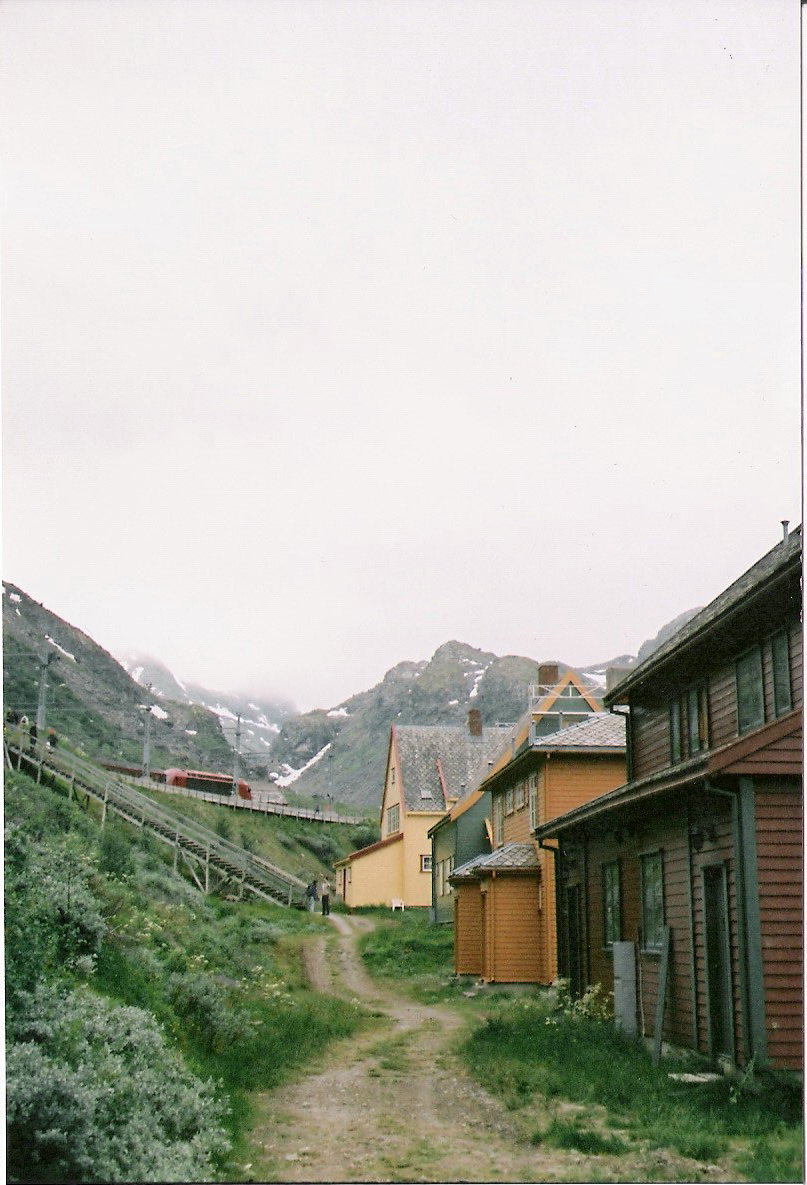
The Oslo to Bergen railway links Norway's two biggest cities, a journey through nearly 8 hours of eyes-glued-to-window scenery of fjords and mountains. As the train leaves the suburbs of Oslo behind, rich green forests spread quickly over the landscape. Coming up close to the train lines, thin trunks look like sticks, as if they could be picked up and snapped in half but, as they climb up the hills, the rows of tree tops give the feathered, soft appearance of a shag pile carpet so dense that, if a giant hand was to appear and grab a handful of trees, it would be as noticeable as plucking one strand from a head of hair. The fjords are seemingly endless, beating the train into the distance, dark blue, glossy expanses with a slightly rippled sheen like fabric pulled tight.

As the train leaves the outlying towns behind, the landscape gets more and more barren, almost desert-like. It dims to khaki, with mossy, lime green rocks strewn across the floor, and the trees thin until the hills evolve into bald mounds, veined with the patterns of rock. Electricity lines swinging across the hills are the only sign of man, aside from small, scattered huts clinging to the rocks with withered Norwegian flags blowing in the breeze. The fjords become choppy, splitting into streams and waterfalls and rivers and the colour of the fjords changes as frequently as the sun goes in and out. Sometimes, the water is so clear and turquoise blue it looks as if it's been dyed the colour of animal pools at the zoo, with blue and green waves swirling at the shore, and frothing where they catch on rocks. Sheer cliff faces end in deep black water whilst others lead nowhere, stopping suddenly as if someone's roughly snapped the bottom off.

Snow starts criss-crossing the hills, appearing in primitive shapes like chalk carvings, and mountains break though puffs of cloud. In mid July, they're still snowy on top. The train rattles through long tunnels, contained by wooden snow sheds on steep ledges, gaps in the wood offering fragments of what's going on outside. The train enters into a tunnel in sunshine and, when it emerges, the sky is grey and still as if a curtain's come down and is just hanging there. At Myrdal, we're allowed out to stretch our legs and the whole air is wet and chill like it's made of raindrops.

Then, suddenly, the landscape is tame again. The water pales to dark calm green and silver. Valleys reveal rolling farmland with sheep lazing in the sun, and children wave from houses. Some passengers have slept through the whole journey, or had curtains pulled across the window — they do it on a regular basis, saying that although you can fly, by the time you've traveled to the airport it's just as cheap and easy to get the train. I don't see how it's a journey of which you can ever tire — just as dramatic as the landscape is the speed at which it changes, even just across the course of a few miles, without taking into account the seasons or even the changing qualities of light at different times of day — I'd love to see the journey again in the winter months when everything is ice and snow.

Thursday, 8 April 2010

The Shrieking Violet Issue 8 — a public transport special! (And a mini-tribute to Alex Chilton)/ Salford Zine Library

Here is Issue 8 of the Shrieking Violet — a public transport special encompassing trams — Alessandra Mostyn has described and drawn her favourite tram journey, Finglands buses — Dan Russell offers a mini celebration of Finglands buses accompanied by a collage and trains — I visit Manchester's second train station, Victoria.

Now it's spring, daytrip season has officially started, and April Preston visits the classic seaside resort Blackpool, whilst rollercoaster enthusiast Dave Robinson recreates the thrill of 'woodies' (wooden rollercoasters) with a guide to Blackpool Pleasure Beach.

There is creative writing by Michael Cassidy and a recipe for spicy vegan hot cross buns by Rebecca Willmott.

Adam Faulkner offers part 2 of his guide to contemporary French music and Alexx O'Shea reviews a night of electronic music at the Briton's Protection.

The cover is by Sophie Wilson, an illustrator currently based in Telford, who has a charming range of merchandise for sale here.

For optimum enjoyment, this fanzine should be read whilst listening to the song Choo Choo Train by the Box Tops. Their lead singer, Alex Chilton, who had a number one record in 1967 with The Letter* (an astonishing 1 minute 53 seconds of pop perfection, all tooting horn chords, swirling organ and shimmering strings over Chilton's gravelly almost-blues growl) at the age of 16, went on to form the powerpop group Big Star, who were my favourite band throughout my teenage years (I spent my schooldays trying to learn their songs on guitar). Alex Chilton died at the far-too-young age of 59 last month. I was very sad, so I suppose this fanzine is kind of dedicated to him. The B-Side to Choo Choo Train, Fields of Clover, is also one of my favourite ever songs (actually I think it's quite a lot better than the A-side).

*

Issue 8 can be downloaded here in pdf form.

Additionally, paper copies might be left in some of the following places: Good Grief (Afflecks Palace), Koffee Pot, An Outlet, Oxfam Originals, Fred Aldous, Oklahoma, Piccadilly Records, Bread and Butter, Cornerhouse, Manchester Craft Centre, Nexus Arts Cafe, Kings Arms.

To have Issue 8 or any back issues* sent to you in the post (free service), email your name and address to Natalie.Rose.Bradbury@googlemail.com.

*Here is a page which has the download links of all the back issues too.

The Shrieking Violet can be read online here, although the pages are in printing rather than reading order.


Issues 1-7 of the Shrieking Violet can also be read in Salford Zine Library, which is in the Engine House at Islington Mill.