Tuesday, 22 November 2011

The strange stories of sounds — Kinokophone at MadLab

Last Thursday I spent the evening in the Northern Quarter immersed in strange sounds and unusual storytelling. 'Kinokologue 1: Sound spore', a temporary sound art installation in the exhibition space at MadLab, was the culmination of a Cornerhouse/Paul Hamlyn Foundation Micro Commission, followed by Kinokophonography upstairs, a regular listening event which showcases sounds sent in from all over the world.

'Kinokologue 1: Sound Spores' was an interactive collection of sound specimens arranged as 'spores' embedded in different objects. Spores were tucked in drawers and filed neatly in a cabinet ready to be opened, or presented as threaded images, interpreted by embroidery artist Akiko Yanagimoto, framed in glass as if in a collaged scene. At the same time as vintage objects were reused and reinvented as listening posts, everyday sounds plucked from their context took on a new meaning as part of a growing sound archive. Listeners were invited to borrow headphones, wander round and get ready to listen closely, then help classify sounds by suggesting categories or turning dials to bring sounds together into compositions and writing down instructions based on successful combinations for future visitors. Although samples included recognisable sounds and even those we might conventionally call music — the meandering of a violin, piercing whistles — the most exciting sounds to explore were those that did not have an obvious source. Burbling water and crunching leaves are atmospheric, but more elusive sounds such as faint 'put-putting' or vaguely familiar scraping are the most interesting as, rather than placing you directly in a scene in your head, they make you listen again and again to try to remember back to the situation in which you've heard them before (if at all).

The origins of the word 'kinokophone' are drawn from both cinema ('kino') and sound ('phone'), and it's easy to build a mental story around each spore. Some sounds stand on their own
— such as the simple, repeated onomatopoeia of the Japanese word 'nyokinyoki', but the recordings presented on the night were not heard in isolation. Contributors either introduced their recording in person or sent a description and context for their sounds, whether a reminiscence about a visit to the dentist that brought about a recording of a dentist's drill and suction — "my pain is your listening pleasure", an anecdote about the conditions in which the recording was taken — conjuring up the exposed, windswept discomfort of hanging around on the side of the mountain to record a pile of rocks, or more technical descriptions about how the sound was achieved — as in 'Growth of reverb', a recording taking advantage of the effects of footsteps on the acoustics of a stairwell at the University of Manchester, a place that was well known to some of the audience. Even those recordings that feature the presence of people are disorientating once stripped of their context: you wouldn't have guessed the setting for a conversation between young people unless told it took place at a goth festival in Whitby.

Sitting in a room of neatly arranged rows of chairs listening to recordings might seem like a strange concept for an evening, but the host described it as a way to "find out about the world by listening to what's around". Whilst my expectations of what an ice berg in Australia would sound like (sparse, barren, windswept) were confounded (it actually sounded bubbling, watery and alive), the recording of a busy, noisy, early morning in Mombasa sounded as if it could have been taken from any urban dwelling or office block with the window open on a summer's day. Recordings such as the Amazon rainforest, taken from the British Library, with its variety of sounds and array of natural wonders (including a bird whose recurring call descended a scale in a way that was almost comical and another bird whose insistent brilling made you wonder if it was the inspiration for the telephone's ring), and an amazingly evocative amplification of tree roots creaking in the wind like groaning wooden furniture, achieved in Lithuania using contact mikes, were beautifully observed. However, my favourite recording was of a sound so ordinary you would not normally think to stop to listen to it. A recording of the shaking of a tin roof on the Manchester University students' union, caused to move by the reverberations of the bass and drums-dominated practise session of a heavy metal band, couldn't help but make me smile.

Find out more about the work of the Kinokophone collective at www.kinokophone.com.

Sunday, 13 November 2011

Quick answers on photocopying, being free and the 'aesthetics' of fanzines

A couple of weeks ago I received an email from a Manchester-based design student named Jenn Trethewey who is currently doing research into self-publishing, with a view to producing a map charting the overlaps between different types of formats in self-publishing. She asked me a number of questions about photocopying, the Shrieking Violet being free and the aesthetics of self-publishing. You can read her questions, and my answers, below:

JT: Why, when you started the Shrieking Violet, did you choose to photocopy and have a free fanzine?

SV: I'm afraid I won't really give you any passionate, ideological answers, as the way I publish mostly comes down to laziness and convenience.

I started off photocopying the the Shrieking Violet because of the immediacy – I could go from finalising the content to publishing and distributing it almost immediately. As there was no waiting around for printers or anyone else to deliver a finished product, it was all up to me.

It is very important to me that the fanzine is free so that it is accessible. Having a cost on it – even a small one, is a barrier to the casual reader picking it up. Also, if there was a cost, selling it would have to be regulated somehow – I wouldn't be able to leave it around to be picked up. Again, the process of distribution would lose its immediacy if some kind of transaction had to take place – it would limit where and how it was available.

The Shrieking Violet was conceived as an alternative guide to Manchester, as there are number of free city guides which are left around the city – in hotels, cafes, bars and other attractions. It seems that most of them are sponsored by big business and are very unimaginative – they mainly recommend shopping, or visiting the big city museums and galleries if you want some culture. I wanted to offer an alternative to that which was also free and could just be picked up in some of those public places, but gave a guide to things in the city which were free.

JT: Why, sixteen issues in, have you kept it that way?

SV: I would love to publish a fanzine on lovely paper with staples and make it a nice object to hold. There are a number of reasons why I haven't, most of which come down to laziness:

1. There are always mistakes and typos in the Shrieking Violet, however hard I try to proofread it. It doesn't matter quite so much so much if it is just photocopied, as a photocopy feels like a temporary object, but a properly printed publication would feel much more 'permanent' and I would want everything about it to be perfect.

2. Photocopied fanzines are quick, cheap and easy to reproduce – if I got a fanzine printed professionally it would be limited by print run and it would be harder to produce extra copies as and when needed if I ran out.

3. As i'm not really from an art and design background, I feel a bit overwhelmed by all the choice of different papers and qualities and ways of printing as I have never had something professionally printed before, but I do know how to use a photocopier. I grew up around my dad's collection of early 80s punk/indie zines, so I knew that photocopying was a long-established way of making fanzines!

4. Cost – it's important to me that the Shrieking Violet is free, and if I got it printed professionally I would need the money to do so, which would probably mean applying for funding, or asking for people to advertise, which would be another stage in the process of making the fanzine that would hold the process up.

So, in answer to your question about why I continue to photocopy the Shrieking Violet 16 issues in, it is about momentum – I decided momentum and keeping the project going (firstly as a monthly zine then bi-monthly, now quarterly) was more important than worrying about improving the print quality.

I would love to produce the Shrieking Violet in colour, but I have struck a balance by having a pdf version online which is in colour – and the vast majority of readers are online, important as it is to have a paper version as well.

JT: I'm looking at the boundaries of different self-publishing formats and how we define them, so I'd be interested from a zine creator's point of view, what do you think makes a zine a zine? Would you say this sort of aesthetic and free distribution is part of what a fanzine is? Or is it the content and motivation behind the publication which you feel defines it?

SV: Regarding content and motivation, I like to think you could call the Shrieking Violet either a fanzine or a magazine. The distinctions between fanzines, artists' books and magazines are often a lot less clear than is made out. I would prefer for the Shrieking Violet to be defined by the content and the quality of the writing inside it rather than how it is delivered. The content and standard of the writing and range of contributors is always the most important thing and not the format it is made in. Just like blogs – I feel they should be judged by the quality of their content just like any other website and not by the medium in which they exist.

I don't know if I can define what makes a fanzine a fanzine as they vary so much. I'm not sure there is an 'aesthetic' that can be linked to fanzines as they range from the very, very basic – handwritten and photocopied – to more 'crafted' artists' books. I have thought about this a lot over the past couple of years, and I have come to the conclusion that 'self-publishing is a far more helpful word/concept than 'fanzine' because it is much broader and encompasses many different types of publications and many reasons for publishing, but the thing that often unites them all is autonomy and the freedom to be your own editor and maker.


Jenn's blog: http://ideasandthat.tumblr.com

Tuesday, 1 November 2011

The Shrieking Violet issue 16, Manchester Blog Award and recent inspiration

Issue 16 features Bert Jansch, Manchester's typography, city quarters, Esperanto, Belle Vue, smokey beans, creative writing, poetry, embroidery and illustration.

I have been thinking about the different types of quarters that seem to be appearing more and more, not just in Manchester but in other towns and cities I have visited.

Nija Dalal is a writer and radio producer, and has just finished an MA in Anthropology. She's radio obsessive, cooks and crafts and sews, and keeps a blog about it when she remembers. She grew up in the American South, in a bizarre immigrant household, though no more bizarre than most immigrant households. She says "y'all." Currently in Manchester, she's lived in Sydney and Atlanta, and she's looking for a job in radio (do you have one going, by the way?)...Nija has condensed some of her Masters thesis findings into an article about the anthropological implications of Manchester's typography.

Bill Chapman, who has been speaking Esperanto since 1967, got in touch with me offering an insider's perspective on an article I wrote about the Esperanto for the modernist issue 1. During our subsequent exchange of emails, he sent me a photo of the Manchester Esperanto society in 1948 (motto 'Obstinately onwards'!) and told me about the adventures Esperanto has enabled him to have. Esperanto celebrates its 125th anniversary next year, and I asked Bill to expand on his stories in article form for the Shrieking Violet. Bill is a magistrate in north Wales and has worked for many years in education and training, most recently in the field of lifelong learning. He is enjoying being a grandfather.
Long-time contributor and friend of the Shrieking Violet Rebecca Willmott describes herself as 'a self publisher with a specific writing interest in revisiting the circus with a needle and thread'. Her favourite things are: pumpkins, clowns, embroidery hoops and running writing and book binding workshops with children and sometimes adults, 'but children are more curious'. Manchester's Belle Vue circus holds a particular fascination for Rebecca, and she has written and embroidered an article on it. Rebecca has just moved to London to start an internship at textile magazine Selvedge.

Louise M. North wrote her first story, about a blue apple, aged 5. She likes writing about the odd, the weird and the wonderful and, if she can manage it, the odd, weird and wonderful all in one story. Louise has combined the odd and weird in a story about a recognisable Manchester locale, with an illustration by Alex Boswell.

Cyrus Amini, who has contributed a poem to issue 16 of the Shrieking Violet, has previously been an independent video producer and broadcast professional. He now develops property nicely but mainly concentrates on enjoying himself.

Mr Jacket's smokey beans recipe came to the Shrieking Violet via Morag Rose of the Loiterers Resistance Movement. I have tried and tested it and recommend eating hearty helpings on top of toasted, buttered rye bread for dinner on a winter's night, with the leftovers for lunch the next day.

The cover is by Manchester-based illustrator Bryony Jackson. I'm really pleased as I have long been a fan of Bryony's work and have been asking her to design a cover ever since the Shrieking Violet started back in August 2009!

Daniel Fogarty, an artist and designer based at Rogue Studios in Ancoats, kindly assisted with the design and layout.

Remember, this publication is best read whilst listening to guitarist and singer Bert Jansch, who died of cancer last month.

Read issue 16 online here:
Download and print your own copy of the Shrieking Violet here.

Very badly photocopied copies will be left around various places in the city centre this afternoon and tomorrow afternoon, including Piccadilly Records, Good Grief! shop (in the Soup Kitchen), Koffee Pot, Oklahoma, Nexus Art Cafe, Cornerhouse.

To request a copy in the post (free) or to contribute to future editions email Natalie.Rose.Bradbury@googlemail.com or join the Shrieking Violet Facebook group.

Manchester Blog Award

The Shrieking Violet won Best Arts and Culture Blog at the 2011 Manchester Blog Awards which took place during Manchester Literature Festival, after being nominated for the third year in a row. It was good to hear readings from other blogs at the awards ceremony, and to hear the winning entires in the Real Story competition, including Shrieking Violet contributor Nija Dalal! It was a shame that I was rushing off to the Jens Lekman gig at Band on the Wall, on the other side of town. Many thanks to anyone who read, nominated or voted for the Shrieking Violet.

Other winners included Shrieking Violet issue 10/Manchester's Modernist Heroines contributor Hayley Flynn, who won Best City and Neighbourhood Blog with Skyliner. David Bailey, who designed the cover for the Shrieking Violet issue 10, won Best Personal Blog for Food Legend.

Recent inspiration

I've been dipping in and out of the artist Ryan Gander's book Catalogue Raisonabble Vol. 1. My favourite bits of the book are his writing, especially extracts from his 'Loose Associations', interesting essays which flit from topic to topic in 'loose associations'. These led me to a brilliant magazine called Dot Dot Dot, produced by Stuart Bailey of Dexter Sinister, in which some of Gander's Loose Associations appeared. I've been reading issue 19 of Dot Dot Dot, which compiles editions of a newspaper called THE FIRST/LAST NEWSPAPER which was issued from Port Authority for three weeks during November 2009. Content is a mixture of archive material and contemporary articles written by different international artists and writers, some fairly short and others more in-depth, quite often concerning the media, the history of the press, the evolution of publishing and mass communication.

I recently watched this lecture from 2007, which has contributions from Stuart Bailey, as well as Michael Bierut from the website Design Observer. I really enjoyed hearing about how Dot Dot Dot started and developed as a magazine, and how it received submissions of content that was not what you would expect to find in a graphic design magazine but the editors published it anyway to change conceptions about what 'should' be printed. I was also interested in Michael Bierut's talk about how Design Observer started and grew, and attracted readers despite the length of its posts! He made some observations about comments on blogs and blogging 'communities'. I am often discouraged that there are few comments posted on the Shrieking Violet (especially negative comments) and the lack of discussion or debate around anything I write.

How many quarters make a city? Clue: it's not four

Birmingham has seven designated city quarters1, Sheffield eleven2. In Manchester, the well-known Northern Quarter (and slightly less well-known Green, Civic and Millennium Quarters) will soon be joined by a co-operative quarter (although the Co-op Group hopes the public will take to its official name, NOMA, speculated to be a reference to its geographical position just north of the city centre3) and another, a Medieval Quarter, is proposed. Add to that other well-defined areas of the city which are not officially designated quarters, but could be seen as such – Canal Street and surrounding Gay Village as a gay quarter, Chinatown as a Chinese quarter, a university quarter around Oxford Road – and there are a lot of slices that make up Manchester.

There is a bewildering away of terms for dividing up the city into convenient chunks: corridors (the area around the universities and university hospitals is packaged as the corridor, Manchester's “economic and knowledge powerhouse”4), gateways (Southern Gateway, a new residential and business district in an area which had suffered from "a lack of identity and economic purpose"5), an urban village (Ancoats), the UK's first Urban Heritage Park6 (Castlefield) and even a curry mile. The language and concepts used to describe quarters is similar to that applied to these other corridors, gateways and urban villages, and they share many of the same attributes and aims – rejuvenating an area through mixed-use developments that will attract business and investment to the city and help raise its profile beyond the city boundaries.

Quarters often reflect the aspirations of a place, and are used as a way of conveniently packaging and marketing the different types of activities that make up the diverse life of a town or city. If a town or city has a well-defined creative quarter, for example, a hub of cultural industries, it will not just attract creative people but will also catch the eye of tourists and shoppers eager for an alternative retail or leisure experience. This provides customers for other facilities such as hotels and transport, and therefore acts as an incentive for business investment. Likewise, a heritage or tourist quarter puts a city's attractions conveniently into one place for visitors – and attracts the sort of retail or dining experiences that go with it.


The use of quarters to define areas of a city is nothing new. Think of Paris's quartiers – meaning living quarters. Cities have long had designated areas based on ethnicity – Jewish Quarters being a widespread example – and Birmingham, to name just one city, still has Irish and Chinese Quarters. Other quarters grew up around shared characteristics uniting the people who lived or worked in an area, such as speaking a common language (Latin around the universities in Paris' famous Latin Quarter, during the Middle Ages, a name which struck). Other quarters were named after the industry that was prevalent in an area, for example Birmingham's renowned Jewellery Quarter, catchily marketed as 'Birmingham's Gem'7. Or they may simply be descriptive of what's there, like Altrincham's Market Quarter, or what goes on there, such as Leicester's Business Quarter. Others are defined in geographical terms, including Manchester's Northern Quarter, which also goes by the postcode N4, or based on obvious physical attributes, such as Stoke-on-Trent's Canal Quarter. Others reflect the type of people the area has come to attract, or wishes to attract, or tells members of a certain demographic they will find likeminded people there – for example Liverpool's Gay Quarter. They can also be a tool in conservation, if a number of noteworthy buildings are clustered in one area.

Manchester's Civic Quarter, outlined in 2009's Civic Quarter – Manchester Central Regeneration Framework, aims to use Manchester's heritage, including some of its key buildings – the town hall, central library, Manchester central and St Peter's Square – as well as its transport links and infrastructure, to attract business and institutions to Manchester in “a new meeting place in the city centre”. Its goal is to extend both the city centre and business district and: “Bring together the values of civic pride and civic leadership, with international trade and commerce, world class innovation and research, at the heart of an entrepreneurial community.”8It also acts as a link between the various other districts that comprise the city centre: Spinningfields, the corridor etc.

The proliferation of quarters all over the country today, some based on a logical connection with an area and some more tenuous, often coincides with redevelopment and regeneration. Manchester's Millennium Quarter (there are also Millennium Quarters/Villages in London) refers to the redevelopment that took place around Manchester Cathedral after the area was destroyed by an IRA bomb in 1996. Its name reflects that rebuilding took place in the lead-up to the Millennium as well as the fact it incorporated one of a number of national projects funded by the National Lottery through the Millennium Commission9.


Typically, quarters incorporate new or improved public space (Cathedral Gardens, check), retail (Selfridges, Harvey Nichols, the Triangle, check), leisure (the Printworks, check) and residential opportunities. Often, refurbishments of traditional buildings sit alongside eye-catching new builds. The Millennium Quarter acknowledges Manchester's past, containing some of its most historic buildings (the cathedral, Chetham's Library), but it also contains new flagship development such as Ian Simpson's Urbis building, which was conceived as a museum for the city.

Soon, the area could have another quarter, currently dubbed the Medieval Quarter10 by local media, that will straddle two city centres, linking to the Greengate development in Salford. Plans include a new cathedral square, as well as a redesign of Cathedral Gardens, new memorials to the anti-slavery movement, the suffragette movement and firefighters. A statue of Oliver Cromwell, currently in exile in the suburbs, could also be moved there.

Just down the road is NOMA – colloquially dubbed the Co-op Quarter to reflect the fact that the Manchester-based Co-operative Group is redeveloping a huge, 20 acre site11 near its new headquarters. The £1 billion plan, funded by the Co-operative Group with some investment from the Council, will see the makeup of the area fundamentally changed to attract new up-market shops, offices and cafes, potentially generating thousands of jobs. New public spaces will be created and the inner ring road will be moved. The Co-operative Group will be hoping that the quarter can be seen as a physical manifestation of its values, which include commitment to community and environment.


Quarters can create a sense of place. Put a name on it and people can feel an affinity with a place and identify with the characteristics associated with it. As people are increasingly encouraged to live in city centres as opposed to the suburbs, residing within a distinct quarter makes it a lot easier to see yourself as part of a neighbourhood. When asked where you're from you might no longer have an area such as 'Chorlton' or 'Withington' on the tip of your tongue, but being able to say you live in 'the Northern Quarter' or 'the Green Quarter' helps whoever you are talking to identify a more specific locale than the more general term 'city centre', which encompasses a wider geographical area.

The advantages of this for developers are clear: from 2004 onwards, the Green Quarter was created just outside of Manchester City Centre, referring to the largest ever housing development in the city. Developers Crosby Homes promised a “self-contained urban oasis, combining 10 cutting-edge apartment blocks, business accommodation, hotel, leisure and retail facilities set against the precious commodity of lush landscaped open green space”. Sold on its close proximity to Victoria Station, the MEN Arena, the Printworks and leisure and retail opportunities, the developers highlight “the convenience factor of a lifestyle on their doorstep”. They tempt: “Are you addicted to city living, yet yearn for more than a splash of greenery? Do you enjoy the buzz of the urban social whirl and the spark of metropolitan business, but would relish having a haven to escape to?”12The green part? It was envisaged that more than half of the area would be public open space with lawns, tree-lined walkways, water features and landscaping.

A common example of the adoption of quarters as a regeneration strategy can be seen in cathedral quarters, which are found in towns and cities around the country, including Sheffield. Blackburn's town centre strategy13 works with “the inherent and distinct uses of existing areas”, including the cathedral quarter, which has “one of the most established identities in the town centre”, to “encourage a unique sense of place”. Heritage quarters are being established in towns and cities including Gravesend and around the harbour in Sunderland. University quarters include Stoke-on-Trent's catchily-named UniQ, a partnership between local education providers that aims to raise aspiration and increase skills in the town.


One of the most prominent types of quarters is the creative, or cultural quarter, which can be found in towns and cities around the country including: Southampton, Brighton, Folkestone, Birmingham, Sheffield, Leicester, Oldham, Liverpool, Stoke-on-Trent, Doncaster, Boston, Colchester, Leamington Spa, Wolverhampton, Bedford, Bury and Warrington14. The Local Government (LG) Improvement and Development Group put together a guide to cultural quarters, which it defines as “an existing cluster of creative and cultural industries, or the desire to create a cluster of creative and cultural industries”15. Quarters give creative people the opportunity to “work, live and socialise in one environment”, and the LG foresees the associated networks and facilities growing up around them. In Folkestone, Kent, the Creative Quarter was initiated by a charitable Trust buying and refurbishing, then letting, empty properties to creative businesses and artists, supplemented by events such as a book festival and art triennial16.

Whilst there is debate over how desirable it is to set out to create a creative area, as opposed to letting it evolve naturally over time (and there are also concerns about the knock-on effects of 'gentrifying' an area, including pricing out its previous occupants), Manchester's Northern Quarter, which was one of the first cultural quarters in the country along with Sheffield's Creative Industries Quarter, is seen as a successful example of what a cultural quarter should be and do. As the LG site observes, “the most successful examples of cultural quarters usually had some longstanding cultural activity or venues”. The Northern Quarter became established as an alternative to mainstream shops such as the Arndale Centre, its lower rents attracting a mix of cafes, bars, vintage clothes shops, independent book shops, record shops and galleries. It also has a distinctive nightlife, with a reputation for alternative gigs and club nights. Its proximity to the city centre shops, as well as transport interchanges such as Shudehill and Piccadilly, means the Northern Quarter is described in the Northern Quarter Development Framework Report of 2003 as: “A key piece in the city centre jigsaw, an area different in character and function to any other part of the city centre and of great strategic importance to Manchester as a city of distinctive quarters.”17


Increased investment in and focus on the Northern Quarter as an area came about after Manchester City Council commissioned a Northern Quarter Regeneration Strategy in the mid-nineties. This set out a vision for a mixed-use area, including increased residential space, as the Northern Quarter's role shifted from housing traditional industries such as textile manufacture to incubating new creative industries. The Northern Quarter Association was formed, a voluntary body comprising residents, representatives of trade and users of the area, and various environmental changes were made such as commissioning public art to make clear the area's identity as a cultural hot-spot. Around a decade later, the Northern Quarter Development Framework Report observed: “The individuality of the N4 remains – it is not currently a ‘corporate’ location, a place for large firms or for retail or leisure chains. It is the place for the independent sector, where residents of Manchester and visitors can buy high quality, unusual products and soak up the atmosphere of a truly ‘working quarter’.”1

Councils are honing in on quarters and creating visions and plans for areas at postcode level, but quarters are part of a bigger strategy to put cities like Manchester on the world-map. Ensuring certain quarters cover specific functions ensures that Manchester is seen to possess everything you would expect to find in a world city. The Northern Quarter Development Framework Report explicitly states of the Northern Quarter: “This non mainstream offer is important for any ‘global’ city.”19


Cities change and evolve up over time. The name 'Northern Quarter' entered popular use because it referred to an area which already had a distinct identity and role in the city. Few people outside those who live in the Green Quarter refer to it as such (or would even have reason to think about it as a 'place'), and it remains to be seen whether the other quarters, or even the name NOMA, will enter popular conversation as place-markers.


Quarters have been at the back of my mind for a while as something I would like to know more about. Above is merely a collection of things I found interesting about them. If I had had more time and space I would have liked to have also thought about the creation of Spinningfields as a 'luxury shopping quarter', and thought more about other concepts such as urban villages and had a closer look at the overlap with quarters and the language that is used to define and sell them.

1 For a list of the seven city quarters outlined in Birmingham's Big City Plan see http://bigcityplan.birmingham.gov.uk/tag/seven-quarters/

2 For a list of Sheffield's eleven quarters see http://sccplugins.sheffield.gov.uk/urban_design/quarters_city_centre.htm

4 For more on Corridor Manchester visit http://www.corridormanchester.com/

9 For more on Millennium Projects, including Urbis, see http://www.millennium.gov.uk/cgi-site/awards.cgi?action=detail&id=87&t=2

11 See http://www.noma53.com/ for more information on what's proposed.

13 See http://www.blackburn.gov.uk/server.php?show=ConWebDoc.2472 for more information on the town centre strategy.

17 Northern Quarter Development Framework Report, 2003

18 Northern Quarter Development Framework Report, 2003

19 Northern Quarter Development Framework Report, 2003

There are some great videos on Glasgow School of Art's Vimeo channel, including a lecture on culture-led regeneration, which looks at creative or cultural quarters in Manchester/Salford, Sheffield, Newcastle/Gateshead and Glasgow:


There is also a good lecture on the idea of creative cities and creative classes, and the differing experiences of big cities and small/medium size cities:

Friday, 14 October 2011

Self-publishers of the World Take Over! Salford Zine Library exhibition and film at Salford Art Gallery

The Shrieking Violet was interviewed over the summer for a film compiled by Salford Zine Library which will be shown during a new exhibition at Salford Art Gallery. Craig Barr from Salford Zine Library interviewed self-publishers across Manchester, including OWT Creative, Vapid Kitten and Manchester Municipal Design Corporation, and invited zine makers from all over the world to send in short films of themselves. Also on show will be items from the Salford Zine Library collection, usually based at Islington Mill, Salford.

Watch the trailer, starring artist, actor, Hotpants Romance member and the Shrieking Violet issue 11 contributor Lowri Evans, which has music by Maria and the Gay:


Watch a short chapter from the film here:


And another here:


The exhibition and film will run from October 15 to January 29 at Salford Museum and Art Gallery, Peel Park Crescent, Salford M5 4WU.

Friday, 7 October 2011

Issue 16 of the Shrieking Violet will be dedicated to Bert Jansch (1943-2011)

The Shrieking Violet issue 16, which is currently in production, will be dedicated to (as in I will recommend that people listen to his music while reading it) Bert Jansch, singer and guitarist in Pentangle and notable folk musician in his own right, who died from cancer earlier this week at the age of 67.

It will be the third issue of the Shrieking Violet to be dedicated to the memory of a musician who soundtracked my teenage years and passed away prematurely: Issue 8 was finished in April 2010, coinciding with the death of my musical hero Alex Chilton (Box Tops/Big Star) at the age of 59, and Trish Keenan of Broadcast passed away just as I was finishing issue 12, aged only 42.

One of the most compelling arguments for owning records (or books) in a physical format is that you never forget how you came into possession of those that sum up certain stages of your life.

As a big fan of folk and blues guitarists like John Fahey, I’d heard a lot about Bert Jansch but it wasn’t until a trip to Ireland after my A-levels to meet the editor of a fanzine I had been contributing to that I bought The Best of Bert Jansch (along with Fakebook by Yo La Tengo and a Hank Williams boxset, both of whom also became major musical obsessions) from a cosy, crowded record cum bookshop in Dublin. The record came to define the end of that summer, the changes in my life as I moved away from home to start university, and the passing of the days into autumn; there’s a darkness and sadness to Bert’s music behind its delicate, fingerpicked beauty and I have always thought that Bert’s was a music for the drawing in of the days, falling of leaves from the trees and the brief intensity of autumn light.

What makes Bert’s music for me is his warm, personal voice, which is one of the most distinctive and recognisable I’ve come across. As well as being one of my favourite guitarists, he’s also one of my favourite singers: his voice is plain, unadorned and unaffected. Bert’s is singing how it should be, unflashy and unshowy, complementary to rather than distracting from the guitar melodies which are at the centre of his songs.

As a shy, awkward teenager, when I started university my love of musicians like Bert Jansch helped me make friends. A fellow guitarist lived in my flat in halls and we traded CDs, introducing me to Bert Jansch’s 1968 album Birthday Blues.

This summer I stumbled across The Pentangle’s absolutely magical 1969 LP Basket of Light for £1 at a car boot sale at the end of my parents' road in Kent, a record I had long coveted on vinyl. Returning home, I rushed to put it on the stereo. My mum, who was lucky enough to be teenager during punk and post-punk, protested loudly and turned it off; she couldn’t stand it. In a reversal of the usual parent-child relationship, my taste in whimsical, gentle, introspective folk music made me a rebel!

Recipe callout

I am currently looking for a vegetarian/vegan recipe to include. If you would like to contribute a recipe, with photo of the finished dish, email Natalie.rose.bradbury@googlemail.com.

Friday, 23 September 2011

The 'public art' of Ford Madox Brown: Manchester's town hall murals

If there is one building that every visitor to Manchester (not to mention every resident) must see, it's the town hall. A building founded on cotton and industry, it's a working monument to the trade that made Manchester what it was, from the statues of great men that stand in the entrance ways to the bee mosaics laid into its floor to ceilings that are covered in the coats of arms of Manchester's former trading destinations. The architect, Alfred Waterhouse, even aimed to capture the area's history in its architecture through a series of murals, realised as Ford Madox Brown's twelve scenes in the great hall. Unfortunately, unless you've been invited to an event in the great hall, it's unlikely you've made it up close to Brown's great work of public art. Partly this is because, as curator of Manchester Art gallery's new exhibition Ford Madox Brown: Pre-Raphaelite Pioneer, Julian Treuherz, says, “It's in use all the time. It's a working building”, and partly because the public by and large don't know they are allowed to look around the building. Now, as part of the exhibition, the murals will be freely open most Sundays.

When the murals were painted, says Julian, the town hall would have been more accessible (although, he admits, “the very, very poor would not have got through its door”) as it was regularly used as a venue for public meetings. Waterhouse intended art to be an integral part of the building, with murals throughout – though this eventually proved to costly and time-consuming as Brown's murals in the great hall alone took fifteen years to complete.

Commissioning murals for the building at all was, says Julian, an act of “complete daring” by the architect following the failure of similar schemes in the Houses of Parliament (Brown's proposals for the Houses of Parliament murals, which were not chosen, are in the Manchester Art Gallery show) and the Oxford Union which, unsuited the the UK's damp climate, soon faded. Waterhouse learned from this and the preparation for murals in Manchester town hall was carefully thought out. Hot air was installed behind the spaces where the murals would go, and stained glass kept to a minimum, free of flashy colours that would shine onto and distract from the paintings. A Gambier Parry style of spirit fresco was chosen, and the walls prepared so that the pigment would react with the surface of the walls – making them “truly architectural, not easel painting”, says Julian, as “they're meant to tell at a distance in this space”.

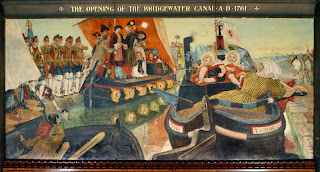
Whilst Waterhouse tried to ensure the murals were a success technically, Brown faced other difficulties. Winning the town hall commission is described by Julian as a 'lifeline' for Brown in the last years of his life, but it was not easy: he suffered from gout and ailments brought about by the cold in the building in winter and a stroke meant the loss temporarily of the use of his right hand. Nor did the council offer their unfailing support, vetoing his plan to end the series of murals with a depiction of the Peterloo Massacre. His painting of the opening of the Bridgewater Canal was also unpopular, with its pomp and circumstance and bright, bawdy colours.

Many of the events in the murals have only a “tenuous link to Manchester” as, explains Julian, “Manchester did not really have a history with lots of heroic events and great personalities.” A Roman Fort is built in Mancenion by a worker writhing with tattoos. Christianity is brought to Manchester following the baptism of King Edwin at York. Closer to home the Fly Shuttle is discovered at Bury, jeered by baying luddites. The world famous scientist John Dalton's discovery of natural gases, a pastoral scene, is overlooked by a curious, almost-cartoonish cow. Brown intended the murals to be 'typical' of Manchester's history rather than 'documentary'. In some cases he even imagines how the future might be, envisaging crowds of children at Humphrey Chetham's school. Animals and children recur throughout the pictures, which are often light-hearted. As Julian says, Brown's paintings are humorous, containing “a lot of fun and wit and satire”. He is “anti-hierarchy and egalitarian” as an artist and “emphasises role of ordinary people, has a lot of fun at the expense of authority figures.” He paints his friends, family and patrons into the pictures – and even himself as the Archbishop of Canterbury.

As the accompanying exhibition at Manchester Art Gallery shows, Brown was in his element as a storyteller. Passionate about literature, he often depicted scenes from Shakespeare and other great works, for example creating series of narrative stained glass windows both for churches and private houses.

Brown believed in “equality between the fine and decorative arts”, designing many of the frames for his paintings, and the exhibition also displays examples of his furniture. He also excelled as a portrait painter, eliciting a candid directness from his sitters, among them Madeleine Scott, daughter of the famous Guardian editor CP Scott, perched atop a then-fashionable tricycle. Another of his most striking paintings, 'Mauvais Sujet (The Writing Lesson)', which depicts a sensuous young girl biting into an apple, her hair in disarray, shows Brown's concern for society: proceeds went to Lancashire Relief Fund to help those affected by the Lancashire cotton famine.

Brown's talent for storytelling and portraiture combine in pictures such as the vivid 'Last of England', where you can see the steely determination on the emigrants' faces, and 'Work', one of his best known paintings. Described by Julian as showing “a humble incident – the type you wouldn't have been allowed to exhibit in the Royal Academy”, it comprises a street scene based around the laying of a sewer in London. Presented is a cross-section of nineteenth century life, from the rich on horseback to workers bent over in toil, right down to the unemployed, beggars and the very poor – those who had to sell wild plants such as chickweed in the street. In the background, layers of advertisements on the wall show the concerns of the time and reflect Brown's interests, including posters for workers' colleges, and the scene is watched over by the social thinker Thomas Carlyle. As Julian explains: “Ford Madox Brown challenged prevailing ideas of what art should be. Victorian artists were governed by decorum. They did not paint life as we saw it in the street.”


At £8 for entry, perhaps the Art Gallery show is suited to enthusiasts. But even when the exhibition has finished, the town hall murals are accessible to the public – just ask at the front desk and, as long as there are no events on, you should be able to wander the great hall at your will.

Ford Madox Brown: Pre-Raphaelite Pioneer, opens at Manchester Art Gallery, Mosley Street, on Saturday September 24 and runs until Sunday January 29 2011. Entry is £8 for adults, £6 for concessions and free for under-18s.

www.manchestergalleries.org

Photos used by permission of Manchester Art Gallery (click for larger images)

Wednesday, 7 September 2011

Meeting William Mitchell (the modernist magazine issue 2)

"Today it has become necessary to demolish the myth of the 'star' artist who only produces masterpieces for a small group of ultra-intelligent people...the artist must step down from his pedestal and be prepared to make a sign for a butcher's shop (if he knows how to do it). The artist must cast off the last rags of romanticism and become active as a man among men, well up in present-day techniques, materials and working methods. The designer of today re-establishes the long-lost contact between art and the public, between living people and art as a living thing."
Bruno Munari, Design as Art, 1966

At the start of July I traveled to London to meet William Mitchell, a prominent post-war architectural sculptor (and innovator in the use of materials such as a new type of concrete called Faircrete) whose work I have been visiting across Greater Manchester and Liverpool over the past year. I spent the afternoon with Mitchell and his wife Joy at their flat in Marylebone, where we watched black and white archive footage from several episodes of Tomorrow's World that were presented by Mitchell (he can't remember exactly when), and their local chip shop, where the couple's lively anecdotes continued (and lunch was paid for with the flourish of a £50 note).

We discussed things including: industrial design (Mitchell helped design the first 125 and 250 mph trains, which were tested at Marylebone); Prince Philip's (in)famous reaction "What the hell is that?" to his Minut Men sculptures outside Salford University (then Salford Technical College) when the Allerton Building was opened in 1967 (ironically, says Mitchell, the Prince had been heard to complain of a "lack of adventurousness" in contemporary architecture, and Mitchell's connection to Prince Philip goes back further, to when they both served in the navy during the war); the big personalities and back stories behind some of Manchester's most high profile buildings (such as the Piccadilly Hotel in Piccadilly Gardens, now the Ramada); his many commissions across the world and working with groups such as schoolchildren; having his own company, William Mitchell Design Consultants Group; Mitchell's numerous, sometimes controversial, speaking engagements; his Dodi and Diana memorial in Harrods; the rediscovery and reassessment of his work, including the renovation of a mural in Hawaii; public space and how to define 'public art'; the dying out of skills such as mosaic making, and why mosaics are not widely commissioned any more; the stigma attached to social housing, even in the post-war period; and the market-led state of art and architecture today ("it's not the quality of the art that makes the headlines but the record prices”).

The maquette for the doors to Liverpool Metropolitan Cathedral hangs in the entrance to the Mitchells' flat, which also contains pieces of furniture he made, including two tables in the same style as his mosaic in the Piccadilly Hotel (possibly my favourite Mitchell piece) inset with waste products such as bits of old pianos. "You forget to look at them," said his wife, but the couple kindly moved their furniture around while I took photos.

The text below is a slightly longer version of the interview that will appear in Issue 2 of the modernist, accompanied by photos supplied by the Mitchells. the modernist is quarterly publication produced by Manchester Modernist Society. Issues cost £3.75 each — or £15 for a subscription (including postage).

Issue 2, which is themed 'brilliant', also features: Ben Tallis on Orford Ness; Eddy Rhead on the Arndale's Cromford Court set; Stephen Hale on painter Kit Wood; Laura Gaither on Conrad collectibles; Jack Hale on Salford's Stella Maris Salvation Army centre; Matthew Whitfield on Southgate, Runcorn; Richard Brook on Manchester's District Bank; and news and reviews.

Issue 2 will be launched, with wine, at Ferrious (in a converted railway arch on Whitworth Street West) on Thursday September 15 from 6-8pm.

It will also be available from Cornerhouse bookshop, Magma and RIBA Hub in Manchester, News from Nowhere in Liverpool, Henry Moore Institute in Leeds, Site gallery in Sheffield, Aye-Aye books in Glasgow, Magma and Tate Modern bookshops in London, PLACE in Belfast, do you read me?! in Berlin, Papercut in Stockholm, or online here.

William Mitchell: Artist, Designer, Inventor

A man, armed with a tube, is doodling giant-scale on a concrete wall. Dressed in white overalls he explains, from behind a protective helmet, that he is blasting the wall with grit, enthusiastically advocating the technique's potential for widespread decorative use. The man is William Mitchell, artist, designer, innovator, inventor – and sometime television personality. Mitchell made an entertaining presenter and the programme demonstrating sandblasting was just one of the episodes of Tomorrow's World he was asked to present because “I could talk at the same time and didn't confuse people with art”. He remembers,“I got lots of letters from doctors saying I would die at a very young age as my lungs would be filled with dust and to stop what I was doing” – although at 86 he is still very much alive and opinionated.

In the 1960s and '70s Mitchell, who had studied Industrial Design at the Royal College of Art, pioneered new techniques and materials, working with other professions such as architects, engineers and builders. In another edition of Tomorrow's World, Mitchell balances on a plank of wood above a building site in Croydon, where he is installing a textured concrete wall in an office block. He explains: “There were not many people in my line of work who would go out on the roof with the builders. That was unusual. If it was now I would have had to wear protective clothing I couldn't even get up the stairs in.” The most remarkable episode, though, is that in which he demonstrates a new technique he has come up with for advertising – an unrealised plan that have illuminated Manchester's Piccadilly Gardens with a 350ft by 65ft sign comprising thousands of lightbulbs triggered by films and photoelectric cells. Mitchell says you can still see the holes on Piccadilly Plaza where the bulbs would have gone.

Planners across the UK – and as far afield as America and Hawaii – wanted a piece of Mitchell for their developments, and he undertook hundreds of public and private commissions. These range from the small, functional and unobtrusive – clocks in schools, motorway detailing – to the grand – the massive (in Mitchell's eyes, "almost barbaric") doors to Liverpool Metropolitan Cathedral (the design for which had to be signed off by the Pope) and, later, the Egyptian Room at Harrods. Mitchell was so prolific he can't remember the exact location and details of each artwork, but there are a several in some of Manchester's most striking and iconic Modernist buildings – a bold fibreglass mural in the entrance to the plush CIS Tower, panels around the lift shaft in the snaking Gateway House on Piccadilly Approach and sculptured decoration covering the Humanities Building at the University of Manchester.

Mitchell's most publicly visible work in Manchester and Salford is his Minut Men, three giant concrete monsters outside the University of Salford. Mitchell says he had to set them on fire to get the plastic moulds off* (something he notes would never be allowed today, especially so close to the main road!), and the figures are extraordinarily detailed, covered with patterns and inlaid with mosaic. He explains: “I wanted to do something with the material which was not indicative of trying to be something else. As it was new, let it be new. It had as much to do with the practicality and being outside. I also had to take into account, was it waterproof and was it vandal proof?”


Often, says Mitchell, his artworks used a “very, very involved process”, a challenge to himself to prove they were possible. He remembers: “It was almost an exercise in character building, the artworks were so hard to get to the finish of!” Another unusual use of materials can be seen in the epic mosaic, gleaming with objects such as bottle tops and textured by the addition of gravel, that climbs the full height of the staircase in the Piccadilly Hotel in Manchester's Piccadilly Gardens. Made of bits of furniture and pianos set in resin, Mitchell says "there's a richness to it". It took up the whole of his studio and he had a whole team sanding it down as he wanted to show “there was still the possibility of doing hand craftwork”.

Mitchell finds public art to be a problematic concept: “One of the troubles of public art is the public are not asked whether or not they want it.” Yet you can tell Mitchell is proud of the artworks which people have taken to heart: he was pleased to hear of a fashion show being held in front of the Minut Men in Salford, and recounts that Salford students defended the figures from attack by rivals from Manchester University. He even tells a story of tenants taking it upon themselves to clean one of his artworks in a council block. Mitchell also considers his fantastical creatures for the water gardens in Harlow, Essex – modern day gargoyles for a new town – to be a success. Too often, he says, artworks of the period were “thought of as brooches to stick on the building”, whereas art needs to “give a sense of the international, community and place”. Harlow, he thinks, was different as “they were starting to put an infrastructure in, an environment”.

Mitchell would like to see a percentage for public art built into new developments today: “I think it's appalling architects don't consider art. It is so categorised today, art and architecture. There isn't any interrelationship to my mind. At one time there was the possibility of an integrated art form but now you don't get anything like that.

“Every square inch in London is built up as far as ground level. Architecturally, buildings take no notice of the pedestrian. Where the building hits the ground is more like the basement than a public thoroughfare.”
Today, some of Mitchell's works have already been demolished, whereas others are in buildings that have fallen out of favour and face uncertain futures. He's stoical about artworks being lost when buildings are knocked down, although he thinks it's important that “some are kept to give an idea of what the time was like and the type of things you could do”. The social and historical significance of these remarkable artworks is now being reassessed. In Islington, London in 2008, one of Mitchell's works for a school was the first mural of its kind to be listed in its own right, not in the context of the listing of the building to which it was attached. In a library in Kirkby near Liverpool too, a mural has recently been restored and reinstalled. It had languished in storage after the library, ironically, “took it down to be modern”. Those trying (unsuccessfully so far) to get the Turnpike Centre in Leigh listed, which, when it was opened in 1971 featured a new, open-plan library design, also highlight Mitchell's distinctive concrete frieze on the front.

Mitchell still receives requests to undertake commissions, mainly from the Far East, where he says "the money is". He is currently working on a book, which will be “part instruction book” (“always paint the concrete”, he insists) and “part adventure book”. There couldn't be anything more appropriate for this brilliant artist. As he sums up his long career, “It has been an adventure! I was a person of my time. Nowadays I'd be put in a box!"

* Rumour has it that some of the moulds still hang in the Modernist bungalow built by the Allerton Building's architect John Parkinson Whittle in Didsbury as his family home.

For photos and more information about the works discussed above visit Mitchell's extensive website at www.william-mitchell.com.

If you want to find out more

A Pathe Newsreel of Mitchell at work in 1960:

CEMENT MURALS


An essay by Dawn Pereira, who has been researching public art commissioned by the London County Council at the University of East London, on Mitchell's legacy

A resource which provides a fascinating introduction into the influence of art on town planning in post-war Britain, with an overview of the Festival of Britain, new towns, housing, comprehensive education etc

Jonathan Schofield on concrete public art in Manchester