Friday, 15 April 2016
Postcard from Manchester: Seeing your city through someone else's eyes
Read online at: http://mymarcotravel.com/postcards/manchester-seeing-your-city-through-someone-else-s-eyes
Friday, 8 May 2015
The Manchester Bees documentary: Shrieking Violet interview
Saturday, 9 June 2012
Help Save Library Walk!
Library Walk, a curved walkway nestled in between EV Harris's Grade II* listed Central Library (1934) and the Town Hall extension (1938), has long provided a convenient link between the municipal heart of the city – Albert Square and the Town Hall – and the busy public interchanges of St Peter's Square and Oxford Street. In an area dominated by continual tram traffic, busy roads with one-way streets, bus lanes and taxis serving the large hotels that face onto nearby streets, the lone pedestrian can feel outnumbered and overwhelmed. Library Walk is a rare place that prioritises the pedestrian, providing a calm, convenient walkway that cuts through the jumble and avoids having to go round the bulk of Central Library or the Town Hall. It is the quickest, simplest route from A to B.
While part of Library Walk's appeal is practical, it also has a value which is indefinable, arising not just from its beauty and elegance but its atmosphere. Unlike in many buildings and urban landscapes, here you can lose yourself in your surroundings and be enveloped in the communion between two buildings reaching for the sky. We can all appreciate how Central Library looks from a distance, but it is equally impressive close-up: by following the contour of its curves we experience the architecture too. It's possible, for a moment, to be overtaken by the place and forget where you're going or why, but feel part of a shared heritage and cityscape that exists on a grand scale. Library Walk is a place that is unlike any other in Manchester.
The argument against altering Library Walk is also symbolic. If Library Walk is gated, we lose not just one footpath, but a significant right; the right to control where we are allowed to go in the city. Public safety arguments in the planning proposal cite a rape which took place in Library Walk, and the tendency of people to urinate in the passageway. Ian Simpson, quoted in Building Design, called Library Walk a 'dangerous place', saying: “It needs to be a managed space.”
While any rape is horrific, it is unrealistic to design out all risk from the city. It is impossible to try to police every public space – but it should be possible to provide education, with the aim of creating a culture in which respect is the norm, and facilities such as public toilets. Making artificially sanitised spaces, and designating some places safe and others unsafe, hides the wider issues around where and why acts such as rape take place. Furthermore, when some people take the attitude that women should not be surprised they attract unwanted attention if they walk alone at night, the public safety argument helps perpetuate notions about what is 'sensible' behaviour for women, stipulating where and when they 'should' and 'should not' walk.
The plans for Library Walk are unnecessary – not least at a time when services such as libraries are facing spending cuts. Ultimately, there is no need to seek to 'fill' Library Walk, or give it a function other than as a thoroughfare. The current absence of a structure on Library Walk does not mean it is lacking in purpose, or a place with unfulfilled potential.
The Heritage Statement on Library Walk says: “As a potential tourist destination, Library Walk is not a pleasant public space for visitors to the Civic heart of one of the largest cities in the UK.” I beg to differ. In its own, unassuming way, Library Walk already captures the public imagination, as is evidenced by it being one of the most photographed views in Manchester. As prominent photographer Aidan O'Rourke, who has snapped most of Manchester's buildings, puts it: “It's perfect as it is.”
For practical suggestions on how to register your objection to the plans, visit http://manchestermodernists.wordpress.com/2012/06/04/do-you-object-to-the-proposals-for-a-glazed-link-between-manchester-town-hall-extension-and-central-library.
To find out more about how to involved in a campaign against the proposals, join the Save Library Walk! Facebook group.
Friday, 23 September 2011
The 'public art' of Ford Madox Brown: Manchester's town hall murals
When the murals were painted, says Julian, the town hall would have been more accessible (although, he admits, “the very, very poor would not have got through its door”) as it was regularly used as a venue for public meetings. Waterhouse intended art to be an integral part of the building, with murals throughout – though this eventually proved to costly and time-consuming as Brown's murals in the great hall alone took fifteen years to complete.
Commissioning murals for the building at all was, says Julian, an act of “complete daring” by the architect following the failure of similar schemes in the Houses of Parliament (Brown's proposals for the Houses of Parliament murals, which were not chosen, are in the Manchester Art Gallery show) and the Oxford Union which, unsuited the the UK's damp climate, soon faded. Waterhouse learned from this and the preparation for murals in Manchester town hall was carefully thought out. Hot air was installed behind the spaces where the murals would go, and stained glass kept to a minimum, free of flashy colours that would shine onto and distract from the paintings. A Gambier Parry style of spirit fresco was chosen, and the walls prepared so that the pigment would react with the surface of the walls – making them “truly architectural, not easel painting”, says Julian, as “they're meant to tell at a distance in this space”.
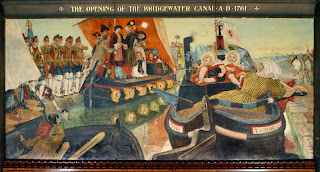
Whilst Waterhouse tried to ensure the murals were a success technically, Brown faced other difficulties. Winning the town hall commission is described by Julian as a 'lifeline' for Brown in the last years of his life, but it was not easy: he suffered from gout and ailments brought about by the cold in the building in winter and a stroke meant the loss temporarily of the use of his right hand. Nor did the council offer their unfailing support, vetoing his plan to end the series of murals with a depiction of the Peterloo Massacre. His painting of the opening of the Bridgewater Canal was also unpopular, with its pomp and circumstance and bright, bawdy colours.
Many of the events in the murals have only a “tenuous link to Manchester” as, explains Julian, “Manchester did not really have a history with lots of heroic events and great personalities.” A Roman Fort is built in Mancenion by a worker writhing with tattoos. Christianity is brought to Manchester following the baptism of King Edwin at York. Closer to home the Fly Shuttle is discovered at Bury, jeered by baying luddites. The world famous scientist John Dalton's discovery of natural gases, a pastoral scene, is overlooked by a curious, almost-cartoonish cow. Brown intended the murals to be 'typical' of Manchester's history rather than 'documentary'. In some cases he even imagines how the future might be, envisaging crowds of children at Humphrey Chetham's school. Animals and children recur throughout the pictures, which are often light-hearted. As Julian says, Brown's paintings are humorous, containing “a lot of fun and wit and satire”. He is “anti-hierarchy and egalitarian” as an artist and “emphasises role of ordinary people, has a lot of fun at the expense of authority figures.” He paints his friends, family and patrons into the pictures – and even himself as the Archbishop of Canterbury.
As the accompanying exhibition at Manchester Art Gallery shows, Brown was in his element as a storyteller. Passionate about literature, he often depicted scenes from Shakespeare and other great works, for example creating series of narrative stained glass windows both for churches and private houses.
Brown believed in “equality between the fine and decorative arts”, designing many of the frames for his paintings, and the exhibition also displays examples of his furniture. He also excelled as a portrait painter, eliciting a candid directness from his sitters, among them Madeleine Scott, daughter of the famous Guardian editor CP Scott, perched atop a then-fashionable tricycle. Another of his most striking paintings, 'Mauvais Sujet (The Writing Lesson)', which depicts a sensuous young girl biting into an apple, her hair in disarray, shows Brown's concern for society: proceeds went to Lancashire Relief Fund to help those affected by the Lancashire cotton famine.
Brown's talent for storytelling and portraiture combine in pictures such as the vivid 'Last of England', where you can see the steely determination on the emigrants' faces, and 'Work', one of his best known paintings. Described by Julian as showing “a humble incident – the type you wouldn't have been allowed to exhibit in the Royal Academy”, it comprises a street scene based around the laying of a sewer in London. Presented is a cross-section of nineteenth century life, from the rich on horseback to workers bent over in toil, right down to the unemployed, beggars and the very poor – those who had to sell wild plants such as chickweed in the street. In the background, layers of advertisements on the wall show the concerns of the time and reflect Brown's interests, including posters for workers' colleges, and the scene is watched over by the social thinker Thomas Carlyle. As Julian explains: “Ford Madox Brown challenged prevailing ideas of what art should be. Victorian artists were governed by decorum. They did not paint life as we saw it in the street.”
At £8 for entry, perhaps the Art Gallery show is suited to enthusiasts. But even when the exhibition has finished, the town hall murals are accessible to the public – just ask at the front desk and, as long as there are no events on, you should be able to wander the great hall at your will.Ford Madox Brown: Pre-Raphaelite Pioneer, opens at Manchester Art Gallery, Mosley Street, on Saturday September 24 and runs until Sunday January 29 2011. Entry is £8 for adults, £6 for concessions and free for under-18s.
Photos used by permission of Manchester Art Gallery (click for larger images)
Friday, 4 March 2011
Manchester's Modernist Heroines — publication and events

Manchester Modernist Society, The LRM (Loiterers Resistance Movement) and The Shrieking Violet have teamed up for a collaborative project exploring the stories of ten fabulous North West women spanning the fields of invention, aviation, media, science,geography, design and architecture throughout the twentieth century and into the twenty first. Manchester’s feminist history did not stop with the Suffragettes!
Anyone (please note: these are not women only events!) is welcome to join us on Sunday March 6 at the Town Hall in the Women of Achievement room from 1-4pm for your free copy of 'Manchester's Modernist Heroines’. Manchester's Modernist Heroines is a special edition of the Shrieking Violet fanzine (with a cover beautifully stitched and collaged by Rosa Martyn, who studies Hand embroidery at the Royal College of Needlework) which aims to commemorate their achievements, uncover many more via your own favourites, and who knows – inspire some heroines of tomorrow. An exciting range of contemporary Manchester women – ranging from artists and writers to tour guides and even a dance troupe! – has responded to the ten women, and the results include essays, interviews, poetry, planned events and artworks.
The publication can also be read online here:
Or downloaded and printed here.
At 3pm on Sunday March 6 The LRM will be curating a walk inspired by the work of Modernist Heroine Professor Doreen Massey focusing on flow, energy, gender and exploring space. The wander will uncover some of the hidden histories and power relationships which have shaped the city; Manchester is made up of myriad stories and some about our marvellous modernist heroines are absent from the official narrative.
This is the start of an ongoing project; please tell us about your heroines on the day or add them directly to a special Modernist Heroines page on the Modernist Society website.
Saturday, 21 November 2009
Manchester's Mr Blobby - and other decorations
You know it’s that time of year again when (aside from creeping TV commercials spreading thin, enforced jolliness for sale at Tesco and B and Q), the workmen start arriving in Albert Square.It starts with the legs - four huge blocks big enough to support what comes next, the obese, oversize frame of Manchester’s own Mr Blobby. Early in November, Santa’s lifted into pride of place on the Town Hall, from where he can survey the town square in all its glory, his twinkling boxes of golden presents scattered across nearby lampposts.
His vantage point is dark until his welcome party, the customary Christmas lights switch on, when Santa reminds the city of his existence in a display of 100,000 glowing lights. This year, he was announced by X Factor winner Alexandra Burke plus, appropriately for such an over-the-top caricature, local pantomime stars.
Sitting atop a 32 foot structure, Santa wishes those below a ‘Merry Christmas Manchester’. Subtle it isn’t; at ten metres tall, eight metres wide and six metres deep, his scale is huge. Something so cartoonish is an absurd sight on Alfred Waterhouse's stately neo-gothic Town Hall. Santa completely overshadows other seasonal reminders such as the pair of discreet poppies that flank him on the town hall around Remembrance Day. They can’t compete; though they too are oversized, they don’t have his sheer bulk.
Santa’s so fat he doesn’t even have legs, just bloated, blobby feet, and seems to prompt mixed reactions from shoppers at the Christmas markets below. A 59 year old from Swinton said: “I would prefer something more traditional. I preferred the old one in the tower, but it kept coming down. Maybe it will look better in the evening when it’s lit up.” His wife, though, said: “I like it. It’s only there for a couple of weeks anyway - it’s not like it’s permanent!”A businessman visitng from the US said: “Maybe it’s there to draw people here, but I wish it was on a slightly more human scale! The colours and pretty and the lights are nice, but I didn’t notice it until you pointed it out!” On the other hand, 21 year old James said: “It’s a good piece of culture!” and a woman from Leyland said: “It’s lovely. I’m a fan of Christmas and all the things that go with it.”
When he was first unveiled (a similarly grotesque inflatable Santa was finally laid to rest in 2006 after succumbing to a growing shabbiness and propensity to puncture), Councillor Pat Karney proudly proclaimed: “'It is very hi-tech and very 21st Century'. It will put Las Vegas in the shade.” It’s as if the council has done a tour of those notorious houses which compete with rooftop displays every year, and decided to go one better with what they have on their roof.
Of course, it’s not just Albert Square that gets the Christmas lights treatment. The pollution of Oxford Road is offset briefly by rows of green firs. Deansgate is a wonderland of simple but wintry scenes. I have to admit, though, that my favourite is the unconventional Christmas tree in Piccadilly Gardens.
Eschewing a traditional tree (that honour is reserved for Albert Square, which hosts the fir tree that’s donated by the people of Stavanger, Norway every year), instead the shape of a tree is loosely represented in a 32 foot tower of illuminated silver balls. A real tree could look tawdry and forlorn rattling around in that empty concrete space (a conventional tree would have to be massive to make any impact on the open space of the gardens, and could too easily become tacky if overloaded with too many decorations or shabby if vandalised), but there’s something really simple yet effective about the sphere tree that I love. When illuminated at night, its fragile, delicate cages cast a monochrome white glow that offsets the coldness of Tadao Ando’s concrete pavilion. The pile of wire baubles somehow makes the sparse space, which is dominated by Ando’s minimalist concrete wall, more welcoming. What could be stark and lost amongst the rich architecture of Albert Square somehow fits in Piccadilly Gardens.
Piccadilly Gardens is no stranger to unusual takes on trees. The ball tree has replaced a cone tree that was previously installed at Christmas time, and at the other end of Piccadilly Gardens, there’s already another unconventional tree, the 11foot high steel Tree of Remembrance that was erected in 2005 to remember the victims of bombing in Manchester during the second world war. These two opposing visions of trees somehow make you appreciate the few bare trees growing around the area even more.
The ball-tree is a beacon, visible from the northern quarter, guiding you down the narrow streets late at night towards Piccadilly Gardens and the prospect of home. Its only potential downfall is Manchester’s unpredictable weather, occasionally falling victim to high winds.
However you feel about Christmas, the Christmas lights add a sheen to the city that could make even the most hardened anti-Christmas cynic believe in magic - or at least spread a little glow for a small period of time. It’s nice to see a bit more colour on the city streets (imagine if the fairy lights cheering up Piccadilly Gardens were made permanent, like those in the trees outside Piccadilly Station or around Sackville Street Gardens) even if it’s just for a little while.
Thursday, 2 April 2009
One and All at Castlefield Gallery
The walk to Castlefield Gallery is something I love about Manchester, partly because of the way Edward Walters' Congregational Chapel, one of my favourite buildings, comes into view little by little. Tonight was a perfect spring evening, and its tower gradually struck a silohuette against the pink sky with an unusually large pink-red sun getting lower in the background.
Unfortunately, some of the exhibitions at Castlefield Gallery have gone a bit over my head in the past (although I really enjoyed the Laura White exhibition). I've found them too conceptual for the casual viewer, or been a bit overwhelmed by too much video or technicality and esoteric ideas. One and All works really well though, as there's enough of visual interest but it's also based on a sound concept - that of communities and urban regeneration, and the way we see the city around us, as well as more fundamental ideas of the changing role of the artist.
There's challenging, unconventional work, such as Andrew Wilson's board game based on networks of people, but there's also painting and sculpture.
I have to admit that I only got as far as the installation in the Town Hall earlier this year, called TV. Artist Hafsah Naib posted advertisements asking people who were thinking of getting rid of their television to donate it to her project, and the work TV is a collection of these TVs in a circle. We sit down and watch each of the TVs, on which are playing interviews with their former owners on the subject of television and its role in their lives - when you think about it, getting rid of a TV is saying goodbye to a large part of the fabric of your home for a lot of peope.
Some the interviewees are slightly awkward, and some take naturally to the screen like actors performing a monologue. I was slightly disconcerted when I saw one of my friends unexpectedly on one of the screens the first time round, but I think that's the point - as one of the interviewees says, TV has conventionally been one of those unifying things in our society that's part of nearly everyone's life and everyone is expected to have a view on, from Coronation Street and Eastenders to the X Factor. These people aren't experts in a traditional sense - or maybe TV is something on which everyone is an expert, not least in the way in which we build up relationships with programmes and series over time (as one interviewee says, she always remembers the last ever episodes of programmes like Friends and Frasier as being particularly poignant).
It's like reality TV gone a step further, challenging our notions of who should be on TV and who is worthy of our interest. For an exhibition which portrays the fast-changing world around us, it's interesting to see how the interviewees view television - often with mistrust, seeing it as propaganda, a tool for disseminating advertising and censored knowledge. It's also a reminder of how old fashioned television, a staple of our lives for so long, is becoming, in this age when children grow up with the internet as their main source of information. It starkly illustrates the generation gap: one man talks about a 'TV meter' that measured how much television the family was watching - a form of pay as you go TV, which seems extremely archaic, and another interviewee describes how a friend made the decision to get rid of her television for a couple of years in an incredulous, 'would you believe it' tone even though TV is probably going to be obsolete for the children of the near future.
For some interviewees, TV is a chance to tell their life story, to have an audience for their opinions: "children these days get a better education watching the TV than they do at school".
The individual's tale is also told in Jo Lewington's video Digital Film 15, Cheetham Hill August, which focuses in on the human in a uniform environment. We have a worker's eye view of a textile factory - literally, as the video was filmed by workers wearing head cameras. It's slightly disconcerting having hands appear from nowhere which aren't yours, performing the repetitive routine of a pillow manufacturer.
Grennan & Sperandio offer the closest to conventional 'art', albeit starting from a marginalised viewpoint, with paintings of the type of places and details of Manchester's streets that wouldn't normally make it into a landscape painting, including that funny slither pub in Hulme.
William Titley's dustbins, turned into sculptures housing water fountains and illuminated in bright colours, double as striking examples of recycling, and Jil Moore's large, transparent glass pieces, like vases patinaed with images of the city's transport system, are beautiful. Her sculptures are displayed by the gallery's huge windows, and when I was looking at them the wind suddenly shook some pale pink spring blossom from the trees outside like a snow shower. Somehow this display of nature in such an urban setting complemented Moore's vases, which project robust urban images onto objects based around translucency and light, perfectly.
Unlike some of the other exhibitions of modern art I've been to lately, there's enough to draw you in for a closer look that you'll want to think about the themes behind the art - ie, the role of the individual, and how much space we really have to be individuals in the modern city. As well as giving you things to look at, the exhibition makes you think about the way we view our city and whether it's dictated by outside forces we aren't really aware of.
One and All is at Castlefield Gallery until May 17 (my birthday!)
2 Hewitt Street
Castlefield
Manchester
M15 4GB
www.castlefieldgallery.co.uk
www.one-and-all.org
Monday, 23 March 2009
Dave Haslam: From Engels to Elbow: The History of Manchester Being Heard at Manchester Histories Festival Saturday March 21
The highlight of the absurdly overcrowded Manchester Histories Festival at the weekend - apart from being inside the Town Hall, amidst its nooks and crannies, mosaics, stained glass windows and Ford Madox Brown murals - was a talk by the former Hacienda DJ, XFM presenter, lecturer and writer Dave Haslam, based on his book Manchester, England.I haven’t read the book - which Haslam describes as a “biography” of the city, Manchester in his mind being akin to a person with its own “psyche” and “personality traits” - but I’d like to.
Haslam describes Manchester as a “hybrid city”, its population constantly changing and absorbing immigrants throughout the centuries, from those seeking work and better life during the industrial revolution to the annual influx of students. Haslam himself moved to Manchester relatively late, but exudes a love of the city.
The most important of Manchester’s character traits, says Haslam, is its famed “self-assertiveness”. This can be seen in its history of producing radical thinkers, social movements and, in the latter half of the twentieth century, popular culture that has spoken out as a voice for change.
Perhaps because of its second city status, Haslam suggests Manchester has always attracted the ‘other’, been a "location for the alternative", and it’s this sense of “distance and difference”, its autonomy from London and the fact that it’s a long way from the locus of political power and the media centre, that allows countercultures to thrive. That’s why Manchester has historically had a strong DIY element - you make your own entertainment.
Although the talk is wittily entitled ‘From Engels to Elbow’, this seems to be mainly an alliterative device as Engels is more dwelled upon than Elbow. Haslam has a knack for catchy sound bites, also helpfully reducing the theme of his lecture to the link between "chart hits and Chartists".
For Haslam, "pop culture is a necessity”. The fact the talk takes place in the council chamber of the town hall, underneath the Manchester coat of arms and Concilio et Labore motto, shows how much pop culture has become part of the establishment. Haslam is trying to ensure pop sociology is accorded the same importance as what we normally think of as worthy of inclusion in the history books.
His talk draws the not often made link between Victorian Manchester and the music scene that culminated in Madchester which, it seems, are more similar than you might think. He tells us Victorians “lived their lives on the streets”, debating on street corners, pamphleteering and registering protest through strikes. Victorian Manchester was “awash with ideas”.
Reading out Engels’s description of a hedonistic Saturday night on the streets of Manchester, Haslam notes that the excesses of today’s Saturday nights wouldn’t have been out of place in Victorian times - it seems the Victorians, too, were 24 hour party people. Surprisingly, Haslam considers that the Victorians would have valued nightclubs as a place for “interaction”, as opposed to our society’s “retreat into the private realm”.
Manchester was a birthplace of the punk movement, which Haslam sums up as the “desire to be heard”. We need rebel yells, he says, because “the alternative to being heard is silence”. Haslam isn’t so much claiming that Manchester is an inherently musical city, though, with sounds rising spontaneously from its city fabric, more that the famous art it came to be associated with arose out of its many problems. From the overcrowding of Ancoats to the failed Utopianism of the Hulme crescents, out of alienation came creativity. To Haslam, pop music is so important because it allowed the unlikely alliance of “arty weirdo types and tough kids” .
Often, those whose art has become associated with Manchester and Salford wrote as a criticism, from the authors Anthony Burgess and Elizabeth Gaskell - whose novel Mary Barton is an expose of the conditions of the working classes - to the sparse music of Magazine. Shelagh Delaney’s 1958 play Taste of Honey, which on its release was the subject of front page outrage at its honest depiction of Salford life, is cast as a precursor to punk rock with its "no barriers", “back to basics" depiction of reality.
Some of the audience react with shock when Haslam compares the formation of Factory Records to the foundation of the Anti Corn League, but you can kind of see his point. Tony Wilson is described as “an enablist, a propagandist and a conduit”, and that’s it - Factory records may not have made great political statements, but it was the Manchester music scene and Hacienda that put Manchester back in people’s minds and attracted people to return to the city during the bleak Thatcher years, despite Thatcher's best efforts to marginalise the city.
When asked by a member of the audience what the next big thing might be, Haslam acknowledges the absurdity of a 47 year old presuming to predict the future of pop music. Another listener asks how Haslam thinks the recession will affect the Manchester scene. Haslam is critical of contemporary Manchester, which is “property developed to death” and “neutered by big business”. If the message of the talk is that great art arises from an admission that things are “not perfect”, and the need for something to “rebel against” and “escape from”, it seems likely the next big thing will arise through the cracks of the consumer dream.
www.davehaslam.com