Manchester Left Writers have been selected to undertake an exhibition as part of Castlefield Gallery’s ‘Launch Pad’ series, chosen by Jerwood Charitable Foundation Director Shonagh Manson.
The Powerhouse Liberation Movement will bring together film, installation, music, performance and a new publication. MLW core members Natalie Bradbury, Bob Dickinson, Steve Hanson and David Wilkinson have been searching the city (dubbed the “economic powerhouse of the north of England” by Manchester City Council) for ‘free’ spaces: spaces where notions of commonality, free expression and liberation are discoverable and can be accessed by all. MLW have recorded their exploratory journeys across the city, from the Gay Village and ancient earthwork the Nico Ditch to the satellite towns of Stockport and Rochdale. This has resulted in a series of lo-fi ‘Notebook Films’ documenting places, encounters and experiences. These will be displayed alongside maps, notes, photographs and objects found and made during the process of making the films. MLW have also commissioned a critical essay by Dr Gavin Macdonald, Lecturer in Art History at Manchester Metropolitan University.
During the public preview on Thursday 5 May (6-8pm), and repeated for Museums at Night on Thursday 12 May, MLW will perform new poems to accompany the work on show. In addition, the quintet Vocal Harum (of which MLW writer Bob Dickinson is a member) will perform a set of a cappella songs about buildings. MLW will also discuss and answer questions about their work and the exhibition at a public event on Saturday 14 May. The exhibition continues until Sunday 15 May. For more information, including times, visit www.castlefieldgallery.co.uk/event/launch-pad-the-powerhouse-liberation-movement.
Facebook event
Showing posts with label Rochdale. Show all posts
Monday, 2 May 2016
Saturday, 23 March 2013
Woman's Outlook: a surprisingly modern magazine? publication
The publication I made to present my talk about co-operative women's journal Woman's Outlook at the Rochdale Pioneers Museum can be read online below (I made some mistakes in the original version of this booklet, like mixing up a Labour and Conservative Prime Minister, but am trying to change any mistakes I spot!).
Download and print your own copy as a PDF here (NB, all pictures are for illustrative purposes only – please don't reproduce them!). It was good to meet some local Co-operative members, and people from the Rochdale branch of the Workers' Educational Association, and there were some interesting questions at the end. My talk can be listened to online as a podcast:
After presenting a history of Woman's Outlook, I finished my talk by showing some pages I had compiled from current-day women's magazine Stylist, on the basis that it is the only women's magazine I have ever really read (I read it because it is given out free on the streets each Wednesday, and I also read the male version of the magazine, Shortlist, also because it is free!). Whilst there are clear differences between the two magazines – Outlook was a political, campaigning magazine with a very defined audience, whereas Stylist is basically an advertising channel and sees itself as reflecting the 'age of coffee cup politics', where issues are something to be chatted about over a cup of coffee – I wanted to show the types of topics which are considered to be of interest and relevant to women today, from reader surveys aimed at building up a picture of what it's like to be a modern women, to quizzing readers about their sex lives, to highlighting issues like abortion, equal pay, women's continued underrepresentation in Parliament, childcare and flexible working. I find it interesting that Stylist continues to profile women with interesting careers, from an oceanologist to a reverend, and how it features articles about women's status in other countries – for example, Italy – and how the lives of women elsewhere in Europe have been affected by the financial downturn. There is also a weekly international page summarising news stories concerning women across the world, and ahead of elections Stylist profiles political parties and the ways in which their policies would affect women. Woman's Outlook ran a number of profiles of Eleanor Roosevelt, and she is still being held up in Stylist today as an exemplary first lady and woman in public life. On top of that, Stylist features the type of content you would expect to see in a woman's magazine, from recipes to beauty and fashion.
I went to see the new Ken Loach film, Spirt of 45, the evening before my talk, to get some inspiration and context about the period, and would highly recommend seeing it.
I have been invited to repeat the talk 'Woman's Outlook: a surprisingly modern magazine?' at the Working Class Movement Library in Salford, which also contains volumes of Woman's Outlook, on Wednesday 26 June at 2pm as part of its Invisible Histories series.
Also related, Cazz Blase will also be revisiting the talk she did at the 2012 Victoria Baths Fanzine Convention as part of the series, on Wednesday 29 May at 2pm. 'Worlds within worlds: punk ladies, riot grrrls and fanzine culture' will discuss the role women played in the UK punk scene and the UK incarnation of the female focused, female dominated riot grrrl scene.
Saturday, 16 March 2013
Talk: Woman's Outlook – a surprisingly modern magazine, 6pm, Thursday March 21
I'm doing my first ever talk at the Rochdale Pioneers Museum soon, about Woman's Outlook, a co-operative women's magazine which ran between 1919 and 1967. I've spent quite a bit of time researching the magazine in the National Co-operative Archive, and taking photos, and will be sharing what I found out and how I feel the magazine compares to magazines aimed at women today, in the form of a magazine. I've also conducted interviews with some inspiring women who were members of the co-operative women's movement in the second half of the twentieth century.
If you would like to attend, please book here. The event will start at 6pm and is free to attend.
Woman's Outlook – a surprisingly modern magazine?
For nearly five decades, Woman’s Outlook was the voice of the Co-operative Women’s Guild, the campaigning organisation which worked to raise the status of women both in the co-operative movement and in society, and its onetime editor Mary Stott later became a longstanding editor of the Guardian women’s pages.
From its origins in Manchester in 1919, Outlook provided an enticing mixture of articles addressing both the personal and the political, combining fashion, fiction, features and recipes with advice for working women – in many ways, not dissimilar to the content of women’s magazines today!
‘Woman’s Outlook: a surprisingly modern magazine?’ will explore some of the key issues addressed in Outlook, and look at how the magazine encouraged women to get involved in campaigning for a better world. Topics covered by Outlook such as women's representation in parliament, equal pay and healthy eating remain highly relevant today, and the talk will end by considering whether the type of content provided by 21st century women’s lifestyle magazines has really changed much since the days of Outlook.
The talk will take place in the Rochdale Pioneers Museum, which is based in the original building where the first successful co-operative shop opened in 1844 and has recently been refurbished. The Museum is well worth a visit and is a 15 minute walk from Rochdale train station, which has regular trains to Manchester. There are also buses to Rochdale, and a recently-opened tram!
Please pass this on to anyone you think might be interested.
Facebook invitation
I had the opportunity to test my talk out at the most recent Islington Mill Art Academy open crit. Read about it at http://islingtonmillartacademy.blogspot.co.uk/2013/03/art-academy-open-crit-150313.html.
Friday, 9 November 2012
Review: Greater Manchester's Public Swimming Pools: A Pictorial Guide
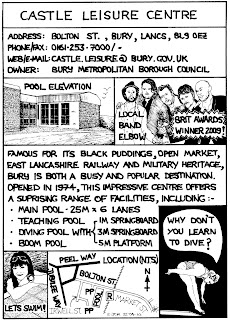
The Shrieking Violet issue 15 featured a page about Levenshulme Baths, the historic swimming pool in the Manchester suburb of Levenshulme, drawn and written by John Mather, who got in contact after setting himself the challenge of swimming in each of Greater Manchester's 50-odd public pools.
His project is now complete, and the resulting guide, Greater Manchester's Public Swimming Pools: A Pictorial Guide, is out now. Mather's watery journey was a labour of love, and he fights the corner for what he terms “swimming's unique and often understated role in society” – the Guide is clear that the function of swimming reaches far beyond health and fitness to encompass social and community benefits. As well as acting as a guide to each building and each pool's facilities, Mather's book goes out beyond the pool doors to take a wider look at the people and communities they serve, taking care to include something memorable or special about each pool's location, from local landmarks to famous innovations such as Rolls-Royce (Stretford) and Stephenson's Rocket (Eccles), and show the “fascinating and diverse collection of towns and people” that is Greater Manchester. Each entry is handily annotated with essential information such as contact details, location and amenities such as parking.
Mather's love affair with swimming started when he learned to swim in Bury's old Victorian baths, which “seemed not just a place to swim but more like a landmark of civic pride and opulence”. Just as there is a huge diversity of towns in Greater Manchester, there is a great variety in the styles of pools found within them, from those associated with Manchester's first city architect, Henry Price, in the early twentieth century, with the old-fashioned pool-side cubicles remaining (Withington, Chorlton), to a number of pools built in the 1960s and 1970s – including Radcliffe Pool which, Mather said, set a benchmark for future pool building by local authorities – as well as recently opened, bang up-to-date facilities and even a pool in a converted cinema (Tyldesley). Mather views each pool on its merits, without expressing a preference for any architectural period or style.
The Guide is often humorous, and Mather slips in references to local celebrities, from the Rochdale Pioneers, who opened the first successful co-operative shop in the town, to Frank Sidebottom (Altrincham), John Cooper Clarke (Broughton) and George Formby (Atherton), as well as local personalities such as longstanding swimmer Sam Quinn, who has been a Broadway Baths regular for 75 years.
Dive below the surface, and you discover stories about the individuals who have used these pools over the years. Greater Manchester, Mather says, has a long tradition of swimming and Olympic success, a “long forgotten 'Golden Age' of swimming prior to the First World War”, when “Greater Manchester's swimmers literally led the world”. For instance, Henry Taylor from Chadderton, a swimming instructor for many years in the town, won three golds at the 1908 London Olympics. Today, the region's pools are used by everyone from learner swimmers to elite swimmers from national and international teams, and have hosted many Olympic and Commonwealth medallists.
Pool buildings have social history written into their brickwork and tiles. Now derelict, Collier Street Baths in Salford, opened in 1856, is Britain's oldest surviving swimming baths building. Withington Baths in Manchester, which still says 'Men' and 'Women' above the entrance where the sexes would once have been separated before entering the water, took the daring step of allowing the city's first mixed bathing in 1914. No visit to Manchester's pools, of course, would be complete without a reference to Edwardian water palace Victoria Baths (despite the current lack of water!), and Mather considers the past, present and future uses of the building.
I read the Guide as a call to action, a reminder to get swimming and use some of these pools before they disappear forever. Rochdale's spectacular art deco Central Baths, which were still in use as recently as this summer, have now been demolished. The futures of Levenshulme and Chorlton Baths are both uncertain, and there are plans to close the historic, much-loved Royton and Crompton pools in Oldham (Crompton Baths is the oldest Baths in Greater Manchester still serving its original purpose) in order to replace them with a single, modern facility.
Greater Manchester's Public Swimming Pools: A Pictorial Guide can be purchased for £5.99 at www.lulu.com/shop/john-c-mather/greater-manchesters-public-swimming-pools/paperback/product-20441129.html.
Tuesday, 16 October 2012
The Co-operative Women’s Guild: an alternative education
In March I am going to be doing a talk at the Rochdale Pioneers Museum about the co-operative women's magazine Woman's Outlook (published by the Manchester-based Co-operative Press between 1919 and 1967). The magazine intrigues me because it blended news about the campaigning and educational activities of the Co-operative Women's Guild with tips for cooking, nutrition, child rearing and homemaking. I am trying to find former readers, or at least women who were members of the Guild at the time, to speak to. Lynette at the Working Class Movement Library got me the name and phone number of one woman, Pat Williams, who was willing to talk about her memories of being part of a Branch in Sale, Cheshire in the late 1950s and early 1960s, when she was in her late twenties and early thirties. She was also a member of a standing conference for women. Pat's mother was a co-operator and in the Guild before her, and Pat herself became a member of the Co-operative at the age of twenty when she got married and her new mother-in-law took her to sign up. Pat looked after her four children, and later ran a nursing home “on the basis of socialism and co-operation”. Now in her seventies, Pat is still politically engaged. She is a long-term member of the Labour party – she received a certificate from then-leader Gordon Brown when she reached fifty years of membership – and was still attending the Labour Party Conference until last year. She continues to be part of a Co-operative members' group in Manchester.
Whilst Pat didn't read Woman's Outlook – in fact, she hadn't heard of it (although she has been reading the Co-operative News, also published by the Co-operative Press, for years) – I chatted to her on the phone for over an hour and it was a brilliant way of getting a sense of what it was like to be part of the Women's Guild, and what it meant to members, even in the 1950s and '60s when the Guild was an ageing organisation and membership was declining. Pat recalls that the Guild was “mostly elderly people” when she joined, and that “some of the elderly women were so active”, but that a new group came in of about six women in their twenties and thirties. Pat attributes the Sale branch's success to an “exceptional leader”, and remembers that branch meetings attracted around 30 members. There was also a branch in nearby Altrincham. Membership was made up of “all sorts” and “all ages” of women, from teachers and proofreaders to MPs' wives, although Pat recalls that many of the women were poor and bought secondhand clothes.
Co-operative identity
What really struck me was how strongly Pat identified as a co-operator. She explained that “the Co-op was always part of what you were”, adding that “the divi meant a lot” to members and that the visiting Co-operative insurance man “became quite a friend” . This meant, she said, “we were very loyal to the co-operative movement” – members wouldn't have dreamed of going to a non-co-operative competitor. She also said: “It meant something to be in the Women's Guild. We were very proud of it.”
An alternative education
Pat emphasised just how important the Guild was as an alternative education for its members, saying: “It was our learning group and our university. This was the great thing about the co-operative movement. It widened women's access to society.” Many of the older members would have left school at 12 and 13, although Pat describes these women as “far-reaching” despite their lack of formal education: “They had very little education but knew what was right and what was wrong.” The Guild, says Pat, was “an opener for so many women”, and a “forerunner in everything”. She said the Guild was a way of “learning what was going on in the world”. Pat remembers that her branch talked about subjects that were taboo at the time such as domestic violence and homosexuality: “It got rid of all those taboos.” Branch educational activities included talks on jobs and other issues and guest speakers were invited to speak at meetings, from university lecturers to a Lord. Pat highlighted that they were also there “to listen to us too”. As Pat said: “Not only was it social, the meetings were interesting. We were active politically as well as socially.”
Campaigning and issues
Members of the Guild felt empowered by their activities. As Pat says, “we felt we had a say” and “we were recognised as not being frivolous”. This was important because at the time, says Pat, “the co-operative movement was very much a man's thing”. She explained “You can get votes for women but it doesn't mean you are going to be taken seriously or that businesses are going to put you on their boards.” The Guild enabled members to tell directors of co-operatives how they felt about the way co-operatives were being run at that time, and the Guild encouraged its members to become members of boards of co-operatives. She explains: “We were interested in the running of the shops and the way the co-operative movement was going. We went to all the meetings of Co-op food stores and we all asked questions. Our questions had them quaking!”
Another important aspect of the Guild's work was to tell MPs how members felt about certain issues. Pat remembers that “it was a very interesting time”, saying: “There was always something going on. I can't remember everything we did but we were always very busy!” Campaigns undertaken by Pat's branch encompassed working hours, equal pay for women, the colour bar, anti-Apartheid, and banning additives in children's food. The branch also boycotted South African food. Pat remembers that one protest, calling for equal pay for women, involved going on an open lorry from a co-operative shop in Sale to one in Manchester, and that the women were shouted at by men in the street to get back to changing nappies! It seems that the members' opinions were sometimes taken into account by those in authority, though; Pat remembers that the Branch was consulted by the town clerk on the building of a new council estate, and asked what facilities were needed.
Each Guild branch was connected to the wider co-operative women's movement, and Guildswomen had a chance to meet up every year at Congress. Pat remembers voting on what was coming up at Congress, and attending one congress in Blackpool. She remembers it fondly as a social as well as a political event: “We all believed in the same thing. It was almost as good as going to the Labour Party conference!”
A social organisation
The Guild also ran social activities such as autumn, Christmas and Easter dinners and theatre trips. Pat gave the impression of a supportive and close-knit group of women; she still sees members she was friends with in the 1950s. Pat also remembers that many of the branch members were very good at baking – in those days, “you didn't go and buy a scone or a cake, you made one”. Guild members had their own speciality, such as pastry, and “people passed on things”. She says: “There is nothing wrong with learning to be a good cook and a good manager – it's all a part of a woman's life.”
The end of the Sale branch
The Sale branch, which met in an old co-operative hall, had to find a new home due to redevelopment of the area. There were attempts at starting a branch on a council estate, but Pat said these failed when women stopped going out at night because of concerns over safety. She also admits that, for many women, who were increasingly going out to work, the Guild had outlived its purpose anyway. She said: “It was great, and it did what it needed to do at the time. Things have changed for women and co-operative women have had a lot to do with the change. Today, more women are educated. Women don't have time for things like the Women's Guild now.” However, Pat would like to see more women's groups today: “Women on their own are better. They've got their ideas”
Labels:
1950s,
1960s,
campaigns,
Co-operative Women's Guild,
Cooperative,
education,
History,
Magazines,
Manchester,
Protest,
Rochdale,
Sale,
social history,
Woman's Outlook,
Women
Thursday, 19 July 2012
Talk: ‘Woman’s Outlook: a surprisingly modern magazine?’
I will be doing a talk on the former Co-operative Women’s Guild periodical Woman’s Outlook at the Rochdale Pioneers Museum next year (Thursday March 21), as part of a series of lectures on aspects of co-operative history, and would love to hear from anyone who has memories of reading the magazine between 1919 and 1967.
Working in close proximity to the National Co-operative Archive, I have developed a fascination with Outlook. For nearly five decades it was the voice of the Co-operative Women’s Guild, the campaigning organisation which worked to raise the status of women both in the co-operative movement and in society, and onetime editor Mary Stott later rose to prominence as a longstanding editor of the Guardian women’s page. From its origins in Manchester in 1919, Outlook provided an enticing mixture of articles encompassing both the personal and the political, combining fashion, fiction, features and recipes with advice for working women – not dissimilar to the content of women’s magazines today!
‘Woman’s Outlook: a surprisingly modern magazine?’ will explore some of the key issues addressed in Outlook, from suffrage and peace to maternity benefits, pensions and nursery education, and look at how the magazine encouraged women to get involved in campaigning for a better world – at the same time as helping prepare them to take on more prominent roles in co-operative societies.
Topics covered by Outlook such as female representation in parliament, equal pay and healthy eating remain highly relevant today, and the talk will end by evaluating whether the type of content provided by 21st century women’s lifestyle magazines has really changed much since the days of Outlook.
I would love to hear from any women who were members of the Women’s Guild in this period, especially those who remember reading Outlook or any other co-operative periodicals, as well as anyone who has any interest in the magazine. If you can help, or can put me in touch with anyone who might be able to help, please email Natalie.rose.bradbury@googlemail.com.
Friday, 17 July 2009
Toad Lane, Rochdale - the best museum I've been to in ages!
If you've ever wondered why Manchester has a Corporation Street or the area around Shudehill and Victoria is lined with grand old buildings advertising wholesale exchange across the country, it's because the Coop, the nationwide banking/ food/ insurance/ travel chain, has its roots in Greater Manchester.The Cooperative Society we know today may have its headquarters in Manchester, with a statue of Robert Owen - perhaps the world's most famous cooperative thinker, best known for founding a workers' community in New Lanark and fighting for workers' rights - offering protection to a child outside, but it all started in a small street in Rochdale back in 1844. Today, the Coop's main office is just a stone's throw from Manchester Victoria, where trains to Rochdale take 15 minutes.
28 'ordinary men', who became known as the Rochdale Pioneers, took it upon themselves to open a shop for two hours, two evenings a week, concerned at the exploitation of the poor by unscrupulous traders who 'mixed sand with the grain and soil with the cocoa'.
Back then, the landlord wouldn't allow a group lease, but now the Coop is the biggest consumer owned company in the world and the building where the first shop was opened, which is tucked away behind Rochdale's present day shopping area, is a fascinating museum dedicated to one of the world's biggest social movements.
On arrival, a member of staff gives a brief history of the movement. I was told proudly ‘anything cooperative today is thanks to these lads here’ and given a background to the industrial landscape: 'During the hungry 40s, wages dropped 80 per cent, but this was a chance for workers to work their way out of poverty'.
The museum, which is mainly just one room, is crammed with artefacts like weavers' clogs and looms. Objects such as pamphlets, caps and truncheons used against workers and campaigners during strikes illustrate a timeline of the cooperative movement in Rochdale. Later, letters between different branches show its spread across the world.
There are explanations of divi day, when those who invested in the company could reap their share of the profits, and the principle behind the cooperative movement can be seen first hand through the commodity tokens and Labour notes - a form of currency used mainly by craftsmen that was equal to the amount of time it was estimated goods should take to make - on display.
Cooperativism is based on the idea that labour is exchanged for labour and noone should be able to make a profit out of others.
In the nineteenth centrury, it also offered a way for workers to be educated and improve their lives socially as well as economically.
Toad Lane doubled up as a reading room and classroom to promote the ‘educational, cultural, social traditions’ of the cooperative movement, and the museum has information relating to pageants and plays held by cooperative societies as well as cricket matches between different branches and copies of the Pioneer song book.
Upstairs is like an aladdin's cave of objects donated by people from all over the world, from displays of goods on sale in cooperative shops over the last two centuries - including, intriguingly, haemonglobin capsules - to bikes and banners and a 1920s magic lantern. There are photos of cooperation in action all over the world, from Sweden to South America.
A 1934 article from the Rochdale Observer entitled 'the Romance of the Coop' describes how the Coop ‘started on £28, now handles £346,000,000 a year’, and the Coop is just as successful today.
Cooperativsm based on the Rochdale Principles is practised worldwide, with over 800 million members in more than 100 countries, and a display on Fair Trade shows how the Coop is still helping the less fortunate today.
Rochdale Pioneers Museum
31 Toad Lane
Rochdale
Lancashire
OL12 0NU
The museum is open from Tuesday to Saturday, 10am to 4pm and Sunday 2pm to 4pm.
Adults £1.00, children/students/senior citizens 50p, family ticket £2.00.
http://museum.co-op.ac.uk/
http://www.co-operative.coop/
Tuesday, 30 June 2009
En Plein Air: Knitted Nature, Touchstones, Rochdale
A small room in an art gallery, hung with canvases in muted colours. Though they range from small countryside scenes to large paintings of the seaside, what they all have is that they were created outside, in the moment, and were chosen to show how art can be alive and transport the outdoors inside. The exhibition brings together artists who have drawn their inspiration from the outdoors, yet something's lost in translation. There's something flat about them, like the effect you get when paint dries and the colours become less vibrant.Your eye, however, is drawn to something incongruous, over by the door. It appears to be a window box or plant pot on the floor, from which are climbing tens of flowers in every colour you can think of, with reds and fluorescent yellows and oranges leaping out.
This artwork almost dances through the air, fragile tendrils twisting against the pane of glass in the door. It's more alive, somehow, than any of the other works in the room. When you get closer, you realise it's knitting, but not as you've seen it before. It's sort of a pop art take on flowers, remade in wool, shiny, fluffy and multicoloured.
The flowers are cartoonishly real - gaps are knitted into the pattern where the veins of the leaves would be, thread winds through the blooms like filaments, tiny clear beads glisten like a trail of dew and silvery embroidery trails across leaves.
Others are more obviously stylised, with buttons for centres. It’s like nature magnified, complete with perching bumblebees. A starburst flower is like a giant sun, a lacy, frayed flower looks indistuingishable from the real thing, whilst also resembling la sea sponge or anemone. Another seems like a floppy starfish. Bluebells and poppies are easily identifiable, and other flowers are plaited, clumped in clusters, coiled like roses and balls of colour.
Knitted Nature, and an accompanying tree adorned with knitted Valencia oranges in Broadfield Park across the road, is an installation by the Manchester knitting duo ArtYarn who invited knitters across the world to knit a leaf or flower and send it to be part of their indoor garden.
It stands out as a reminder of the beauty that’s in the everyday around us, both in nature and in traditional crafts like knitting. Knitted Nature is so striking because it uses the imagery of nature that’s all around us and recreates it in an art form that is so often practical and useful - so conventional and accessible.
In her 1974 essay In Search Of Our Mother’s Gardens, the African-American novelist Alice Walker uses an evocative description of her mother's garden to explain how African-American women of her mother and grandmother’s generations, who were denied a basic education because of the legacy of slavery and segregation, and were therefore often unable to even read or write, expressed their creativity in the only ways they could, often conventional crafts.
Walker raises fundamental questions about what it is to be an artist - many of these women were anonymous and would have never considered themselved to be artists - and concludes that her mother’s art was her garden, describing a type of woman who ‘left her mark in the only materials she could afford, and in the only condition her position in society allowed her to use’.
Walker asks when he ‘overworked mother’ had time to ‘know or care about feeding the creative spirit', and challenges conventional ideas of who can be an artist, saying: "The artist that was and is my mother showed itself to me only after many years."
Like a painter, her mother ‘adorned with flowers whatever shabby house we were forced to live in…she planted ambitious gardens - and still does - with over fifty different varieties of plants that bloom profusely from early March until late November’.
This garden instilled in Walker a love of beauty and art that transcended their poverty. She even implies it alleviated the hardship they had to endure: "Whatever she planted grew as if by magic … because of her creativity with her flowers, even my memories of poverty are seen through a screen of blooms - sunflowers, petunias, roses, dahlias, forsythia, spinea, delphiniums, verbenas".
This special talent wasn't unique to Walker's mother, though - according to Walker, every women is an artist. She quotes Virginia Woolf’s classic feminist novel A Room of One’s Own, which explores the notion that inside every women is the potential to create art, when allowed to flourish.
Walker distinguishes between ‘high’ and ‘low’ art, arguing that inside the traditions that were handed down from generation could be found works of art. She says: "Many of us have spent years discovering it. We have constantly looked high, when we should have looked high - and low."
Walker touches on the rediscovery of craft as an art form in In Search of Our Mothers' Gardens by describing a quilt on display in the Smithsonian Institute in Washington, saying: “It is considered rare, beyond price. Though it follows no known pattern of quilt making, and though it is made of bits and pieces of worthless rags, it is obviously the work of a person of powerful imagination.”
Vernacular art is a common theme in Walker’s writing. In another of Walker’s shorter pieces, the 1973 story Everyday Use, Walker explores the reappropriation of folk art - in this case, quilts again - by scholars and the establishment.
She describes how quilts, whilst stitched from ostensibly worthless scrap fabric, can become more than a sum of their parts, often a stitched history containing within them the story told by their composite pieces.
The quilts in Everyday Use contain 'scraps of dresses Grandma Dee had worn fifty and more years ago. Bits and pieces of Grandpa Jattell's Paisley shirts. And one teeny faded blue piece, about the size of a penny matchbox, that was from Great Grandpa Ezra's uniform that he wore in the Civil War'.
The story raises interesting questions about the value and authenticity of art, particularly folk art. The story is broadly based around the contrast between the old way of life and the new, featuring a mother with two daughters, one of whom, Maggie, stays at home with her mother and another, Dee, who leaves the family home to study.
Dee considers the quilts to be of no inherent value, 'old fashioned' and 'out of style', until she leaves the traditional way of life and realises their value as museum pieces. She reduces the role of the quilts to 'priceless' relics of a quaint way of life that is fast disappearing - once they are removed from the context in which they were made, of course, and hung on a wall.
Dee tries to remove the quilts from their place in the family home and is offended they are set aside to be handed down to Maggie instead of her. She says: "Maggie can't appreciate these quilts...she'd probably be backward enough to put them to everyday use."
She rejects newer quilts offered to her, saying: "I don't want those. They are stitched around the borders by machine." Her mother counters "That'll make them last better", but Dee insists "That's not the point".
The quilts had been set aside to be handed on to Maggie on her marriage, but the artform itself is also passed from generation to generation. Whilst Dee is sent away to be educated, it is Maggie who is taught the craft of quilt making. Even though Dee accuses her mother of not understanding her 'heritage' by keeping the quilts in everyday use, her mother is perpetuating the tradition that enabled the quilts to be made by handing it on to Maggie to keep alive certain aspects of her heritage.
In In Search of Our Mothers' Gardens, Walker pays tribute to her own mother for the gift she left Walker - her mother ‘handed on the creative spark' and instilled in Walker ‘a heritage of the love of beauty’. She acknowledges the debt she owes the women who went before her. She says: ‘Art is her gift, the legacy of respect she left to me, for all that illustrates and illuminates life. She has handed down respect for the possibilities and the will to grasp them.’
In one of the defining images of the essay, Walker describes how her mother’s garden shared and disseminated the beauty she created, just as crafts and traditions are passed on from generation to generation and shared: ‘And I remember people coming to my mother’s yard to be given cuttings from her flowers. I hear again the praise showered on her because whatever rocky soil she landed on, she turned it into a garden. A garden so brilliant with colors, so original in its design, so magnificent with life and creativity that people…came to stand or walk among my mother’s art.’
That's why it's so interesting to see crafts like knitting and embroidery in a gallery setting, in this age of mass production - whether they are created to be used or just conceived as objects of beauty, knitted and crafted goods strengthen the relationship between creator and product. By inviting knitted and embroidered goods into a gallery, the tradition of the handmade is celebrated and kept alive.
In Search of Our Mothers' Gardens can be read here.
Knitted Nature (part of UK DIY)
Touchstones Gallery
The Esplanade
Rochdale
Lancashire
OL16 1AJ
http://www.link4life.org/index.cfm?fuseaction=c.showPage&pageID=1452
Until September 6
http://www.artyarn-knittednature.blogspot.com/
Saturday, 27 June 2009
Welcome to Rochdale
Subscribe to:
Posts (Atom)