Friday, 29 October 2010

Pumpkin vs. squash

Although technically a type of squash, I find the light, subtle, juicy orange flesh of the round, orange skinned pumpkin infinitely nicer, both in texture and in taste, than the bland, soapy, sweet, almost perfumey stodginess of something like a butternut squash. Unfortunately, pumpkins only tend to appear in this country in October and then disappear again after Halloween once their novelty factor has worn off, which is a shame for such a versatile vegetable which yields so much delicious food, both from its flesh and seeds. Luckily, pumpkin flesh is ideal for freezing, so it’s easy to eat fresh pumpkin around Halloween then freeze the rest (either in thick slabs or bite size chunks) to be used throughout the winter, in meals as diverse as soup, curries, risotto and lasagna — or simply just enjoyed roasted.

To prepare a pumpkin, I slice the top off with a long, serrated knife and remove the seeds with my hands, setting aside in a bowl (these seeds can be either cooked immediately or frozen). To maximise the amount of flesh I get out of the pumpkin — if you want to carve a face into your pumpkin, then you’re going to need to slice the top off then scoop the flesh out from the inside — I remove the skin with a sharp knife as if peeling a potato (due to the round nature of the vegetable, it can be easier if you chop it into smaller chunks). I then chop the flesh into cubes, and either cook immediately or place in sandwich bags or plastic containers and freeze. After it’s been frozen, pumpkin can either be left out to defrost if planning ahead, or thawed for ninety seconds in a microwave when needed.

Pumpkin and apple soup with cumin

This is the nicest food I know how to make. Pumpkin, apple and cumin really is a dream combination — all three flavours are improved immeasurably in the company of each other. Hearty, warming Pumpkin, apple and cumin is my all-time favourite type of soup — probably because, due to the limited availability of pumpkin the rest of the year round, I only eat it in Autumn when the idea of winter is still novel and before it gets too bitterly cold. Dark, early nights are softened by the cosiness inside, and crunchy leaves and the excitement of Halloween, bonfires and fireworks outside.

Serves 3

550g pumpkin, chopped
4 apples, peeled and chopped (no particular variety — I use the type that come, ten for a pound, in sandwich bags from the Arndale Market)
One large onion, chopped
3 cloves of garlic, chopped
700ml vegetable stock
350ml apple juice
1-1.5 teaspoons cumin
Six sage leaves, chopped
Salt and pepper to season

Sauté the onion in olive oil in a large pan for five minutes. Add the garlic, pumpkin and apple and sauté for a further five minutes. Add the apple juice and stock and simmer for 25 minutes. Add the sage leaves, season well with salt and pepper, stir in the cumin and remove from the heat. Puree with a hand blender, adding more water if necessary.

Roasted pumpkin seeds

These make a satisfying snack during the day or a crunchy alternative to popcorn to take to the cinema.

Simmer the pumpkin seeds, fresh or frozen, in lightly salted water for 10-15 minutes. Preheat the oven to a medium to high heat. Drain the seeds well, place in a shallow baking dish or tray and coat with olive oil. Season well with salt and freshly ground black pepper and cook for 20-25 minutes (checking frequently as there is a very fine line between just cooked and burned!), stirring every few minutes. The pumpkin seeds are done when they are crispy and starting to go brown around the edges.

Roasted pumpkin with gnocchi and rosemary

This quick and simple but effective meal is my favourite lazy convenience food, and one of my favourite dinners. Preheat the oven to a medium to high heat. Take the required amount of pumpkin cubes (described above) out of the freezer and defrost. Drain any water, coat with olive oil on all sides and place in a small, shallow casserole dish with a fat clove of garlic, chopped. Roast in the oven for ten minutes. Chop a few sprigs of fresh rosemary, to taste. After the pumpkin has been cooking for ten minutes, add the rosemary and roast for a further ten minutes, stirring occasionally, until the pumpkin starts to go golden and crispy around the edges. Meanwhile, bring a pan of lightly salted water to boil on the hob. Add gnocchi and simmer until the gnocchi rises to the surface of the water. Drain. Remove the pumpkin from the oven, stir the gnocchi into the pumpkin and its juices, season well with salt and freshly ground black pepper (and cumin if desired), grate cheese on top and serve in the dish it cooked in.

The above recipe also works well with aubergine, with the addition of honey and lots of cumin.

Sunday, 24 October 2010

Masculine, feminine: Shortlist and Stylist magazines

Every Wednesday morning, two free magazines appear on the streets of several cities around the country, including Manchester (as well as airport lounges and French Connection stores). Left in piles next to the Metro newspaper, or handed out by men in yellow jackets, they’re designed to be grabbed by workers on their daily commute.

Why two magazines? Well, with its bold title in an unfussy font and covers in primary colours featuring prominent men such as Alan Sugar, Gordon Gecko, Russell Brand and Fabio Capello staring you straight on, with some cover stars, such as Tony Blair, so important they’re further emboldened in black and white, Shortlist is aimed at attracting the eye of men. The strapline promises that inside you will find ‘News, Sport, TV, Cars, Movies, Style’ — the same subjects you might see covered in the ‘Men’s Lifestyle’ section of a newsagents. Stylist’s decorative font, italicised to give the impression it’s a bit more thoughtful, and backed up by a palette of pinks and lilacs, is meant to attract the female sensibility. Its sleeves show cupcakes, shoes, handbags, a puppy with floppy ears, and singers and Hollywood actresses staring pensively into the distance or looking down shyly. Inside, is ‘Fashion, Travel, People, Ideas, Beauty’.

The two magazines are produced in the same building, and published by the same company, yet their whole premise is that men and women are fundamentally different. Rather than looking at the interests men and women have in common and producing a magazine anyone could find interesting, they focus on heightening traditional male and female pursuits and exaggerating conventionally male or female attributes until the two magazines display complete parodies of what is ‘masculine’ or ‘feminine’.

The magazines’ content is primarily concerned with selling a certain, ideal lifestyle — something for men, and women, to aspire to, which often harks back to recapturing the values of an earlier era. In Stylist, interviewees are praised for their sophistication, glamour and mystique, and for being enigmatic — in comparison with what the magazine regards as the ‘laddish’ behaviour of some women today. Shortlist talks admiringly of the ‘hard living charisma’ of Serge Gainsbourg and the glamour of the Rat Pack, emphasising timeless elegance, from Savile Row tailoring to owning a decent watch — ‘The mark of a gentleman’.

Shortlist is obsessed with the escapist themes of adventure, endurance, war and danger, from endless articles about drug lords and South American gangs to reports from war zones, instructions about how to survive in space and lists of the most dangerous places in the world to trade in. Shortlist is also heavily biased towards technology, and keeping up to date with the latest ‘must-have’ gadgets. Interestingly, Stylist has more emphasis than Shortlist on food and literature (although it does liken Philip Larkin, hilariously, to a ‘grumpier, smarter Bridget Jones’), but Shortlist makes more of music, covering newer, 'hipper' bands compared to Stylist's recommendation of mumsy music like Robbie Williams.

In case you’d missed what’s being sold to you, Shortlist backs it up with adverts for beer that promises adventure, deodorant that will ‘give you balls’, face cream that ‘wages war on oily skin’, phones aiding survival and endless adverts for cars, watches, clothes and the Discovery Channel. Stylist, in contrast, is primarily packed with adverts for grooming products such as shampoo and hair dye, IKEA furniture, clothes and the occasional car or rom com film.

Each magazine has a regular columnist with whom we’re supposed to empathise and sympathise. Danny Wallace’s column, in Shortlist, is one of the highlights of the magazine, a feature that rarely fails to make me laugh as he fails woefully at performing everyday tasks, from ordering a sandwich to securing the services of a plumber. His well-written column reads like a piece of creative writing exaggerated slightly for comic effect. I don’t believe for a minute that he’s as hapless as he makes out. Unfortunately, the same can’t be said for Dawn Porter, who was somehow given a column in Stylist magazine (which, thankfully, seems to have disappeared for the time being) despite being one of the least interesting women you can imagine meeting. Over the course of a few insipid paragraphs of fluff, Porter shares insights into her life such as being chased by a wasp, dying her hair and having PMT.

In her recent critique of contemporary feminism, One Dimensional Woman, Nina Power said ‘If the contemporary portrayal of womankind were to be believed, contemporary female achievement would culminate in the ownership of expensive handbags, a vibrator, a job, a flat and a man’. We can blame a lot of this on Sex and the City, which, in one of several Sex and the City specials, Stylist claims ‘shaped the cultural development of the 21st century’ and acts as a ‘champion of women…a platform for female independence, career success, a woman’s right to hideously expensive shoes…and made single life sexy’ (I couldn’t agree less with this description of Sex and the City — which focuses on superficial, self-obsessed, dull, needy women whose lives revolve around where their next man is going to come from). Stylist goes on to say that the biggest appeal of the women in Sex and the City is that they are ‘real’, managing to ‘tap into the pysche of modern, professional women brilliantly’, yet they are not like anyone I know or would ever wish to meet. It states that, unlike '99% of the female population', ‘men just don’t understand Sex and the City’ — ignoring all the women who, too, think Sex and the City is banal and shallow.

The biggest problem I have with Sex and the City (aside from its limited depictions of homosexuality and bisexuality) is the same I have with Shortlist and Stylist magazines — the distinctions they make between men and women, and the way they don’t even try to understand each other. The women in Sex and the City show little interest in anything outside men and each other; their level of political engagement is limited to sleeping with politicians, they have no heterosexual male friends and find it seemingly impossible to relate to men on any level other than sex — not that they want to. As Samantha says: “I’ve never been friends with any men. Why would I? Women are for friendships, men are for fucking.”

At the start of this century, David Gauntlett noted in Media, Gender and Identity: An Introduction (one of many studies of men’s and women’s magazines) that the men’s magazine market is relatively new as it had long been thought that “‘real men’ didn’t need a magazine to tell them how to live". Today, however, Shortlist magazine seems hell bent on reclaiming manliness from a perceived social and cultural assault on male values and pursuits. It runs articles with titles such as ‘Why it’s ok to be a man again’, and Giles Coren defending the barbecue as ‘the last bastion of masculinity’. Despite this, there’s just as much pressure on men as women to look after their appearance, from protecting their hair on holiday to ten steps to getting the perfect beach body.

Shortlist and Stylist magazines are inherently conservative. Writing almost forty years ago, in a set of essays entitled Ways of Seeing, the critic John Berger said 'publicity is the culture of the consumer society' — advertisements are the images by which capitalism sustains itself, selling the public an idealised vision of themselves. It manufactures glamour, which is described by Berger as the 'happiness of being envied'. Publicity shows people who they could be and where they could be placed within society if they make the right choices (ie purchases) or, if they already hold that position in society, it sells them the ability to maintain that position — one which is, in the eyes of others, enviable. Shortlist and Stylist magazine, despite masquerading as serious magazines which are read for their content, are in fact just publicity for the dominant, accepted lifestyle. Those who read Shortlist and Stylist do so either because they accept that the lifestyles the magazines portray are something to aspire to, or because they already belong to the social group that can afford such a lifestyle. They see their values reflected, so their place in society is therefore reinforced and confirmed.

I don’t, however, think that either magazine is bad — they both have several features I enjoy, and in both magazines there are whole sections I flick straight through (sport in Shortlist and beauty in Stylist). Shortlist magazine’s ‘Secret Genius’ quiz page is fun for passing time, and some of the ‘Instructions for Men’, such as ‘how to avoid showing fear in a job interview’, are useful. Stylist magazine celebrates female achievements, holds networking events for female entrepreneurs and prints women’s responses to topical news stories such as the Marie Stopes TV advertisements. Its ‘Elsewhere’ page rounds up world news stories relating to women around the world, often focusing on the quirky and bizarre, which I would otherwise have missed. I’ve also cut out and tried several recipes from Stylist magazine (Shortlist too used to publish recipes, but stopped for some reason). ‘Work Life: A one-day diary, from morning latte to lights out’, which looks at the typical day of a different career woman each week, from school teachers to paramedics to zookeepers, is a good idea — although it almost always focuses on women in London and the south. I admired Stylist’s election coverage, which looked at each of the main parties’ policies, and how they affect women, in turn, and even hosted a women’s question time.

Furthermore, both magazines, albeit separately, try to address issues affecting men and women, such as depression, bereavement, work life balance, housework and fertility, and sometimes even offer new perspectives on much written about stories — what it’s really like to be raised by a teenage parent, the psychological impact on men of women waiting longer to have children, the mindset of female terrorists and mafia members, and what motivates women to ‘kiss and tell’.

I’ve been reading Shortlist since it started in 2007 (Stylist is a far more recent addition to newsstands which hit the streets just over a year ago), for the simple reason that it has a sense of humour — it makes me laugh. Of the two, I’d say Stylist is the slightly better magazine — not, I’d like to think, because I’m a woman, but it has more consistently substantial, varied content than Shortlist which, as the name suggests, is full of lists of trivia aimed at a short attention span. Stylist has some good features, from a recent article about women graffiti artists to reports on the oppression of women around the world and pieces on serial killers and prostitution. The main criticism I’d make of both magazines is their homogeneity — the people and lifestyles shown within their pages are rarely anything other than white, affluent and heterosexual.

I don’t understand why, instead of patronising us with sexist, outdated notions of male and female interests, such as ‘a generation of women obsessed with shoes’, Shortlist Media can’t just produce one super magazine that will appeal to everyone, combining the intelligent, interesting, feature length articles and topical news stories of Stylist with the humour and factoids of Shortlist. I, for one, would definitely read it.

www.stylist.co.uk
www.shortlist.com

You might also enjoy my friend Olivia Singer's article about Stylist magazine and feminism.

Thursday, 21 October 2010

$100 & A T-Shirt — A Documentary about Zines in the Northwest US

A few years ago, a documentary was made about the Portland Zine Symposium, which takes place in Portland, Oregon, every year. As well as showing footage of the event, including a seminar conducted by Calvin Johnson, the film compiles interviews with zine makers from the city’s Independent Publishing Resource Centre, covering such fundamental questions as ‘What is a zine’, and concluding ‘zines are a visual medium — we should try our hardest to make them look good’, ‘Who makes zines’ (’99% of us are all nerds’), ‘Why make zines’ — not to make profit, but to have fun, educate and ‘alter people‘s perceptions', ‘How do you make zines?’ — something to have in the back of your mind is that ‘everything needs to be a multiple of four’, ‘Where have zines taken us and what’s next’ and, perhaps most importantly of all, ‘Why do people spend all their time in front of Xerox machines?’.

It’s a thorough introduction to zines, suggesting their spirit goes as far back as Martin Luther nailing his words to a church door, and can be identified in publications as diverse as the pamphlets of Thomas Paine, publications from the Labor movement, satirical magazine the Realist, the poetry anthologies of the Beats, and the punk and Riot Grrrl movements, when women made zines in their ‘hundreds and hundreds’.

The interviewees leaf through a zine library, picking out their favourite zines — or the strangest, which range from the niche — zines about collecting shoes and a publication about substitute teachers — to the practical — from a pamphlet dedicated to fonts to feminist zines offering advice on rape, sexual assault, the law, where to go for abortion advice and insight into mental health problems — and the downright grotesque — a zine about ‘the use of bodily fluids for revenge’.

There’s a strong community element, with zine makers sending zines all over in the post and receiving detailed critiques in return. The documentary’s charm is the enthusiasm everyone shows towards what they do, with one participant describing it as a ‘co-dependent relationship I couldn't break up even if I wanted to’ and others concurring ‘You have to find a way to produce it no matter what it takes’ because if you didn’t ‘you’d be standing yelling on street corners’.

Saturday, 16 October 2010

Autumn, Pennine Lancashire and Panopticons

I have a mental list stored up ready for those fortuitous occasions, which happen about once a year, when I have an afternoon spare, it's not raining too much and I am in the company of someone with a car who will drive me wherever I want to go. High up the list of places I have wanted to visit for which a car is essential (or, at least, a lot more convenient than public transport) is the Pennine Panopticon trail, which consists of four monumental public artworks which were installed a few years ago in the hills above Lancashire mill towns.

We made it to the first three, but not as far as the final artwork in Blackburn. We started in Haslingen, walking up narrow country lanes from the town to what I thought was the least impressive of the Panopticons, although the country walk was lovely (bright green, mossy walls, yellow and orange poppies and marigolds growing out of cracks in the thin layers of bricks and leaves trickling down from the trees). Halo is a giant metal UFO which resembles a big children's climbing frame. Apparently it's lit up with green LED lights at nighttime and, seen from the motorway, appears to float over the town, but in the daytime it looked a bit tatty and worn where bits of the plastic hanging down from its structure were already snapped and broken.

Far more impressive is the Singing Ringing Tree high above Burnley, where the clouds hover above the top of the hills, which takes the appearance of a large, windswept tree shivering on the side of a hill. This sculpture interacts with its environment, as it consists of narrow tubes of steel of different lengths which are tuned to produce chords as the wind whistles through them. When you approach from a distance, it coos softly like birdsong, almost making you look out for a hidden chorus of seagulls. Close up, as you stand underneath, noises come at you from all directions, a sort of call and response which reminded me of all the instruments of an orchestra tuning up to A at the start of a concert, listening to each other and adjusting their pitch until they're in tune with each other.

I associate the word panopticon with the nineteenth century philosopher Jeremy Bentham, who designed a prison based on the concept of the panopticon; a place where the prison guard could watch the prisoners at all times, without them being sure when they were being observed (so, a place where everything is on view, and a form of psychological as much as physical control).

The artwork at Colne is based on a broader definition of a Panopticon as a place providing a panoramic or comprehensive view. Atom is a concrete oval structure perched on the side of the hill which has large viewing holes looking out over the hills and a shiny, round nucleus in the middle, which again distorts these views in its reflection. The irregular viewing holes make it resemble a washed up pebble which has been eroded over time by the sea, and the metal coating on the outside of the Panopticon itself is becoming weathered; its turquoise seams show and it's beginning to take on the bloomed, layered look of the landscape around, which is criss-crossed with old walls, dappled with trees and patches of brown and scattered with sheep.

I like the Pennine Panopticons because they aren't just alien interventions in the landscape. As well as being new additions to the spectacular hills that dominate the skyline all around, and being artworks which are fascinating in their own right, they make you look at and think about what's already there. It's impossible to see the Singing Ringing Tree without noticing the huge wind turbines blowing in the wind below; the same wind that produces music for the Singing Ringing Tree generates power for homes in the area. You're also always conscious of the ways that man has intervened in the landscape before, and continues to make a mark, from the dense rooftops of the towns beneath to the ever-present buzz of the motorway in the background.

Tuesday, 12 October 2010

Newspapers on Film — visiting the North West Film Archive

I first became interested in films about newspapers after discovering Wakefield Express by the Free Cinema director Lindsay Anderson, a portrait of the town’s newspaper commissioned to mark the paper’s centenary in 1952, which places the Express at the heart of the Yorkshire community it serves. Lasting just over thirty minutes, it’s a snapshot of Wakefield life, and the city’s expansion, which the Express was there to record at every moment — as the narrator notes, ‘the Express has grown with Wakefield’. It was rescreened in the town last year during protests against the Wakefield Express leaving its town centre offices and moving to the outskirts of town.

Similarly, films in the North West Film Archive document Manchester’s history as the ‘second city of newspapers’, where both northern editions of the daily national papers were produced, as well as Greater Manchester's own regional daily paper the Manchester Evening News.

News Story is a twenty minute behind the scenes portrait of the Manchester Guardian made in 1960, four years before it moved to London (and a year after it dropped the ‘Manchester' part of its name), which traces the history of the paper from its foundation in 1821 following the Peterloo Massacre to its status as an international paper.

The NWFA also holds two documentaries about the Manchester Evening News (like the Wakefield Express, the Evening News, too, has now moved out of town — from Deansgate in the city centre to Chadderton, Oldham earlier this year): Here is the News, made to mark the paper’s centenary year in 1968 and The Voice of a Region, from 1970-2, which celebrate the Evening News’ role as ‘an important voice for a famous city’ and ‘a strong heart for the community it serves’.

Lingering on the city’s achievements and admiring its new modernist architecture, they’re modern and optimistic, talking admiringly of Manchester’s abundance of supermarkets and self-service stores, panning past glamorous shop fronts, showing celebrities such as George Best and exalting the young people of the city. In Here is the News, bright yellow Ford vans glide around the city's roads to a soundtrack of jaunty jazz, distributing newspapers like rolled up rays of sunshine.

Shown being read in a suburban home by members of the nuclear family, the Manchester Evening News is ‘the family newspaper that is indeed a member of the family’. It’s a ‘pleasure at the end of the working day’ that's ‘read by all types of people — men and women, young and old, rich and poor’, and is ‘full of the sorts of things that everyone is interested in’, from the stock market, football, dogs and horses to fashion pages, recipes and hints for housewives and nightclubs, cinemas and jobs for young people.

The films rush around the different departments that work towards the ‘daily miracle’ that is the production of a newspaper; from crime reporters at the scene of the crime to clattering typewriters with hands dancing over the keys, splashing chemicals in the darkroom, pipe-smoking men in waistcoats, girls chattering on telesales headsets, the sawing of metal plates and the rolling of printing presses that could turn out up to 38,000 papers an hour.

The Voice of a Region visits the Evening News’ then new premises, purpose-built by the architects Leach Rhodes Walker next to John Rylands Library on Deansgate (where Spinningfields is now), praising the ‘striking modern building’ surrounded by courtyards and squares where the public can relax, ‘soothed by the sight of flowers’. It concludes ‘as the city continues to grow, so will the newspaper’.

Unfortunately, though, within decades the old ways of newspaper production were becoming obsolete. In complete contrast to the confidence of the Evening News films, The Way It Was comprises of grainy, jerky footage shot in Thomson House (now the Printworks entertainment complex) on Withy Grove, base of the Mirror and Telegraph, which was once home to the largest composing room in Europe.

Filmed shortly before the printworks was taken over by the press baron Robert Maxwell in 1985, maudlin classical music accompanies images of the massive machinery which has come to rest, zooming in on contemporary headlines and hovering over the word ‘redundancies’. Another brief film, New Newspaper Premises, shows old staff who made been made redundant being shown the new computerised facilities which replaced them.

If you're interested in seeing archive footage relating to any aspect of local history, you can search the North West Film Archive's website and make an appointment to go in for a viewing. Also look out for public screenings of highlights from the collection.

Wednesday, 29 September 2010

Aubergine and lentil lasagna


Serves 4-5

For the ragù

50g soy mince
100g red lentils
One medium to large onion
3 fat cloves garlic
One tin chopped tomatoes
5 tablespoons tomato purée
½ teaspoon cocoa powder
1 teaspoon sugar
A glug of tomato ketchup
12 tea spoons Bisto favourite gravy granules (veggie friendly)
One tablespoon dried basil
One tablespoon fresh basil
Pinch cayenne pepper
Pinch paprika

For the white sauce

75g butter
70g flour
500ml milk
Nutmeg

Glug of olive oil
One medium to large aubergine
125g packet of mozzarella
Salt and pepper for seasoning
Nutmeg

4-5 plain lasagna sheets
4-5 spinach lasagna sheets

Slice the aubergine lengthways and salt by placing in a large baking tray, covering with salt and leaving for 30-40 minutes.

Heat the oil in a large pan and add the onion, chopped. Stir for five minutes then add the garlic, chopped, cook for another five minutes. Add the soy mince and lentils and stir well to ensure they are coated with oil. Add the tin of chopped tomatoes and 200ml water. Turn the heat right down and keep stirring for another fifteen to twenty minutes, adding the tomato purée, ketchup, cocoa powder, sugar, gravy granules, basil (in whichever order you like) and enough water to ensure the mixture doesn’t stick to the pan. Season with nutmeg, paprika, cayenne pepper, salt and ground black pepper to taste.

Meanwhile, heat the butter in a smaller pan on a low heat and add the flour when the butter is bubbling. It should form a paste. Stir. Then, gradually add the milk and stir until absorbed. Repeat the process until you have the desired consistency. Keep cooking on a low heat, stirring all the time and adding more milk or water if required. Season well with salt and ground black pepper. Generously grate nutmeg into the sauce and stir.

Turn off the heat for the ragù and white sauce. Preheat the oven to 190 degrees.

Rinse the aubergine and pat dry with kitchen roll. Fry in olive oil for five minutes on both sides until golden.

Spread half the ragù evenly on the bottom of a large, rectangular baking dish. Add a layer of half the aubergines. Pour a third of the white sauce on top and spread out evenly. Place the spinach lasagna sheets on top, breaking off pieces from the corners if necessary to make the sheets fit the dish. Add the remaining ragù and spread out evenly on top of the lasagna. Add the rest of the aubergines in a layer. Cover with white sauce and spread out evenly. Add the plain lasagna sheets. Top with the remaining white sauce and spread the mozzarella evenly on top.

Bake for 35 minutes until golden and bubbling.

Saturday, 25 September 2010

Story of the Salford Star

A few years back, you might have seen copies of free community magazine the Salford Star, a snapshot of life in Salford that was searching, biting, sometimes funny, often celebratory and always readable and well-written. It featured everything from investigative reporting — showing the other side of local ‘success’ stories such as the Lowry, Mediacity and Urban Splash regeneration — to chats with councillors, gig reviews and interviews with local musicians and artists — the role, in fact, you would expect a local newspaper to fulfil. The Salford Star, though, was launched as an independent project, written and produced by Salfordians for Salfordians, with up to 100 members of the local community involved, from a pool of writers and photographers to graphic designers in bedrooms all over Salford, and families distributing it around the city streets door-to-door.

Unfortunately, the chances are you've never got your hands on the Salford Star. Since starting in 2006, the Salford Star produced nine highly regarded print copies — the magazine was even runner up in the prestigious nationwide Paul Foot Award for Campaigning Journalism in 2007 — before it was forced online in 2008, due to a difficulty attracting advertising and what could be seen as unfair competition from Salford City Council’s own expensive to produce, self-congratulatory magazine Life In Salford which is distributed around the city’s households. The situation has resulted in a long and frustrating struggle for funding, with requests for public funding repeatedly being denied by council committees.

At a talk at the Working Class Movement Library in Salford during the summer, Salford Star editor Stephen Kingston set the scene, describing the backdrop against which the Salford Star started and the motivation behind it: “Salford is one of the most deprived areas in the country. The Salford Star didn’t come about by people sitting in garrets thinking let’s make a nice community magazine. We spent six months researching what our communities wanted and needed.”

Kingston and the other volunteers chose tell the stories of the city because if they didn’t, no one else would. Kingston has to fit it around working in schools and driving a mobile library: “I was up at 4am this morning investigating swimming and taxi ranks. It’s a full time job investigating what’s going on. We‘re not saying it's right or wrong, we‘re investigating it objectively - who else is there to investigate it?”

At a time when the newspaper industry has been struggling, with local newspapers across the country being forced to make redundancies, or in some cases even close down altogether, the Salford Star plugs an important gap in being able to look at stories in depth and perform vital functions such as holding the local council to account, which includes frequently making Freedom of Information requests and looking at where public money goes.

“Without independent media, there is no democracy. There is no investigative journalism even in the nationals anymore because of the cost of reporting it,” Kingston explained.

“The Salford Advertiser has five reporters and the MEN has one reporter covering Salford — they have no time. Why are there so many police stories in the Salford Advertiser/MEN? They’re written for you, they come with video and a photo. They’re there for you. It’s cheap and easy journalism.”

The Salford Star quickly became a political hot potato (“Those that supported us took copies under the desk with a wink. If we put it in the civic centre then 10 minutes later it would be in the bin — but they don’t tell you they won’t take it.”), with the Council denouncing it as biased, although Kingston insists it is non-political: “They can’t find evidence of us being political or unbalanced. We’re not anti the council. We gave John Merry [Salford Council leader] seven pages — we don’t wave flags saying burn the town hall down, we use it as a bridge. We have no axe to grind. We’re not anti Labour. Whoever was in power we would investigate and print anything we find.”

The Salford Star also shows off positive aspects of life in Salford. Kingston claims: “2/3 of it is positive. We have positive stories — actors, dancers, singers, local artists, football teams.”

He continues, “We give people a voice to tell their stories. The Salford Star gets phoned up at least once, twice, five times a day by people wanting to get their stories told.”

The Salford Star was free, as a cover price could exclude people. Thousands of people a month read the Salford Star now it’s online, from as far afield as London, Australia and Brazil, but Kingston is adamant that ‘it has to be a print copy’. The magazine is currently trying to raise the funds to return to print as “we’re updating practically every day, but 60 per cent of people in Salford don’t have the internet”. Kingston gets lots of encouragement from the people the newspaper serves: “We get supportive letters and we’ve had donations in 5 and 10ps.”

Kingston undertook research in the WCML for inspiration for the Salford Star, linking the magazine to a long tradition of radical publications: “There is a history dating back 300 years of communities trying to tell the truth. We ransacked past community magazines — the Northern Star, the Tameside Eye, Rochdale Alternative Press — every little town had one.”

“People have always tried to stop magazines, criticising them and stopping people from having a choice. In 1712, a tax on newspapers was introduced. In 1815, there was a 4p tax on 2p newspapers. In 1818, the editor of the Manchester Observer was jailed, as was the editor of the Northern Star and Richard Carlile, the editor of the Republican.”

The Salford Star editor may not have been sent to jail, but according to Kingston, censorship is still alive and well, working in far more subtle ways: “Censorship is national and international. In Mexico and Columbia they blow up the offices of investigative journalists. In Britain they do it with your wallet. Salford has a regeneration economy. There is no business in Salford — it’s dead. The only businesses we have can’t afford to advertise. Our potential advertisers would be the Lowry, PCTs, fire and police services, but we’re saying things they don’t want to hear. Any application for funding we make just gets ripped up.”

“Salford has nothing. It’s so hard to do anything in Salford as it’s so spread out. That’s why we need the Salford Star.”

To make a donation towards the future of the Salford Star, or to read the magazine online, visit www.salfordstar.com.

The Salford Star also offers journalism training. Email skingston@salfordstar.com for more information.

Thursday, 23 September 2010

The Shrieking Violet upcoming media special


Some time in the (hopefully near) future, there will be a media special of the Shrieking Violet fanzine. I have long been interested in Manchester's history as an alternative Fleet Street, producing northern editions of the daily newspapers, and the way the buildings of the old newspaper industry still shape the city, from the iconic Daily Express Building on Great Ancoats Street to the Printworks, formerly Withy Grove printing press. The Guardian famously started in Manchester as the Manchester Guardian, and the city also has a history of radical and alternative publications and journals, from socialist journal the Clarion to the Co-operative Women's Guild magazine Women's Outlook.

I would also like to cover good independent, alternative publications today and ask the question why do people still think it is important to produce print publications when it is so easy to publish online in an instant?

Although the Guardian Women's pages started in Manchester, something else I am interested in is whether, in the 21st century, these is still a role for specifically gendered 'men's' and 'women's' magazines, with particular focus on the slightly troubling Shortlist and Stylist magazines which are distributed for free in the city centre.

I have to admit I am feeling quite overwhelmed and have been suffering from writer's/mental block (for this reason, rather than writing anything I have been spending my time trying unsuccessfully to recreate the Daily Express building in lino cut form for inspiration). Therefore, if anyone would like to help me out or make any suggestions, please email Natalie.Rose.Bradbury@googlemail.com.

Saturday, 18 September 2010

Sloe gin, blackberry and apple pie and other recipes from the Ashton Canal

Sloe gin

I developed a taste for homemade sloe gin at my grandparents' house at Christmas time, and I have been regularly consulting them for advice on how to make my own sloe gin. Here are some instructions.

First, identify a sloe bush (as I have discovered, this is difficult — it took me ages, after going through a process of elimination with several other bushes with black berries. It helped when I found out sloes are a type of plum, as then I just squeezed the berries, which look like fat, purple grapes, to see if there was a stone in the middle!). I discovered a bush, conveniently enough, growing out of a wall opposite my favourite building along the Ashton Canal and spent a couple of hours immersed in bushes getting plucked and scratched by branches and stung all over by nettles.

Second, find your jars — I spent a long time wandering around city centre shops in search of suitable jars, before finally settling on some biscuit jars from a pound shop (I'm sure you could probably do better than this by finding a demijohn or something). Then, sterilise the jars by putting them in a pan of boiling water.

Third, pick the sloes! All the recipes called for 450g per litre of gin but, even after doing some climbing to reach the higher branches I only managed to gather 350g (so I accordingly adjusted the amount of gin I used to 777ml).

Once home, wash the sloes and prick all over with a clean needle (I dipped the needle in boiling water). This is the most time consuming part.

When the sloes are ready, place them in the jar with the gin (I used cheap gin from Aldi) and 175g of sugar (the recipe called for caster sugar, I only had light brown sugar so used this instead).

Then, shake, seal and find a cool, dark place for the jars — mine are in the cupboard under the stairs. I split the mixture across two jars so there is space to shake the liquid without spilling it.

Then, shake the jars every other day for a week, then every week for two months (or longer, depending on how soon you want the gin to be ready). After a week, my sloe gin has already turned a warm, red colour like rosé wine and the sloes are getting lighter and lighter, starting to leave the bottom of the jars where they all settled and float around the liquid.

If you don't manage to find any sloes, try grape vodka instead, following the sloe gin recipe above but substituting the gin for vodka, adding grapes instead of sloes and using half the amount of sugar.

Blackberry and apple pie

Shortly after I had picked the sloes, I found an apple tree laden with ripe apples sitting next to an abandoned, boarded up housing estate. Frustratingly, I could only reach one of the apples, although I managed to knock another down with my umbrella and picked a third, after inspecting it for maggot holes, up off the floor.

There were also several blackberry bushes nearby, so I also picked lots of blackberries.

I made a pie using two of the apples and about a dessert bowl's worth of blackberries. I had some pastry in the freezer from the last time I made pastry, so defrosted it. However, to make the pastry:

Place 112.5g butter/margarine in a large bowl. Add 225g plain flour and rub it into the butter. Add a little salt and gradually add cold water table spoon by table spoon until the mixture starts to stick together, and shape it into dough. If you like cinammon as much as I do, add a table spoon of cinammon. When the mixture has formed a dough, wrap it in clingfilm (or a spare carrier bag if none is to hand) and refrigerate for 30 minutes. It will then be stretchy pastry!

Instructions:

Chop the apples and simmer in a little water and 75-100g sugar for 15 minutes (a tea spoon of cinammon is also a nice touch), adding the blackberries towards the end.

Meanwhile, divide your pastry in two (with one portion slightly larger) and roll out two separate pieces of pastry, thinly, on a floured surface. Line a tin or small round baking dish with the larger of the two pieces of pastry.

Add the fruit to the bottom of the pastry, having drained off almost all of the liquid (retain these juices, add to milk, sprinkle with cinammon and allow to cool down for a delicious milkshake!). Then, place the other piece of pastry on top of the fruit to form the pie lid, removing any excess pastry from the sides. Fold the edges of the bottom layer of pastry over the pie lid to form a thick crust to seal the pie. Use any leftover pastry to make a blackberry or apple shaped ornament on top.

Cook for an hour (after 45 minutes, I added a glaze consisting of of 50ml milk, a tea spoon of cinammon and a tea spoon of sugar to the crust) or until the pastry is hard. Allow to cool down then serve with custard.

Apple porridge

The remaining apple I used in porridge for breakfast.

Instructions:

Chop the apple and simmer in a little water for fifteen minutes or so (depending on how late you are running for work!). When the apple is soft, add 50g porridge oats, two tablespoons of cinammon and stir. Add half a cup of milk and stir, adding sugar and more milk or water as required.

Friday, 20 August 2010

A Woman's Place and other films, Manchester Film Co-operative/Working Class Movement Library, King's Arms, Tuesday August 17

Films, especially documentaries, offer a different way of learning about history. They can take us beyond merely hearing about history being created and offer a peek behind the scenes of an event — we actually get to see history in the making and share in the hopes and fears, experiences and emotions of those creating it. As Bernadette Hyland from the Working Class Movement Library in Salford explained: “This is history told by ordinary people.”

In the late 1960s, a student in Oxford piped up during a history workshop and asked why they didn’t study events to do with women. She was told that if she wanted an event, she would have to make it. The young woman was Sheila Rowbotham, now an eminent academic, and she went on to help organise the first National Women’s Liberation Conference at Ruskin College, Oxford in 1970. An event was not only created, but documented, in a twenty minute film called A Women’s Place, which was one of the films screened at the King’s Arms.

The wide-eyed, excited faces of the hundreds of women who descended on Oxford for the National Women’s Liberation Conference shines though the blurriness of the video. We sense the hope and excitement they felt at being surrounded by other women who shared the same concerns as them, as they debate issues about men’s, women’s and children’s liberation — “women are talking again after there‘s been silence for so many years”.

As the narrator of A Woman’s Place admits, though, it’s all very inward looking, and the gathering of educated, eloquent young women contrasts starkly with vox pops of women on the street outside, who are oblivious to the conference taking place and seem unaware that they, as women, face any particular problems. Later on, though, the film shows a march in London "to let the public know who we are and what we stand for". Women, men and children march in support of for the four objectives set out at the conference: equal pay, equal access to education and opportunity, 24 hour childcare and free access to contraception and abortion.

Another film, produced by group of miners’ wives in Derbyshire, demonstrates the power of film to reach out to people across the country at a time when Thatcher used the media to control public opinion of the strikers. The miners’ wives are angry and defiant, filming their experience as a way of showing the hardship faced by ordinary families, as well as the absurdity of the scale of the police reaction to the strikes. A murmur of recognition passes around the crowd watching, decades on, from those who were there and can remember.

By the 1980s, the women’s movement encompassed broader aims, such as solidarity with Northern Ireland, and lesbian and black rights. A film about International Women’s Day is an all singing, all dancing celebration of diverse groups of women coming together.

These films show not only the attitudes of the time, but how far we have come — and how far we have left to go. In a discussion afterwards, one women claimed: “We’re going backwards, people think we’ve won.” But, as members of the recently formed Manchester Feminist Network explain, there are new issues to fight against now — the objectification of women, eco-feminism, female genital mutilation, pornography. The women’s movement is far from being silenced, with women still getting together today to hold events like Reclaim the Night and Million Women Rise — today's events, tomorrow's history.

This review was written for the Mule.

Manchester Film Co-operative
does monthly film screenings at the King's Arms, Bloom Street, Salford.

www.wcml.org.uk

Sunday, 1 August 2010

The Shrieking Violet is one! Issue 10 food special

The Shrieking Violet is one! Today is the first anniversary of the Shrieking Violet fanzine, and to celebrate I've made a food special. Issue 10 features all sorts of food related articles and recipes.

The beautiful cover is by David Bailey of Mount Pleasant, who also runs the Good Grief fanzine/comic/record/cassette tape shop in Afflecks Palace, which is a good place to pick up copies of The Shrieking Violet. Inside, Hayley Flynn reviews the Manchester Egg. Morag Rose of the Loiterers Resistance Movement explains why she (and friends) made an edible vegan cake map of Manchester. Alan Smith (also of the Loiterers Resistance Movement) has produced an urban foraging guide explaining what berries to pick and what to do with them. I have written about when I decided to eat stinging nettles. Rachel Cranshaw recounts a recent trip to China, explaining how central food is to their culture. Lauren Velvick has beautifully illustrated and written instructions for making damson gin. Aziza Mills discusses the opportunity for dining out as a vegan. Rebecca Willmott talks about a food co-operative that is being set up at Manchester Metropolitan University. In addition, there is creative writing by Kate Thorburn, poetry by Andrew Beswick and short stories by Craig Lochhead, as well as photography by Chris Vaughan and illustration by Alex Boswell.

Copies will be left in places such as Oklahoma, Cornerhouse, Manchester Craft Centre, An Outlet, Koffee Pot, Nexus Art Cafe, Piccadilly Records etc. Paper copies also feature an attempt at lino cutting.


The Shrieking Violet issue 10 can be read online here with all the pages in the right order.


To print and fold your own copy, click here.

Back issues of the Shrieking Violet can be downloaded here.

To obtain a paper copy of this zine or any back issues, email your name and address to Natalie.Rose.Bradbury@googlemail.com.

To contribute to future issues email Natalie.Rose.Bradbury@googlemail.com or join The Shrieking Violet fanzine facebook group.

Best enjoyed whilst eating blackberries!

Thursday, 15 July 2010

The world outside Manchester part 3 - The Oslo to Bergen railway

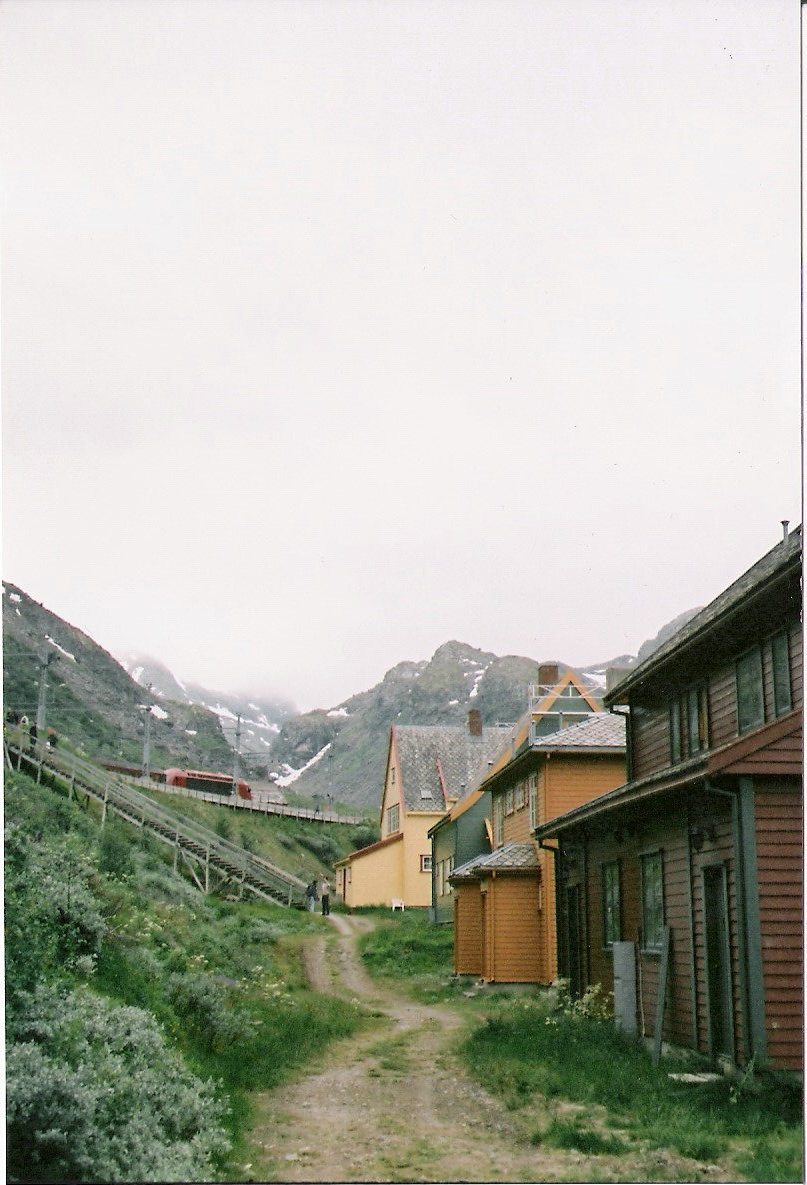
The Oslo to Bergen railway links Norway's two biggest cities, a journey through nearly 8 hours of eyes-glued-to-window scenery of fjords and mountains. As the train leaves the suburbs of Oslo behind, rich green forests spread quickly over the landscape. Coming up close to the train lines, thin trunks look like sticks, as if they could be picked up and snapped in half but, as they climb up the hills, the rows of tree tops give the feathered, soft appearance of a shag pile carpet so dense that, if a giant hand was to appear and grab a handful of trees, it would be as noticeable as plucking one strand from a head of hair. The fjords are seemingly endless, beating the train into the distance, dark blue, glossy expanses with a slightly rippled sheen like fabric pulled tight.

As the train leaves the outlying towns behind, the landscape gets more and more barren, almost desert-like. It dims to khaki, with mossy, lime green rocks strewn across the floor, and the trees thin until the hills evolve into bald mounds, veined with the patterns of rock. Electricity lines swinging across the hills are the only sign of man, aside from small, scattered huts clinging to the rocks with withered Norwegian flags blowing in the breeze. The fjords become choppy, splitting into streams and waterfalls and rivers and the colour of the fjords changes as frequently as the sun goes in and out. Sometimes, the water is so clear and turquoise blue it looks as if it's been dyed the colour of animal pools at the zoo, with blue and green waves swirling at the shore, and frothing where they catch on rocks. Sheer cliff faces end in deep black water whilst others lead nowhere, stopping suddenly as if someone's roughly snapped the bottom off.

Snow starts criss-crossing the hills, appearing in primitive shapes like chalk carvings, and mountains break though puffs of cloud. In mid July, they're still snowy on top. The train rattles through long tunnels, contained by wooden snow sheds on steep ledges, gaps in the wood offering fragments of what's going on outside. The train enters into a tunnel in sunshine and, when it emerges, the sky is grey and still as if a curtain's come down and is just hanging there. At Myrdal, we're allowed out to stretch our legs and the whole air is wet and chill like it's made of raindrops.

Then, suddenly, the landscape is tame again. The water pales to dark calm green and silver. Valleys reveal rolling farmland with sheep lazing in the sun, and children wave from houses. Some passengers have slept through the whole journey, or had curtains pulled across the window — they do it on a regular basis, saying that although you can fly, by the time you've traveled to the airport it's just as cheap and easy to get the train. I don't see how it's a journey of which you can ever tire — just as dramatic as the landscape is the speed at which it changes, even just across the course of a few miles, without taking into account the seasons or even the changing qualities of light at different times of day — I'd love to see the journey again in the winter months when everything is ice and snow.

Sunday, 4 July 2010

The world outside Manchester part 2 - Copenhagen


Scott Walker is the most romantic of singers. In his songs, everything from the regret felt at the end of relationships to rainy days and elusive love affairs glanced through train windows is framed as if taking place in cinematic widescreen. Like silent movies, the accompanying string arrangements and orchestral flourishes say as much as the words, which capture memories of childhood and distant places and people. Copenhagen, from Scott 3 (his prettiest album, containing his most delicate and ephemeral compositions as well as some of the Jacques Brel covers for which he is famous) is one of his most romantic songs of all. Scott's almost perpetually lonely baritone drifts through the changing seasons in Copenhagen, remembering a love affair which he compares to 'an antique song for children's carousels' (maybe he was referring to Tivoli, the famous Victorian amusement park in central Copenhagen). He's at his most relaxed, his voice mimicking the motion of the ride, before the song takes off into an instrumental outro which swirls like a fairground ride.

It would be hard not to make Copenhagen sound romantic. Copenhagen smells of roses, literally - they grow up the side of nearly every building and up from roadside verges. It's a city of bright, dense rows of houses and orange rooftops, the gilded domes and turrets of churches and palaces peeping out from narrow cobblestoned alleys. The city constantly reminds you of its famous son, Hans Christian Andersen, with one of the main roads named after him (and his grave, in Assistens Cemetery is marked by a thick daisy chain and a child's drawing of a princess). The streets are dotted with sculptures, from statues guarded by cherubs in its parks to people carved into wood by the side of the road. Everyone glides around on bikes, children seated in their own little carriages on their parents' bikes. Even in the heat of a Scandinavian summer, you're always close enough to water to find a breeze, from the fountains and lakes of Copenhagen's parks to the wide reservoirs and canals that divide the city into islands. Spring is lingering in Copenhagen - everywhere swans are followed by a parade of cygnets, ducks are surrounded by ducklings and the Canada geese are slowly reaching maturity.

Copenhagen's charm isn't just in its quaint prettiness, though. The city also accommodates striking new architecture, like the Black Diamond extension to the Royal Library, with its huge glass facade looking out onto the waterfront. Copenhagen also has some of the best museums and galleries of any city I've visited, and the Statens Museum for Kunst (Danish National Gallery) is a perfect example of old meets new, with its lakeside glass sculpture hall linking the old building to a new extension. The glass corridor is filled with changing sculpture displays - currently an installation by the Argentinian artist Tomas Saraceno, who's filled the space with big biospheres suspended from the glass ceiling. Some are transparent and catch the light like soap bubbles whilst others, spidery, are like seed pods floating on a breeze away from the trees in the park outside. Some have plants growing inside them, with ropes extending like roots, whilst others are weighed down with water, resembling jellyfish. The museum houses work by international artists, but it's also home to a cross section of Danish artists, such as Per Kirkeby.

Several of Copenhagen's museums open for free on Wednesdays, including the Kunstindustrimuseet (Danish Museum of Art and Design), which offers an overview of Danish design and its context in wider social movements, from Lego to fashion to eco-friendly furniture, with displays on designers like Arne Jacobsen, who designed everything from cutlery to furniture, carpets and curtains for Copenhagen's modernist landmark the SAS Radisson hotel. Outside, in the garden, rehearsals are taking place for a play that's going to take place on a stage that looks like a plywood version of something Frank Gehry would design.

On the same street are several smaller galleries, displaying contemporary art - often colourful and collage based, including Galleri Christoffer Egundi, which has a display of street artists. A short walk away is Kunsthallen Nikolaj (Copenhagen Contemporary Art Centre), which sits in a tranquil square just off the city's main shopping district Strøget. Here, in an old church, is an exhibition by the French artist Zineb Sedira, which fits the space perfectly. The high, domed ceilings mean her video and sound installations, which are often preoccupied with memory (including films of her parents memories of fleeing Algeria for France) reverberate around the building. Floating Coffins is an immersive video installation about the effect of the west dumping its old ships on the developing world, the audience looking out onto a sandy, rust-coloured scene through four screens as if through a window. On the surrounding walls, all painted white, are screens of other sizes, onto which are projected videos of abandoned buildings, shipwrecks and the sea, in varying degrees of close-up - when people appear, they're anonymous. The screens fade in and out, some panning around like memories and others static like photographic fragments of a story. You can still see the church's organ high above, and sounds are just as important as images - screeching birds, the vaguely industrial scraping of metal, the ominous sound of aircraft. It's like the whole building's rumbling.

About 35 minutes up the coast from Copenhagen in Humblebaek, the modern art gallery Lousisiana overlooks the clear green water of the Øresund strait that divides Denmark from Sweden. Although the gallery houses everything from pop art through Francis Bacon to Damien Hirst, as well as temporary exhibitions (at the moment, the brilliant French artist Sophie Calle, whose works are playful interventions into real-life and the everyday) the most interesting section is dedicated to Danish artists, including a section on colourful, primitive artists like Asger Jorn and their links to the international CoBRA movement. Corridors lead off from the main gallery, filled with light like greenhouses, cutting through the sculpture garden outside, where pieces by Henry Moore and Louise Bourgeois look out over the sea from one side and the strange, stunted stone forms of the Danish artist Henry Heerup look in at you from the undergrowth. An Alexander Calder sculpture dominates the view like a primary coloured mobile, swaying slightly in the wind and resembling the ships' flags blowing just below and art is built into the landscape itself - George Trakas' installation Self Passage leads you down to the beach.

A further fifteen minutes up the coast, Kronborg, the inspiration for Hamlet's castle, looks out to Sweden across the Sound from Helsingør, the point at which the two countries are closest. Sweden's third city, Malmö, is a short train ride from Copenhagen across the elegant Øresund bridge, built ten years ago to connect Sweden and Denmark (a striking sight, flanked by spinning wind turbines, from the aeroplane as you descend towards Copenhagen). Malmö's new waterfront area, Västra Hammen, has sandy beaches and jettys for swimming and diving, as well as platforms for evening concerts. It's dominated by Sweden's tallest building, the Turning Torso tower, which consists of nine twisted white cubes

Friday, 18 June 2010

The world outside Manchester part 1 - Berlin

Often, my reasons for wanting to visit new places are based on nothing more concrete than an obsession with music/films/books produced there. I've long wanted to go to Berlin, intrigued by films like Wim Wender's dreamy Wings of Desire, which is set in sparse black and white high above the city (blooming into colour when the angels who are its main characters make human contact), made a couple of years before the fall of the Berlin wall and, later, Goodbye Lenin, with its new take on the reunification of Berlin. As a teenager, I had a fixation with the music of David Bowie, Iggy Pop, Lou Reed, Brian Eno and Nick Cave, who are among the musicians who made Berlin their home in the 1970s and 1980s and produced some of the more experimental music of their careers.
None of these preconceptions prepared me for how big, colourful and green Berlin is today. Almost every surface in the city is covered in graffiti, from scrawled tags on shops to huge murals on walls facing onto building sites. This self-decoration reaches a pinnacle in the art squat Tacheles, on Oranienburgerstrasse. A huge, old building with massive windows overlooking the city, it glows with layers of paint built up over the years, and even the windows are coloured with a patina of graffiti - from the inside, the effect is rather like looking out from the coloured sweet windows of a gingerbread house. There's a general air of shabbiness in Berlin - all the streets are covered in a fuzz of green; weeds growing unchecked from in between the cracks of pavements, plants climbing up the front of buildings and grassy strips following the route of tram tracks down the middle of roads like green islands.
I stayed on a boat on the River Spree in a hostel called Eastern Comfort, a short walk over the grand, redbrick Oberbaumbrücke Bridge - past, if you're lucky, jazz and punk buskers competing with the roar of the traffic - from the district of Kreuzberg, the main Turkish area of Berlin and also an area full of fashionable shops, bars and cafes. The most exciting hostel I have ever stayed in, it swayed from side to side whenever another boat went past - an especially disconcerting sensation whilst standing in the shower.In Berlin, you're never far from reminders of the city's divided past, and this was especially clear whilst staying in Eastern Comfort. The hostel has a sister boat moored on the other side of the river named Western Comfort as, when Berlin was divided, the area over the river - including Kreuzberg- fell into West Berlin, whilst the other side of the Spree was east Berlin. On a free boat tour of the river organised by the hostel, the captain explained that the water belonged to east Berlin, meaning that no-one was able to enter the river without being shot at by patrol boats. This led to four children from West Germany drowning near the site of Western Comfort as no-one was able to go to their rescue. Today, a floating pool on the Spree provides views over both sides of the river. The captain also told us about the redevelopment of Berlin - there are frequent protests against private property developers building new hotels and apartment blocks by the river, led by those who think the waterfront should be accessible to everyone, as well as against things like McDonalds. One of the areas of Berlin which has famously become gentrified is Prenzlauer-Berg. I visited for a giant Sunday fleamarket - think of the biggest car boot fair you can imagine, combined with a festival atmosphere of people selling homemade food and buskers, from jazz bands to three young boys armed with guitars, reverb and a rudimentary drumkit, trying to compete with a mass outdoor karaoke session.
Next to Eastern Comfort, a section of the interior wall remains, now turned into Eastside Gallery, daubed with colourful murals and messages of peace by artists from all over the world. It's possible to follow the route of the wall, with reminders of the American, allied presence, like Checkpoint Charlie, still standing. A rusty, rugged patch of the wall remains in Kreuzberg, with faded though poignant graffiti like 'To Astrid maybe some day we will be together' still visible, and holes looking through to the street outside where Berliners started chipping away at the wall when the fall was announced. Displays on boards in this area describe the human stories of the wall, remembering those who died trying to escape.
Another memorial, near the Reichstag (visitors to the Reichstag can find out about the history of the German Parliament as well as look out over the city from Norman Foster's recent glass extension), remembers the Jewish victims of the Holocaust. Smooth, grey concrete blocks, growing gradually taller, draw you down cramped corridors, over a rising and falling floor, as if in a maze. In the centre, where the blocks are tallest, it's a bit like being lost in a dense forest, bleak even on a sunny day and quiet despite the busy roads which encircle the memorial. Across the road is a real forest - the massive Tiergarten which provides a huge urban park in the centre of Berlin, complete with canals and lakes, as well as more formal rose gardens and long boulevards. You could spend days exploring the Tiergarten, or just use it as a green shortcut to other areas of the city.

After the Jewish memorial, it was strange to go to another exhibition of oppressive corridors and small spaces - a Bruce Nauman show at the Hamburger Bahnhof modern art gallery, part of the Berlin Biennial. As well as permanent displays on Fluxus and twentieth century artists like Anselm Kiefer and Dieter Roth, Nauman's work was on show based around constructions of tight corners and corridors leading to nowhere, lit by neon lights.

Berlin is also full of smaller galleries, particulary concentrated in the area of Mitte, around Auguststrasse. In Weisser Elefant, viewers had to put slippers on over shoes to enter a recreation of a 1960s East German apartment, exploring the concept of the ideal socialist family unit based in pre-fabricated housing. One of my favourite galleries was in a comic book and zine shop called Bongout on Torstrasse. In the back is an exhibition space, featuring a display of cartoons and giant, colourful comic books, whilst at the front are gig posters and artists' books and zines. Here, I picked up a flier which told me about a tape music gig at an artists' space in Neukölln, an area just past Kreuzberg.
Altes Finanzamt is home to a collective of nine artists - eight Portuguese and one Spanish - and hosts gigs, discussions, film screenings and exhibitions*. I went to see Brooklyn based tape composer Aki Onda, who makes music out of found sounds like bird song and street noises, as well as the static of radios and the clicking of cassette players turning on and off. The following day, I returned for a dinner cooked by the artists (Gazpacho soup followed by mushroom and asparagus quiche then chocolate brownie), before a screening of a film about a group of football fans who built their own stadium.
Berlin is one of the most vegetarian friendly places I have ever visited, going out of its way to provide veggie and vegan options, as well as being home to some great vegetarian cafes and restaurants, including Hans Wurst in Prenzlauer-Berg, a vegan cafe which is dedicated to DIY and also sells zines and records and, in Kreuzberg, the veggie fast food joint Yellow Sunshine, where I tried crispy vegetarian schnitzel!

All the bars (and even a Mercedes showroom!) were showing the World Cup on TV screens outside on the street, and following Germany's defeat of Australia, the whole city celebrated in a massive blaring of car and taxi horns. Pedestrians are outumbered by cyclists in the city, and cyclists too joined in with a mass tinkling of bells.

*I gave them some copies of the Shrieking Violet fanzine for a zine fair they are holding at the end of June

Friday, 28 May 2010

Sleeping beauty: The Ashton Canal (article for Things Happen zine produced by Manchester Municipal Design Corporation)

Geese file by, the odd heron perches on the bank, and overgrown trees form a canopy over the bottle green stretch of water. Willow blossom floats placidly, sometimes catching the sun. You might think you’re in the countryside, and not in Ancoats, less a mile outside Manchester city centre. Trees grow out of the sides of once regal looking mills. Others, blackened, have succumbed to vandalism and arson. But the Ashton Canal has an air of enchantment; bracken clings to canal banks, roses rise from the edge of the water, poppies provide flashes of colour amidst the rubble of partially demolished buildings and, in summer, the bushy blossom of buddleia, or butterfly plant, forms a dense purple corridor. Later in summer, tangles of blackberries and sloe will yield fruit. It's a peaceful place away from the hustle and bustle of the city centre, where the heritage of Manchester's industrial past sits side by side with the future.

The canal, which was built over 200 years ago, was still carrying tens of thousands of goods per year even up until the 1930s, before it was left to fall into disrepair in the following decades when the coal pits of east Manchester closed. That the canal is still open at all is thanks to hundreds of volunteers who came from all over the country to clear rubbish blocking the canal in the early 1970s, when the local council wanted to close it. However, after decades of disuse the canal is slowly being rediscovered and reawakened. Boarded up housing estates, mills covered in barbed wire and empty tower blocks contrast with the first signs of the redevelopment of the area – from the Sportcity complex built to house the 2002 Commonwealth Games to Will Alsop’s lurid canal side CHIPS building, three chip shaped blocks perched jauntily on top of one another offering apartments at the top and space for art exhibitions and businesses at the bottom, which was opened last year.

Sue and Al, a forty something couple from Northwich, go on a canal holiday every year and have been on waterways all over the UK. They’re making their way along the Ashton Canal at the end of a trip along the Cheshire Ring of canals which links the Ashton Canal to the Bridgewater, Macclesfield, Trent Mersey, Rochdale and Peak Forest Canals. Sue said: “We know the city centre quite well but we’re coming into Manchester from a whole different angle. I love the contrast between derelict old industrial buildings on their knees about to fall down and the shiny new apartments blocks next door as the area’s regenerated.”

The Ashton Canal passes the six miles from Ashton-Under-Lyne to Manchester city centre through what have, for decades, been some of the most deprived areas in Manchester; Openshaw, Clayton, Bradford and Beswick and Ancoats. Sue admitted: “The hire company told us trouble spots to look out for but everyone’s been fantastic. I can’t believe how many people use the canal. A group of school kids even helped us through a lock and they loved it.”

In 2001, Urban Splash was chosen to plan a whole new waterside community of low density, environmentally sustainable family housing to be built on the site of the notorious Cardroom Estate in Ancoats, which sits towards the city centre end of the Ashton Canal, and the area was rebranded New Islington. As well as renovating historic mills and the old Ancoats Hospital to attract new residents to the area (the population could rise tenfold, with the number of new properties planned far exceeding the houses being replaced), current tenants were consulted on the design of their new houses, built in collaboration with leading architects selected by competition. An annual summer festival would help established communities mingle with newcomers to the area.

This proposals for this community, with the canal as its centrepiece, were inspired by cities such as Amsterdam, and promised to incorporate facilities like new doctors surgeries, schools, a farmers market and – listed with great precision on the New Islington website – ‘the best fish and chip shop in Manchester, a poncey wine bar, a chic little Italian with red checked tablecloths and a restaurant with 3 Michelin stars’. A phrase was coined to describe this way of living – an ‘uburb’ – combining all the facilities of the suburbs with the urban lifestyle of the city centre. Richard Hatton, Director of Development for Urban Splash, explains: “The idea of New Islington is to be allowed to evolve rather than being subject to one grand master plan. There are quite a lot of different feelings within this area – there’s a bit of everything. The idea is that it’s family friendly. You’re never too far from shops but also never too far from park land. It’s earthy and it’s different from anywhere else in Manchester.”
Work was also started on new canals and a marina. Boat mooring profits will be used to maintain a new eco park called the Cotton Field complete with a beach, orchards, pine trees, a climbing wall and nesting boxes to encourage birds. In the long term, it’s hoped the new canals could even provide water for the surrounding buildings. The park was due to be open in summer 2007, but the credit crunch seems to have put everything back and there’s still no sign of waterside dining, a wine bar, fish and chip shop or farmers’ market either. However, Richard is confident: “Within a year or two there will be lots more boats, lots more colour and lots more life.”
The tour company New Manchester Walks brings visitors to this still relatively underexplored yet fascinating part of the city on a walking tour called Watery Wastelands of Eastlands (soon to be renamed Grand Canals of the East). Green Badge guide Steve Bourne explains: “Almost everyone who visits the region doesn’t know what they’re missing here. This part of Manchester contains the world's early industrial beginnings, but it’s been hit by yet another recession in recent years. We’re just doing our bit to help put it back on the tourist trail again."

To call it a wasteland, though, doesn’t do justice to the deceptively wide array of activities the canal is already used for. Businesses still operate out of some of the remaining mills, from wholesale companies to environmental charities. Bass and drums drift over the canal, coming from rehearsal rooms in mills, and a couple are also home to networks of artists’ studios. A large volume of cyclists pass through to the Velodrome at Sportcity and, on match days, an army of fans in sky blue shirts march to city stadium. People also use the canal for its own sake, from jogging to just sitting day after day watching the world go by.

One sixteen year old from Gorton cycles to the same patch, just past the city centre, every weekend, where he sits and fishes for hours at a time, sometimes with friends and sometimes alone. He admits: “It gets me out of the house. I like it because it’s quiet.” Another, an Ancoats resident, walks his dog along the canal for an hour every day.

Two twenty something cyclists from south Manchester have arrived at the Ashton Canal after following the Fallowfield loop to Debdale Park in Gorton, and are returning using the canal as an alternative route to city centre roads: "We like the ducks. There's not really an equivalent in south Manchester – there’s no water to cycle along. It’s a good facility but it could be improved and cleaned up – we haven’t seen one bin for people who are sitting drinking or having picnics."

Ironically, although canals initially foundered into disuse in the early decades of the twentieth century in the face of competition from rail and road transport, a new transport link could help see the area cleaned up and rediscovered, when the Metrolink extension into east Manchester opens in 2012 – running almost parallel to the Ashton Canal.


Read the article online (the title was changed, not my idea!) in issue 2 of Things Happen here or in free paper copies around the city:


Also features Creative waterways, Manchester Modernist Society, Sans façon, River Medlock, Contemporary Cartography. www.mmdc.org.uk