I was recently commissioned to write an article about cycling for the North West edition of the Skinny, to coincide with the first Manchester bike month. Read the June issue of the Skinny online:
Manchester cycle city
Despite widely-acknowledged benefits to health and the environment, not to mention the wallet, the prospect of navigating confusing cycle lanes, traffic and potholes is often enough to make would-be bikers think twice about venturing onto city roads. “Most current measures are designed to get bikes out of the way of cars, not the other way around,” says cyclist Mike Armstrong, who uses his aptly-named blog Mad Cycle Lanes of Manchester to raise awareness of cycling and call for better provision for cyclists in the city. “It is no good shoving bikes onto pavements in some places only to prosecute people for cycling on the pavement in others.”
But things could be changing. In a culture where many motorists currently see cyclists as a nuisance, Greater Manchester transport chiefs have finally recognised the need for a change in attitudes towards cycling. Plans are afoot to get three times as many Mancunians onto their bikes over the next twelve years as part of the Vélocity 2025 bid, which aims to tap into national funding to create a much-needed new network of cycle routes linking homes, jobs and leisure venues, and consultations about transforming Manchester's busiest cycle route, Oxford Road, with segregated cycle lanes, are currently underway. For transport chiefs, backing cycling makes sense. “Cycling is good for you, good for your wallet and good for the world”, explains Councillor Andrew Fender, Chair of the Transport for Greater Manchester Committee. “It’s cheaper than running a vehicle, there is no need to set off early to beat the traffic, and you’ll be fitter and healthier. What’s not to like about having the fitness level of someone 10 years younger?”
Already, there are a growing number of initiatives in the Northwest to support cyclists into the saddle and raise confidence amongst those on the roads. BikeRight! offers free bike training in Manchester, Merseyside and Warrington for cyclists at all levels, from group classes for complete beginners to sessions practising all-important skills such as signalling, turning and positioning, and one-on-one sessions for more experienced riders who want to practice particular routes. Voluntary groups and small enterprises share bike maintenance skills and, last year social entrepreneur Dipak Patel realised there was a need for secure, low-cost bicycle storage in Manchester. Patel set up his unique enterprise Popup Bikes in a railway arch on Corporation Street which, as well as being a safe place to keep bikes, offers affordable repairs and incorporates a coffee shop hosting events such as bike jumble sales and film screenings. Popup Bikes is fast becoming, says Patel, “the social glue for the cycling community, a place where people can meet and exchange stories and talk about cycling and non-cycling issues”.
As well as being a way of simply getting from A to B, sociability is often an important part of the cycling experience, and organised groups of cyclists provide safety in numbers for those who might otherwise feel discouraged from taking to two wheels. One such group is TeamGlow, which was set up in 2011 to provide a supportive network for female cyclists across Manchester and the Northwest, who often lack visibility and find it hard to feel included in the male-dominated cycling community. As well as providing advice, from buying a decent bike to cycle maintenance, and building up technique and skills, there is at least one organised ride a weekend, from short rides to long distance tours, and members are encouraged to challenge themselves to venture further on a bike. “I went from feeling like an isolated woman on a bike to being part of a group of women,” explains TeamGlow founder Glynis Francis. “I wanted to leave cycling for women in a better place than I found it and see other women have the pleasure of a social cycle ride and fresh air.”
Manchester Bike Month, which takes place this month, offers ample opportunities to team up with other likeminded cyclists, whether united around a love of real ale (Manchester cycle pub crawl, 21 June) or taking on a long distance challenge such as Manchester to Chester (June 23). Other highlights include a cyclists' float in the Manchester Day Parade (Sunday 2 June), a film night (Saturday 15 June), a unicycle taster session (Thursday 13 June) and even a bike naked ride (Friday 14 June).
Greater Manchester still has some way to go before it reaches Amsterdam-levels of bike friendliness, but attitudes towards cycling are starting to change. The more cyclists who take to the city's roads and add their support to initiatives such as Vélocity 2025 and the national Get Britain Cycling campaign, the greater visibility there is and potential to push cycling into the mainstream. In the words of Mike Armstrong: “Provision for cycling should be direct, quicker and more convenient than driving.”
Showing posts with label Exercise. Show all posts
Showing posts with label Exercise. Show all posts
Sunday, 16 June 2013

Friday, 9 November 2012
Review: Greater Manchester's Public Swimming Pools: A Pictorial Guide

His project is now complete, and the resulting guide, Greater Manchester's Public Swimming Pools: A Pictorial Guide, is out now. Mather's watery journey was a labour of love, and he fights the corner for what he terms “swimming's unique and often understated role in society” – the Guide is clear that the function of swimming reaches far beyond health and fitness to encompass social and community benefits. As well as acting as a guide to each building and each pool's facilities, Mather's book goes out beyond the pool doors to take a wider look at the people and communities they serve, taking care to include something memorable or special about each pool's location, from local landmarks to famous innovations such as Rolls-Royce (Stretford) and Stephenson's Rocket (Eccles), and show the “fascinating and diverse collection of towns and people” that is Greater Manchester. Each entry is handily annotated with essential information such as contact details, location and amenities such as parking.
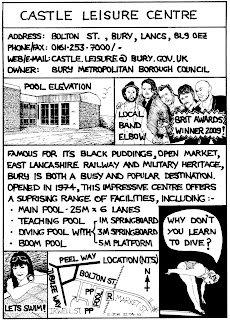
The Guide is often humorous, and Mather slips in references to local celebrities, from the Rochdale Pioneers, who opened the first successful co-operative shop in the town, to Frank Sidebottom (Altrincham), John Cooper Clarke (Broughton) and George Formby (Atherton), as well as local personalities such as longstanding swimmer Sam Quinn, who has been a Broadway Baths regular for 75 years.

Pool buildings have social history written into their brickwork and tiles. Now derelict, Collier Street Baths in Salford, opened in 1856, is Britain's oldest surviving swimming baths building. Withington Baths in Manchester, which still says 'Men' and 'Women' above the entrance where the sexes would once have been separated before entering the water, took the daring step of allowing the city's first mixed bathing in 1914. No visit to Manchester's pools, of course, would be complete without a reference to Edwardian water palace Victoria Baths (despite the current lack of water!), and Mather considers the past, present and future uses of the building.

Greater Manchester's Public Swimming Pools: A Pictorial Guide can be purchased for £5.99 at www.lulu.com/shop/john-c-mather/greater-manchesters-public-swimming-pools/paperback/product-20441129.html.
Monday, 5 March 2012
Revisiting the Irwell Sculpture Trail

Exercise, muddy feet and fresh air are among the less celebrated benefits of viewing works of art, but visiting the Irwell Sculpture Trail is a chance to experience all three at the same time as seeing works by locally and internationally renowned artists. The 33 mile sculpture trail, which follows the River Irwell from Salford Quays all the way to Bacup in Pennine Lancashire, has been around for over a decade now, but recent reinvestment means that, as well as restoring some of the sculptures to prime condition, new, interactive features make the experience far more than just looking at art and going for a walk.
The sculpture trail started in Rossendale in Pennine Lancashire following a lottery bid and gradually expanded to reach as far south as Salford Quays, with artworks leading the visitor through the history of the industrial towns and cities that grew up alongside the River Irwell and the changing uses of the river and surrounding areas. It's a story not just about the Irwell, and the trains, canals and mills that follow its course (the trail regularly meets other waterways such as the Manchester and Bolton and Bury Canal, and the clusters north of Bury can be conveniently reached on the East Lancashire Railway), but local people, incorporating memories and experiences into several of the sculptures. However, some of the artworks on the sculpture trail fell into disrepair over time, and have only recently been restored. Diana Hamilton has been project manager for the Irwell Sculpture Trail since 2007 and is setting the direction for its future. She explained: “It's a really unwieldy project as four local authorities are working together. In the past there was a lack of thought when commissioning and a lack of understanding who would be responsible for maintenance, and that's a problem right across public art. Now there's a new mindset when commissioning public art of making sure there's a maintenance plan.”

A consultation was also held and, while there had been opposition to some of the sculptures at first, Diana says the artworks are now part of their communities: “There was so much local opposition to Tilted Vase in Ramsbottom, and Halo in Halsingden when they were planned, but people love them now.” Each area has a steering group, including representatives from tourist information and community groups, and they have a practical role commissioning temporary artworks alongside the trail. Some of the sculptures came about through the Section 106 planning clause, and councils along the trail made a commitment to spend the money on the arts, often involving the community.

Many of the artists lived in the area where their contribution to the trail is based, and artworks reflect local stories. In Whitefield, near Bury, the artist talked to park rangers and discovered there used to be 'fancy birds' in the park in Victorian times, leading to a simple but effective artwork entitled Canaries in the Park, which comprises still, hard-to-spot model birds sitting still on the railings, and acting as silent spectators in the bowling green. The colour scheme was drawn from tropical sweets from the local sweet factory. Some of the birds have also been adopted by the community and adorn the town's rooftops.
Other artworks give a sense of place. Diana describes Lee Quarry, near the Stacksteads cluster, where bikers interact with the sculptures and use them to perform tricks, as “an amazing performance space”, saying: “It's like being on the moon. You can use the sculptures to find your way around. They give you a sense of where you are.”
New signs and interpretation will help visitors make the most of their visit to each cluster, and QR codes have been added to the sculptures which anyone with a smartphone can scan to hear local stories as well as recordings of the artists and videos of events which have been held alongside the sculpture trail. Diana gives a macabre example: “An old mill owner used to throw children into the river in Salford when they were no longer needed and you can still see the gravestones along the river. There are little nuggets of stories like this to bring the trail alive. Children love gruesome stories; it adds another layer to the experience.” Visitors can also take part in a monster hunt in Rossendale and a geo treasure hunt.
However, you won't need a fancy phone to enjoy the trail. Diana says: “It's all very well if you have a smartphone to use a QR code but we also want to satisfy the rambler in their sixties and seventies. There's a really wide audience, from families with small children to ramblers on their annual expedition. We're keeping all these audiences happy.”

Diana said: “The sculpture trail is a free day out that gets people out and about and walking outside. Because each cluster of sculptures is part of a bigger project, people visit other areas they might not have been to before. Visitors might pick up a sculpture trail leaflet in Salford and end up in Rossendale in Lancashire to see more sculptures. Some people just go to visit a particular sculpture, but others might want to make a day of it and go for a walk.” Among the most popular sculptures are those at Clifton Country Park in Salford, which draw on the park's past as the site of a colliery. Diana said: “So many people don't know there's a country park in Salford, but the park treats the sculptures as an asset.”
With the relaunch of the sculpture trail website, and publication of a free, 32-page brochure in March, there's no better time to visit. The brochure, which will be available from local tourist information points, features information on each sculpture, including road names, parking, bus stops, toilets, places to eat and nearby attractions such as museums, and the website will host a route planner, ordnance survey information, news about events around the trail and resources for schools.

The sculpture trail works with other organisations involved with the environment and public art, and Diana is looking forward to collaborating with the Environment Agency. She said: “We want to experiment and challenge the idea of public art and public art commissioning. The Environment Agency is working on the Irwell and getting rid of the weirs, but they're not allowed to get rid of any of the material from the site so it needs to be reused, which gives us an opportunity to work with environmental artists. There is so much potential along the trail.”
Plan your visit to the Irwell Sculpture Trail at www.irwellsculpturetrail.co.uk.
This interview with Diana Hamilton took place during the writing of an article on the Irwell Sculpture Trail for Creative Tourist, which makes more detailed recommendations of some of the highlights along the trail in Greater Manchester: www.creativetourist.com/features/get-dirty-look-at-art-the-irwell-scupture-trail
Sunday, 14 November 2010
Swimming in history: Historic bathing opportunities in Manchester
My friend Catriona has started a local history society (www.manchesterlocalhistory.blogspot.com) at Manchester University. I have written a guide to interesting places to go swimming for a zine she is producing for the society:
There are few types of exercise more pleasurable, relaxing and energising than swimming. Forget the modern Aquatics Centre, though: Manchester has historic swimming pools which can help you explore the stories of the city at the same time as getting fit. Some date back to times when the provision of public baths was not just for leisure, but part of a wider effort to improve public cleanliness and hygiene, and some are in buildings that are symbolic and influential to the city’s history.
Local authorities across the country started to provide public pools and laundries for their citizens after the Public Baths and Wash Houses Act of 1846. Even into the twentieth century, many people had no water in their houses, let alone an inside bathroom. In Manchester, a number of public swimming baths and wash houses were built in densely populated residential areas by the city’s Baths and Wash Houses Committee to give people the chance to wash their clothes, have baths in privacy and enjoy the comfort of hot water. Although many are long demolished, a handful survive, some of which still function as swimming pools.
The most famous and celebrated swimming baths is Manchester’s splendid water palace Victoria Baths, which opened in 1906. Unfortunately, it ceased to open as a swimming baths in 1993 and the water was drained from the pools.
This guide covers, firstly, historic public swimming baths in which it is still possible to swim and, secondly, a couple of opportunities to swim in some of Manchester’s most luxurious historic buildings.
Levenshulme Swimming Pools, Barlow Road, Levenshulme
Levenshulme Public Baths and Washhouse opened 1921. An early claim to fame is that, in the late 1920s and early 1930s, Sunny Lowry from nearby Longsight used it to train to swim the channel, becoming the first British woman to do so in 1933.
Nowadays everyone enters through the same old-fashioned gates and wooden doors, but the exterior of the building still displays signs of the social hierarchy of the time, with lettering saying ‘Men’ and ‘Women’ marking where there would once have been separate entrances for the sexes. Inside, the segregation would have continued: Levenshulme Baths has two pools, one large pool which would have been reserved for men and a smaller pool for women.
Although it’s unprepossessing from the outside, inside the building’s most striking feature is a beautiful black and white chequered tiled floor in the entrance and hallways. The dramatic effect is heightened by walls tiled in white, cream, black and grey with various combinations of decorative stripes, bands, crosses and geometric patterns. Like Victoria Baths, Chorlton Baths and Withington Baths, the pools are lined with glazed brick — white with grass green bands — that glistens rainbow colours when it catches the light. Lines of cubicles face each other across the pools under a curved ceiling.
The local community has fought threats of closure to keep Levenshulme Baths open, and it has recently undergone refurbishment — although a few years ago it attracted some controversy when it started offering naked bathing sessions for gay men.
Withington Leisure Centre, Burton Road, Withington
Withington Baths is a bit like Victoria Baths on a smaller scale, and the most ornamental of the historic pools which remain open in Manchester. Simple floral motifs adorn the brickwork outside and stained glass inside, shields and drapes pattern the tiles on the staircase, the entrance hall is paved in black and white checks and the council’s coat of arms is recreated in coloured glass above the wooden entrance doors. Light floods into the pool through a glass roof supported by a sloping wooden ceiling.
Withington Baths, which was built in 1911, was designed by Manchester’s first city architect Henry Price. As well as Victoria Baths and the also impressive but now sadly defunct Harpurhey Baths in north Manchester (which are in the process of finding a new, non-watery use as part of Manchester College), Price designed a number of other significant buildings around the city, including the pump house hydraulic power station that provided water to mills, warehouses, the town hall clock and opera house in central Manchester (the building is now part of the People’s History Museum in Spinningfields) and Withington and Didsbury Libraries.
In 1914, Withington Baths became the first baths in Manchester to allow mixed bathing, and it also made no distinction between social classes — often, pools also separated ‘first class males’ from ‘second class males’. Nowadays, the facilities have been expanded to include a gym, and there’s also a sauna just off the side of the pool. Customers have the choice of using either modern changing complexes or old-fashioned style cubicles lining the side of the pool.
Chorlton Leisure Centre, Manchester Road, Chorlton-cum-Hardy
Another Henry Price building, from 1929, which still featured separate entrances for men and women .
Although it has cubicles lining the pool side, Chorlton Baths is largely uninteresting on the inside, with a low flat ceiling and little in the way of decoration. The most interesting thing to see is a plaque erected a the time of opening by Manchester’s Baths and Washhouses Committee which lists the councillors present, including a Mr W Onions.
Radisson Edwardian Hotel, Peter Street, Manchester city centre
There are few places more important to Manchester’s history than the site occupied by the 5 star Radisson Edwardian Hotel. The modern, luxurious hotel (which is so comfortable Sven Goran Eriksson made it his home during his time as Manchester City’s manager) stands behind the facade of the Free Trade hall, probably the most famous building in Manchester. The Free Trade Hall, which has actually been built and rebuilt a few times, was erected close to the site of the Peterloo Massacre of 1819, a protest for democratic reform which turned nasty when mounted soldiers charged the crowd. The building has gone on to host events important to the city’s political and cultural history, from anti corn law meetings in the 1830s and '40s to the Halle orchestra’s first concert in 1858.
If Victoria Baths was the height of luxury in Edwardian swimming baths, then Sienna Spa, in the basement of the hotel, is the ultimate in swimming luxury today. Whereas Victoria Baths’ opulence is created by an ornate décor of tiles and stained glass, the Radisson hotel’s understated black and cream colour scheme is sleek, smooth and minimalist. The small pool glows electric blue, lit from beneath the water.
Swim laps, float on your back, bubble in the Jacuzzi or sit in the sauna and steam room whilst contemplating that, a few floors above, Christabel Pankhust and Annie Kenney raised the question of votes for women in 1905, Dylan dared go electric in 1966 and was heckled with ‘Judas’, and various Manchester music luminaries saw the Sex Pistols play an influential gig in the Lesser Free Trade Hall.
Midland Hotel, Peter Street, Manchester city centre
Just down the road from the Free Trade Hall is another luxury hotel with a health club in the basement.
The huge, redbrick and terracotta Midland Hotel is significant to Manchester’s history as it was built in 1903 by the Midland Railway company next to the Manchester Central train station and used by American cotton traders visiting Manchester on business. In 1906, Mr Rolls met Mr Royce at the hotel, leading to the foundation of the famous car company, and Adolf Hitler apparently once considered it as a potential venue for Nazi headquarters in Britain. Along with the Radisson, it’s taken over by politicians every two years for the Labour Party conference.
The pool is smaller and shabbier than the Radisson’s but overlooks the gym so, whilst you watch gym goers getting hot and sweaty on a treadmill, you can feel thankful that you are splashing around in warm water — a vastly superior form of exercise!
For opening hours and swim times visit:
www.manchestersportandleisure.org/activities/swimming (Levenshulme, Withington and Chorlton)
www.siennaspa.co.uk (Radisson Edwardian Hotel)
www.qhotels.co.uk/hotels/the-midland-manchester/leisure.aspx (Midland Hotel)
There are few types of exercise more pleasurable, relaxing and energising than swimming. Forget the modern Aquatics Centre, though: Manchester has historic swimming pools which can help you explore the stories of the city at the same time as getting fit. Some date back to times when the provision of public baths was not just for leisure, but part of a wider effort to improve public cleanliness and hygiene, and some are in buildings that are symbolic and influential to the city’s history.
Local authorities across the country started to provide public pools and laundries for their citizens after the Public Baths and Wash Houses Act of 1846. Even into the twentieth century, many people had no water in their houses, let alone an inside bathroom. In Manchester, a number of public swimming baths and wash houses were built in densely populated residential areas by the city’s Baths and Wash Houses Committee to give people the chance to wash their clothes, have baths in privacy and enjoy the comfort of hot water. Although many are long demolished, a handful survive, some of which still function as swimming pools.
The most famous and celebrated swimming baths is Manchester’s splendid water palace Victoria Baths, which opened in 1906. Unfortunately, it ceased to open as a swimming baths in 1993 and the water was drained from the pools.
This guide covers, firstly, historic public swimming baths in which it is still possible to swim and, secondly, a couple of opportunities to swim in some of Manchester’s most luxurious historic buildings.
Levenshulme Swimming Pools, Barlow Road, Levenshulme
Levenshulme Public Baths and Washhouse opened 1921. An early claim to fame is that, in the late 1920s and early 1930s, Sunny Lowry from nearby Longsight used it to train to swim the channel, becoming the first British woman to do so in 1933.
Nowadays everyone enters through the same old-fashioned gates and wooden doors, but the exterior of the building still displays signs of the social hierarchy of the time, with lettering saying ‘Men’ and ‘Women’ marking where there would once have been separate entrances for the sexes. Inside, the segregation would have continued: Levenshulme Baths has two pools, one large pool which would have been reserved for men and a smaller pool for women.
Although it’s unprepossessing from the outside, inside the building’s most striking feature is a beautiful black and white chequered tiled floor in the entrance and hallways. The dramatic effect is heightened by walls tiled in white, cream, black and grey with various combinations of decorative stripes, bands, crosses and geometric patterns. Like Victoria Baths, Chorlton Baths and Withington Baths, the pools are lined with glazed brick — white with grass green bands — that glistens rainbow colours when it catches the light. Lines of cubicles face each other across the pools under a curved ceiling.
The local community has fought threats of closure to keep Levenshulme Baths open, and it has recently undergone refurbishment — although a few years ago it attracted some controversy when it started offering naked bathing sessions for gay men.
Withington Leisure Centre, Burton Road, Withington
Withington Baths is a bit like Victoria Baths on a smaller scale, and the most ornamental of the historic pools which remain open in Manchester. Simple floral motifs adorn the brickwork outside and stained glass inside, shields and drapes pattern the tiles on the staircase, the entrance hall is paved in black and white checks and the council’s coat of arms is recreated in coloured glass above the wooden entrance doors. Light floods into the pool through a glass roof supported by a sloping wooden ceiling.
Withington Baths, which was built in 1911, was designed by Manchester’s first city architect Henry Price. As well as Victoria Baths and the also impressive but now sadly defunct Harpurhey Baths in north Manchester (which are in the process of finding a new, non-watery use as part of Manchester College), Price designed a number of other significant buildings around the city, including the pump house hydraulic power station that provided water to mills, warehouses, the town hall clock and opera house in central Manchester (the building is now part of the People’s History Museum in Spinningfields) and Withington and Didsbury Libraries.
In 1914, Withington Baths became the first baths in Manchester to allow mixed bathing, and it also made no distinction between social classes — often, pools also separated ‘first class males’ from ‘second class males’. Nowadays, the facilities have been expanded to include a gym, and there’s also a sauna just off the side of the pool. Customers have the choice of using either modern changing complexes or old-fashioned style cubicles lining the side of the pool.
Chorlton Leisure Centre, Manchester Road, Chorlton-cum-Hardy
Another Henry Price building, from 1929, which still featured separate entrances for men and women .
Although it has cubicles lining the pool side, Chorlton Baths is largely uninteresting on the inside, with a low flat ceiling and little in the way of decoration. The most interesting thing to see is a plaque erected a the time of opening by Manchester’s Baths and Washhouses Committee which lists the councillors present, including a Mr W Onions.
Radisson Edwardian Hotel, Peter Street, Manchester city centre
There are few places more important to Manchester’s history than the site occupied by the 5 star Radisson Edwardian Hotel. The modern, luxurious hotel (which is so comfortable Sven Goran Eriksson made it his home during his time as Manchester City’s manager) stands behind the facade of the Free Trade hall, probably the most famous building in Manchester. The Free Trade Hall, which has actually been built and rebuilt a few times, was erected close to the site of the Peterloo Massacre of 1819, a protest for democratic reform which turned nasty when mounted soldiers charged the crowd. The building has gone on to host events important to the city’s political and cultural history, from anti corn law meetings in the 1830s and '40s to the Halle orchestra’s first concert in 1858.
If Victoria Baths was the height of luxury in Edwardian swimming baths, then Sienna Spa, in the basement of the hotel, is the ultimate in swimming luxury today. Whereas Victoria Baths’ opulence is created by an ornate décor of tiles and stained glass, the Radisson hotel’s understated black and cream colour scheme is sleek, smooth and minimalist. The small pool glows electric blue, lit from beneath the water.
Swim laps, float on your back, bubble in the Jacuzzi or sit in the sauna and steam room whilst contemplating that, a few floors above, Christabel Pankhust and Annie Kenney raised the question of votes for women in 1905, Dylan dared go electric in 1966 and was heckled with ‘Judas’, and various Manchester music luminaries saw the Sex Pistols play an influential gig in the Lesser Free Trade Hall.
Midland Hotel, Peter Street, Manchester city centre
Just down the road from the Free Trade Hall is another luxury hotel with a health club in the basement.
The huge, redbrick and terracotta Midland Hotel is significant to Manchester’s history as it was built in 1903 by the Midland Railway company next to the Manchester Central train station and used by American cotton traders visiting Manchester on business. In 1906, Mr Rolls met Mr Royce at the hotel, leading to the foundation of the famous car company, and Adolf Hitler apparently once considered it as a potential venue for Nazi headquarters in Britain. Along with the Radisson, it’s taken over by politicians every two years for the Labour Party conference.
The pool is smaller and shabbier than the Radisson’s but overlooks the gym so, whilst you watch gym goers getting hot and sweaty on a treadmill, you can feel thankful that you are splashing around in warm water — a vastly superior form of exercise!
For opening hours and swim times visit:
www.manchestersportandleisure.org/activities/swimming (Levenshulme, Withington and Chorlton)
www.siennaspa.co.uk (Radisson Edwardian Hotel)
www.qhotels.co.uk/hotels/the-midland-manchester/leisure.aspx (Midland Hotel)
Subscribe to:
Posts (Atom)